Gaza before and after: Google satellite images show what nearly 3 years of Israel-Hamas war did - The Indian Express
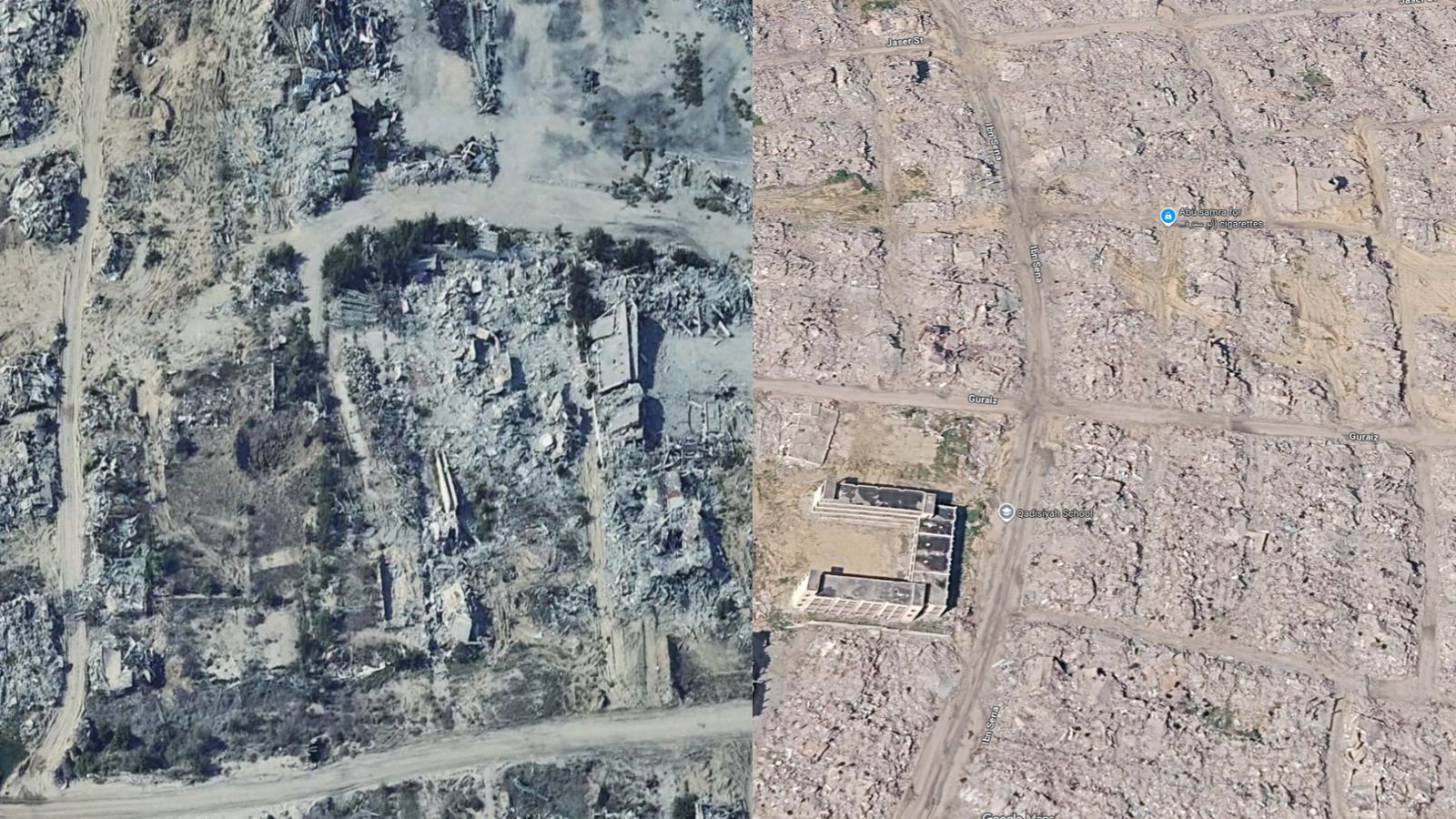
Newly updated satellite imagery available on Google Maps offers a stark view of the scale of destruction across the Gaza Strip nearly three years into the Israel-Hamas war, showing neighbourhoods transformed and large areas of farmland and civilian infrastructure damaged.
The imagery is not from a single date. Al Jazeera‘s analysis found that Google Maps images of Rafah in southern Gaza were captured in 2026, while some images of northern Gaza date to 2025 and 2024.
The visual record comes alongside the latest United Nations satellite assessment, which found that 201,290 structures, about 82 per cent of all structures in Gaza, had sustained damage as of June 16, 2026. Of those, 134,422 were classified as destroyed.
The same streets in Khuza’a, east of Khan Younis in southern Gaza, seen from above in August 2023 and January 2026.
Look along the two main roads and at the mosque and the municipal cultural centre marked on both images: homes, greenhouses and orchards in 2023; rubble, cleared land and rows of tents in 2026.
Satellite imagery: Google. Images aligned to the same area.
Israel has barred foreign journalists from independently entering Gaza since the war began, although selected reporters have been allowed into the territory on tightly controlled military-escorted visits, according to the Committee to Protect Journalists.
The restrictions have made satellite imagery and other remote-sensing data an important source for documenting changes on the ground.
UNOSAT’s latest assessment found that the number of destroyed structures in Gaza had increased by 9% compared with its October 2025 assessment. The total number of affected structures increased by 1.5% over the same period.
The updated @Google satellite images of #Gaza are quite incredible, for all to see… pic.twitter.com/4tZGs9dhP6
UNOSAT estimated that 201,290 structures, or about 82 per cent of all structures in Gaza, had sustained damage as of June 16, 2026. The assessment classified 134,422 structures as destroyed, 13,848 as severely damaged, 28,096 as moderately damaged and 24,924 as possibly damaged. It also estimated that 328,627 housing units had been damaged.
Al Jazeera’s analysis of newly updated Google Maps imagery examined areas from Rafah in southern Gaza to North Gaza. It found that the Rafah imagery was captured in 2026, while some imagery from northern Gaza dates to 2025 and 2024.
The same streets in Rafah, at the southern tip of the Gaza Strip, seen from above in August 2023 and February 2026.
Follow the two main roads that cross at the top of the frame. In 2023, dense housing lines them and rows of greenhouses cover the fields to the east; by February 2026, the housing is largely rubble, the greenhouses are gone, and the ground is cut by dirt tracks and earthworks.
Satellite imagery: Google. Images aligned to the same area.
A recent UNCTAD report said 92 per cent of Gaza’s economic establishments had been damaged or destroyed since October 2023.
Gaza’s GDP per capita stood at $212 in 2025, just 17 per cent of its 2022 level. UNCTAD said unemployment reached 78 per cent, while more than 90 per cent of the working-age population was not employed.
Agriculture and industry were each operating at 94 per cent below their 2022 output levels, while construction was down 99 per cent, the report said. A separate FAO-UNOSAT assessment found that only 3 per cent of Gaza’s cropland remained both accessible and undamaged as of June 24, 2026.
Google updated its Gaza maps with extensive high-res satellite imagery… it’s hard to even stomach it.
Source: SoarAtlas, Google… pic.twitter.com/8JRo5h9s2r
More than 74,000 Palestinians have been killed in Gaza since the war began, according to Gaza’s Health Ministry, while more than 175,000 have been injured, according to figures cited by Al Jazeera.
Following the terrorist attack by Hamas militants in Israel on October 7, 2023, that killed at least 1,200 people, the Netanyahu-led cabinet had announced a direct war against the militant group, and then Defence Minister Yoav Gallant vowed to wipe Hamas “off the face of the earth”.
“We will wipe this thing called Hamas, ISIS-Gaza, off the face of the earth. It will cease to exist,” Gallant had said.
Nischai Vats is a Deputy Copy Editor at The Indian Express. His work primarily covers US politics and visa and immigration policy, alongside broader international developments, with an emphasis on accuracy, verification, and clear explainers. Experience Nischai joined The Indian Express in May 2024 where he works on writing, editing, and refining high-impact stories for digital platforms. His role involves ensuring editorial consistency, factual accuracy, and clarity in coverage of complex policy-driven subjects. Earlier in his career, he worked across Indian digital newsrooms in reporting and editing roles, including stints at Inshorts, Newslaundry, Tiranga TV, and Catch News. His newsroom experience spans rapid digital publishing, ground reporting, and copy editing across national, civic, and policy beats. Expertise His core areas of focus include: US politics and governance: Coverage of American political developments, executive actions, and policy shifts. US visa and immigration policy: Reporting and editing stories on visa categories, regulatory changes, and immigration pathways affecting global audiences. Editorial accuracy and copy editing: Ensuring clarity, language precision, and verification in fast-paced digital news environments. Authoritativeness and trustworthiness Nischai's journalism is grounded in verified sources, official documentation, and clear attribution, in line with The Indian Express’ editorial standards. His background across reporting and editing enables him to translate complex policy updates into reliable, reader-friendly coverage. ... Read More