Frozen symbol, boiler bypoll: Has Trinamool Congress endgame begun?
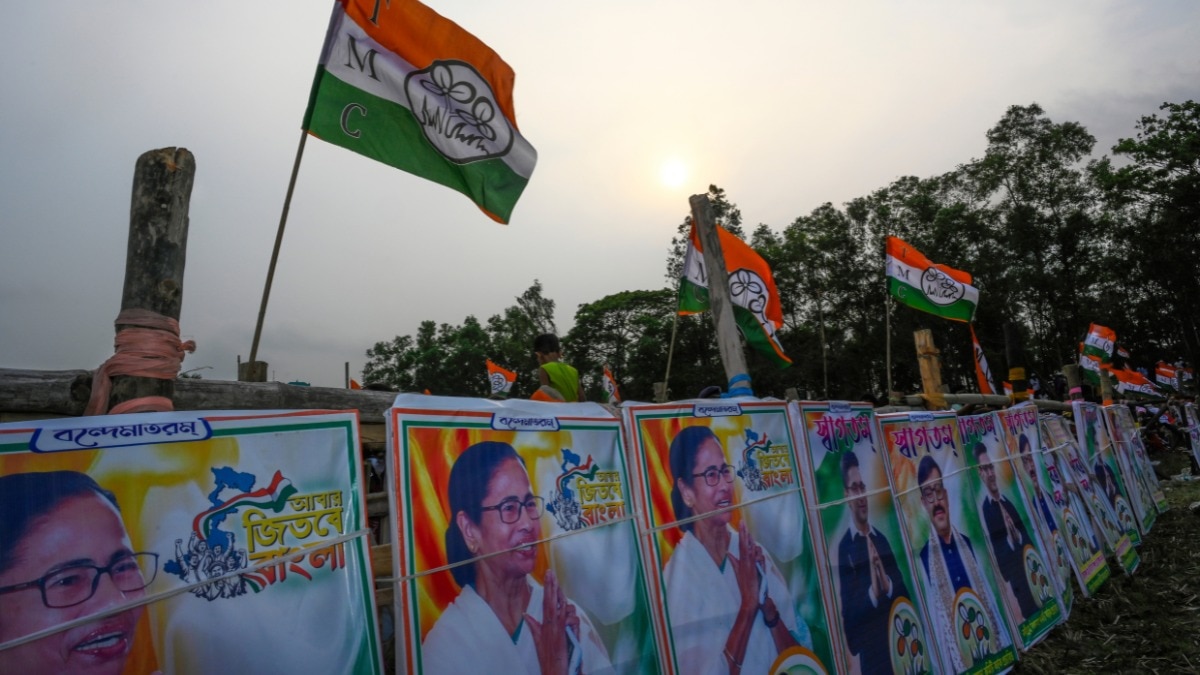
Mamata Banerjee, former West Bengal chief minister and founder of the Trinamool Congress (TMC), declared on September 18 that her party would support Congress candidate Milan Pradhan in the upcoming Nandigram assembly bypoll. She said her decision on the Rejinagar seat would be known in due course.
The announcement came moments after Sanchita Pradhan Dey, the candidate fielded by Mamata for Nandigram, met chief minister Suvendu Adhikari and withdrew her nomination. Adhikari had won both the Nandigram and Bhabanipur seats in the assembly polls this year and chosen to retain the latter.
“She (Dey) had texted us conveying her wish to contest,” Mamata said at a media conference. “I had spoken to Rahul [Gandhi] ji last night. But I did not tell him anything since it is our party’s decision. It is a surprise. But he promised me all sorts of support,” Mamata said.
It is interesting that Mamata, who had rejected the very idea of a tie-up with the Congress for the assembly polls, is now extending her support to its Nandigram candidate even without being asked for. Sources in her party claimed Dey would have anyway been asked to withdraw her nomination at the last moment to enable the party to support the Congress.
However, at the media conference, Mamata alleged Dey was forced by the ruling BJP to withdraw her nomination. She also said the Nandigram bypoll would serve as her message for the 2029 Lok Sabha polls, in the context of future electoral alliances. Even as the remark added to the day’s political speculation, news broke that Pradhan, the Congress candidate, had been arrested by the police in an old murder case.This latest round of the ongoing churn in Bengal politics was seemingly precipitated by an Election Commission (EC) move. For 28 years, the TMC and its ‘Flowers & Grass’—the familiar twin-flower-on-grass symbol—had been inseparable from Mamata. But on the evening of September 17, that association was abruptly suspended, at least for the duration of the upcoming by-elections.
The EC, in an interim order, barred rival groups within the TMC from using either the party's name or its reserved symbol. The decision was not a final verdict on ownership of the party. But for Mamata, who founded the Trinamool in 1998 and is said to have sketched the symbol at its inception, the order marked an extraordinary reversal: a new party name and symbol to contest an election, instead of the political organisation she had launched and elevated to 15 years of uninterrupted power in Bengal.
The EC allotted the name Mamata All India Trinamool Congress and ‘football player’ symbol to Mamata’s faction. The rival group led by Arup Roy and Ritabrata Banerjee were allotted the name Democratic Trinamool Congress and ‘envelope’ as symbol.
The EC formally described the dispute as being between two groups—one led by Mamata and the other by senior leader Roy—and said that both claim to be the TMC.
Ritabrata, leader of the Opposition in the West Bengal legislative assembly, is the political face of the challenge to Mamata that triggered the organisational confrontation. Roy, once a trusted Mamata aide and minister in her cabinet, is the chairperson of the rebel faction.
The immediate trigger has been the October 6 by-elections in Nandigram and Rejinagar, where both factions fielded candidates using the Trinamool name. The EC said there was not enough time to complete the full adjudication under Paragraph 15 of the Election Symbols (Reservation and Allotment) Order, 1968. It therefore decided to put both sides on an “even keel” until a final decision is taken.
Both groups were ordered to submit three preferred names and three free-symbol choices, with the EC to approve one name and allot one symbol to each faction. The names could retain a reference to the parent organisation if the factions wished.
Eleven hours was the time given by the EC to choose a symbol. Mamata's response was filed at 11.36 pm on September 17. Sources said she submitted the three preferred names and symbols under “strongest protest” against the interim order.
That detail matters. Mamata is not accepting the EC’s interim arrangement as an acknowledgement that she has lost Trinamool. Her camp has challenged the order and continues to dispute the constitutional validity of the rival organisational exercise. At the same time, it has complied with the immediate requirement so that its candidates can participate in the by-elections.
The irony of the moment is embedded in the TMC’s history. Mamata was a Congress politician for more than two decades before breaking away. In 1997, amidst an increasingly bitter confrontation with the Congress leadership over the anti-Left political line in Bengal, she began building a separate organisation.
The TMC was founded on January 1, 1998. The party's own account says Mamata had organised a parallel convention outside the Congress's Netaji Indoor Stadium meeting in 1997, reflecting her argument that Bengal needed an independent platform rooted in grassroots politics.
The symbolism was personal from the beginning. On the day the party was launched, Mamata sketched the emblem herself: two green shoots emerging from grass. The image subsequently became the ‘Flowers & Grass’ symbol that voters came to associate almost automatically with Mamata and the TMC.
The fledgling party won seven Lok Sabha seats in the 1998 general election. In 1999, it joined the BJP-led National Democratic Alliance (NDA) and Mamata became Union railway minister. By 2001, after changing alliances, the Trinamool had emerged as the principal challenger to the Left Front in Bengal.
The decisive transformation came a decade later. In 2011, Mamata led the TMC to power, ending the Left Front's 34-year rule in Bengal. The party subsequently won the 2016 and 2021 assembly elections, making the twin flowers one of the most recognisable electoral symbols in the state.
That history explains why the EC order is more significant than just EVMs. For Mamata, the party name and symbol are not simply organisational assets. They carry nearly three decades of accumulated political memory: the anti-Left movement, Singur and Nandigram land agitations, the 2011 change of government in Bengal, her three successive terms as chief minister, and the party's extensive grassroots network. Now, at least temporarily, Mamata must ask voters to recognise her political organisation without the visual shorthand that has represented it since 1998.
The immediate crisis in the TMC began after its defeat in the 2026 assembly elections and subsequent rebellion in the party. Ritabrata, a first-time MLA who was later expelled by the Trinamool, emerged as the face of the rebellion. By June, the rebel camp claimed the support of around 60 of the TMC’s 80 MLAs. Those legislators backed Ritabrata as the leader of the Trinamool legislature party, after which the assembly speaker recognised him as leader of the Opposition.
Initially, the rebels said they were not seeking to leave the TMC. Their stated argument was that Mamata should remain the overall leader but that the party's functioning needed to change, particularly over the role of her nephew and national general secretary Abhishek Banerjee. The confrontation, however, rapidly moved beyond questions of internal reform.
On June 22, the rival camp convened what it described as a special session of the party at a Kolkata hotel and claimed to have elected Roy as chairperson of the national working committee. Ritabrata subsequently communicated with the EC on behalf of that organisation. Mamata's camp rejected the exercise as unconstitutional.
The central legal dispute is over the tenure and authority of the party's national working committee. Ritabrata's side argued that the committee's tenure had expired on February 11, 2025, making subsequent appointments—including those made by the Mamata camp—invalid.
Mamata's side maintained that the committee's tenure was five years and therefore continued into 2027. Derek O'Brien, representing Mamata's side before the EC, cited the party's rules and previous communications with the poll body in support of the five-year tenure argument.
The dispute then spilled onto the courts. An Alipore civil court's July 7 interim injunction restrained Mamata and those acting through her from interfering with the national working committee elected at the June 22 special session and from dealing with party records, funds, bank accounts and properties. But an August 6 order specifically clarified that the civil court's injunction did not determine the question of the reserved election symbol, which remained within the EC’s exclusive authority.
That distinction has now become critical. The EC has not said that Roy's faction owns the Trinamool. Nor has it declared that Mamata has lost the party permanently. Instead, it has said that there are two rival claimants and that a substantive determination under Paragraph 15 is still required.
TMC sources claimed that between July 6 and September 12, the rebels did not reply with a single line to the EC. During these 72 days, the EC said nothing and only got going after the bypolls were announced. The only communication the Ritabrata faction had with the EC was for seeking multiple extensions of time, the sources said.
For Mamata, the immediate political problem is one of recognition. She can no longer rely on the automatic visual recall generated by the twin flowers in the by-elections. A new name and symbol mean a rapid rebranding exercise—from campaign material and flags to booth-level mobilisation and voter communication.
More importantly, the dispute has transformed the question of who controls the Trinamool from an internal political argument into a formal institutional contest. The EC will eventually have to decide which faction, if any, should be recognised as the party.
The scale of the challenge is visible in the nominations already filed. In Rejinagar, candidates have filed papers claiming to represent the TMC with authorisations from both Roy and Mamata. The same has happened in Nandigram. The EC also noted a TMC nomination in Assam authorised by Mamata.
The political consequences have already travelled beyond Bengal. Congress leader Rahul Gandhi accused the BJP and EC of following a pattern in which Opposition parties are split and their symbols subsequently taken away, referring to the earlier Shiv Sena and Nationalist Congress Party (NCP) disputes. He described the episode as involving “vote theft, government theft, now party theft” and said the issue was not merely Mamata's but concerned political parties and voters seeking free and fair elections.
Samajwadi Party chief Akhilesh Yadav also criticised the development, saying in an X post that the EC would gain respect by taking decisions that strengthen democratic values. He then pointedly asked whether the affidavits submitted by his party to the EC had been received.
The Opposition reaction gives Mamata something she has often relied upon in moments of political isolation: a national argument around the treatment of Opposition parties. But the more consequential battle remains inside Bengal—over the organisation, its legislators, assets, cadre network and, ultimately, the political inheritance of the TMC.
For now, the EC has put the most recognisable piece of that inheritance—the ‘Flowers & Grass’ symbol—in cold storage. And that creates an extraordinary historical moment: the party Mamata founded will enter a Bengal election without the name and symbol with which she built it. Whether this is merely a temporary electoral inconvenience or the beginning of a permanent reconfiguration of the Trinamool will depend on the EC’s eventual Paragraph 15 decision—and on which faction can establish organisational control in the meantime.