From BeiDou to AI: How technology helps keep holiday travel safe and efficient
By continuing to browse our site you agree to our use of cookies, revised Privacy Policy and Terms of Use. You can change your cookie settings through your browser.
Passenger traffic at Shanghai Hongqiao Railway Station remained at its peak, with people coming and going in the bustling waiting hall, Shanghai, October 2, 2026. /VCG
During China's National Day holiday, millions of people are on the move, traveling by high-speed rail, road and air or visiting museums and scenic spots. Behind the busy stations, smooth traffic and increasingly convenient sightseeing experiences, a range of digital technologies are quietly working together.
China's railway network handled a record 25.204 million passenger trips on October 1, the first day of the week-long National Day holiday, according to China State Railway Group Co., Ltd. An additional 1,462 trains were scheduled for October 2 to meet strong travel demand.
The ability to handle such large passenger flows increasingly relies on intelligent technologies.
On high-speed railways, artificial intelligence, big data and BeiDou satellite navigation have been integrated into infrastructure inspection, train operations and passenger services. For example, the Beijing-Shanghai High-Speed Railway uses an AI-based visual analysis system to automatically identify potential defects in overhead power equipment, while the Beijing-Zhangjiakou High-Speed Railway uses BeiDou navigation technology to monitor bridges, rails and roadbeds around the clock.
The "Tiejing 110" (Railway Police 110) robot was working at Jiaxing South Railway Station in east China's Zhejiang Province to ensure the safety of passengers, October 1, 2026. /VCG
Robots are also joining railway maintenance teams. In some railway operations, quadruped inspection robots can move independently around freight trains, collect images of key components and transmit data to control centers, helping technicians identify problems more efficiently.
For passengers, intelligence is becoming increasingly visible. Smart inquiry robots at railway stations can answer questions about trains and boarding gates, while AI-powered dispatching systems analyze travel data and adjust transport capacity according to passenger flows.
At Nanchang Railway Station, a smart inquiry system allows passengers to obtain train, seat and boarding-gate information simply by placing their identification cards in a designated reader. At Nanchang West Railway Station, high-precision indoor BeiDou positioning technology helps passengers and ride-hailing drivers locate each other more quickly.
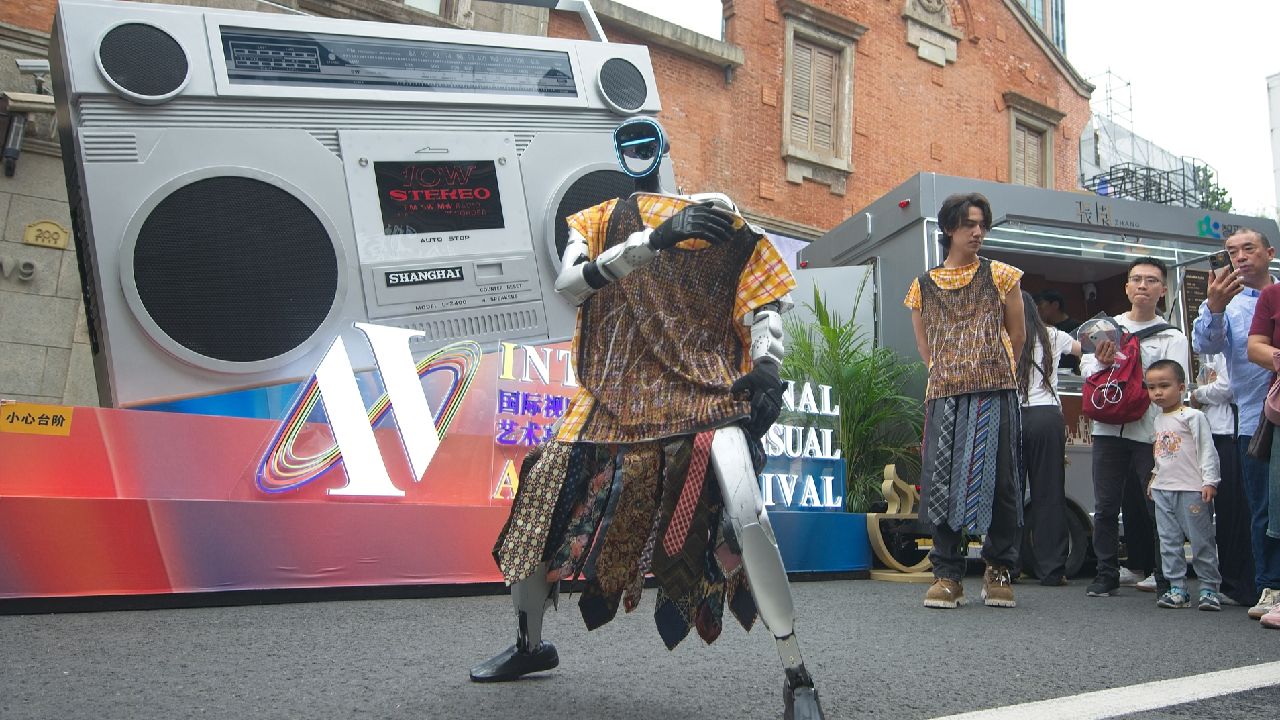
A Unitree humanoid robot interacts with visitors at Zhangyuan during a national holiday event in Shanghai, China, October 2, 2026. /VCG
Technology is also reshaping the tourism experience. AI-powered travel assistants can provide route planning, multilingual guidance and recommendations based on visitors' locations. At cultural venues, VR, AR and digital displays are bringing historical artifacts and cultural heritage to life. In Shanghai, for example, an AI-powered city tourism assistant integrates a wide range of cultural and tourism resources and provides services including trip planning, navigation and ticket information.
In another example, a newly opened AI-themed park in Zhuhai, south China's Guangdong Province, has deployed nearly 300 embodied intelligent robots across scenarios including smart guiding, education, entertainment and hotel services.
From a train running safely across a bridge to a robot answering a visitor's question, technology is becoming less about isolated breakthroughs and more about coordinated applications. As digital tools become embedded in transport and tourism, they are increasingly turning technological innovation into tangible improvements in people's everyday journeys.