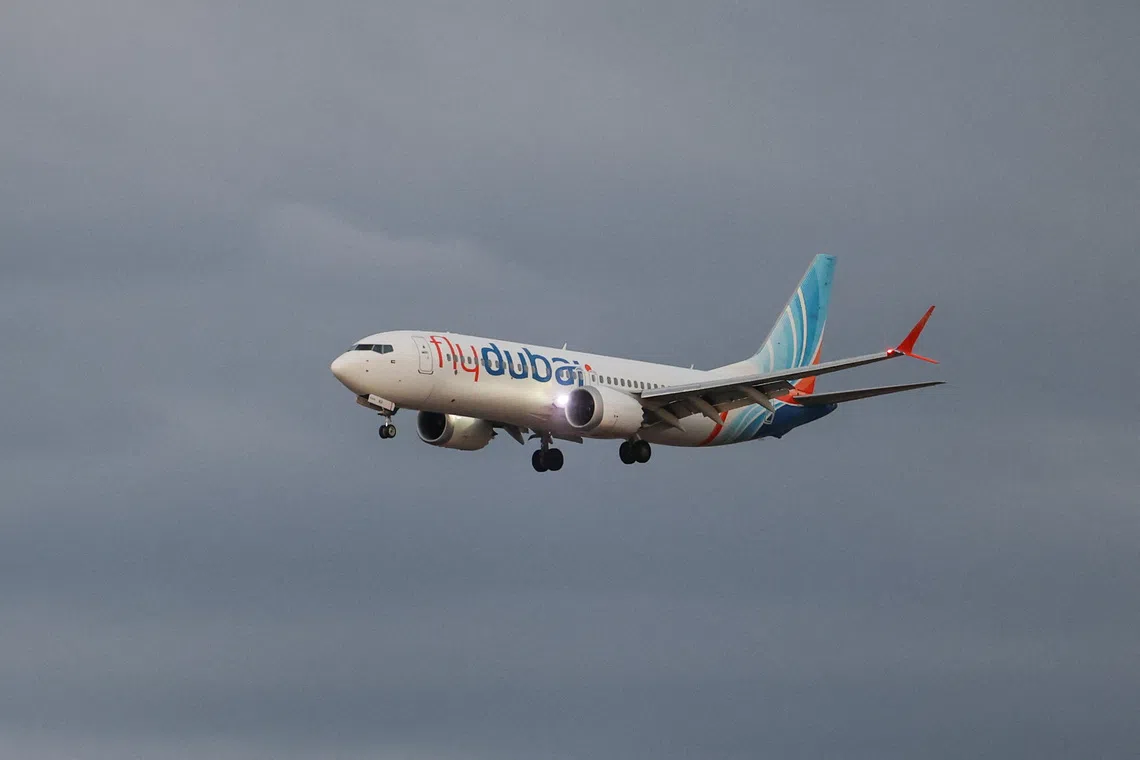
FlyDubai co-pilot attack disrupts Israel-UAE travel, sparks security probe

An attack by a co-pilot who allegedly tried to crash a Tel Aviv-bound FlyDubai flight has thrown travel between Israel and the UAE into disarray and raised fresh questions over aviation security in a region already shaken by the US-Iran war. The co-pilot's motive is not publicly known, and a regional investigation is under way.
The UAE has cancelled all flights to Israel, affecting hundreds of passengers who travel between the two countries on a typical day. Israel and the UAE agreed on repatriation flights from Friday for passengers stranded in the UAE after commercial services were suspended, according to an Israeli official who was not authorised to speak publicly. However, it was unclear late Friday whether those flights had begun.
Earlier in the day, Israel's national carrier El Al said the UAE was delaying the landing permits needed for it to fly into Dubai. Ben Gurion International Airport in Tel Aviv listed Arkia and Israir flights scheduled to arrive from Dubai late Friday and early Saturday. El Al was expected to bring passengers from Dubai to Israel on Sunday. Dubai has been a popular destination for Israelis since the two countries established ties in 2020 under the Abraham Accords.
Israeli Prime Minister Benjamin Netanyahu said on Friday that the co-pilot, identified by Israeli officials as an Omani citizen, had undergone "Islamist radicalisation", but he did not provide evidence. "We are now investigating whether he was sent, and whoever sent him will pay a very heavy price," Netanyahu said in a video message.
US President Donald Trump told reporters that early information he had received suggested links between the attack and Tehran, but he did not elaborate. He also said that if Iranian agents were found to be behind the attack, the United States would "hit them very hard". An official familiar with the investigation said Israeli investigators were involved, but the Emiratis were leading the probe. The official said it was unclear whether the attacker was part of a group and added that there was currently no evidence of an Iranian link.
UAE senior diplomatic adviser Anwar Gargash described the incident as a "dangerous terrorist act" in a post on X and praised the captain for averting a catastrophe. Jon Alterman, chair of Global Security and Geostrategy at the Center for Strategic and International Studies in Washington, said, "The Emiratis are going to be interested in protecting their reputation. They believe people should see them as a place that's very secure, not a place that has serious lapses."
More details also emerged about the flight, which made an emergency landing in Tabuk in Saudi Arabia. Captain Smit Machchhar, who was injured in the attack, and the co-pilot were transferred on Thursday from Saudi Arabia to the UAE, Saudi authorities said. Machchhar is recovering in a hospital in Abu Dhabi. In a televised video call with Prime Minister Narendra Modi on Friday, he described the attack inside the cockpit. "I had so many wounds. I had fallen down," he said, his head bandaged, before breaking into sobs. "I was fighting for my life. At one point, I realised that if I didn't get up ... then passengers would lose their lives."
The first sign of trouble came more than two hours into the flight, when the aircraft suddenly dropped to 16,600 feet, according to flight tracking data. Passenger Daniel Schlichter, who was seated in the second row, said people near the front had heard sounds of a fight in the cockpit moments earlier. The aircraft then climbed to 21,725 feet before dropping again to 15,000 feet, where it remained until it landed safely more than an hour later. "The plane started going down very quickly and we all went back backwards, like the gravity took us backwards," Schlichter said. He added that the cries of children were "horrific". "One of the things that I will never forget is the shouting of the children," he said. "I could hear the children shouting, 'We don't want to die! We don't want to die!'"
The captain eventually managed to open the cockpit door, allowing passengers to enter and restrain the attacker as the Boeing 737, carrying 174 passengers and eight crew members, most of them Israelis, descended sharply. Passengers pulled the co-pilot out of the cockpit and onto the floor of the main cabin, where they tied his hands with headphones. The wounded captain was laid inches away from him, and a dentist treated his injuries. Schlichter and the dentist, Dr Shota Musayev, both said they did not see a knife or any other weapon at the front of the plane. "I could see all the blood on the floor, and I couldn't believe he would still be alive because he had so many injuries," Schlichter said.
The attack has left investigators trying to establish the co-pilot's motive, disrupted air links between Israel and the UAE, and focused attention on how passengers and the injured captain prevented a far greater disaster aboard the flight to Tel Aviv.