Five years on, China's GDI turns UN's development goals into action
By continuing to browse our site you agree to our use of cookies, revised Privacy Policy and Terms of Use. You can change your cookie settings through your browser.
In Cambodia's Kampong Chhnang Province, a smart greenhouse is changing how local farmers grow vegetables – and how they earn a living.
Once dependent on the weather, farmers can now control shading and precision irrigation systems, reducing the vegetable-growing cycle from two to three months to just one month. A local processing factory has approached the farmers to discuss long-term supply partnerships.
The project, supported by China's Guangxi Zhuang Autonomous Region, has directly involved 30 farming households in smart agriculture. Each household is expected to increase its annual income by more than 3,000 yuan ($420), while the village's overall poverty rate is projected to fall by 1 to 2 percentage points, according to the Lancang-Mekong Cooperation China Secretariat.
The project illustrates how development cooperation can translate into tangible benefits for local communities. It also offers a glimpse of the ambition behind China's Global Development Initiative (GDI), which marks its fifth anniversary this year: promoting shared development globally through practical cooperation.
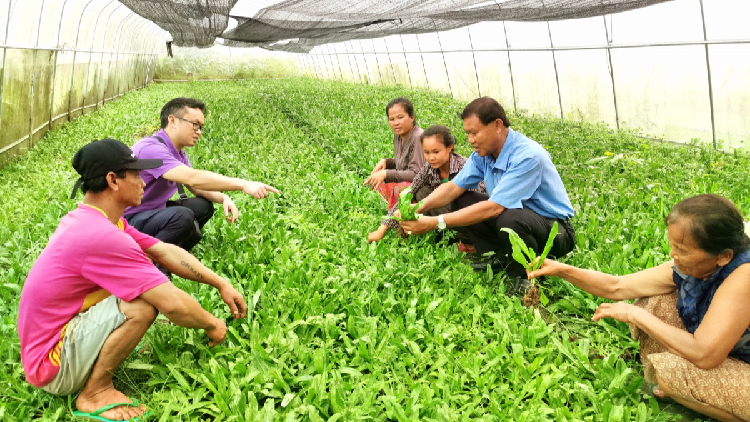
Chinese experts provide guidance to Lao farmers on vegetable cultivation at a vegetable base in Khamhoua Village, Xaythany District, Vientiane, Laos, 2023. /Photo by the Department of Agriculture and Rural Affairs of Guangxi Zhuang Autonomous Region
Chinese President Xi Jinping proposed the GDI on September 21, 2021, during the general debate of the 76th session of the United Nations General Assembly. He called on the international community to place development at the center of the global macro-policy framework and forge a united, equal, balanced, and inclusive global development partnership.
The initiative came as the UN's 2030 Agenda for Sustainable Development faced mounting challenges. Adopted in 2015, the agenda sets out 17 Sustainable Development Goals (SDGs) and 169 targets, including ending poverty in all its forms everywhere.
But progress has been uneven. In 2020, world hunger spiked dramatically by an estimated 118 million to 161 million people compared with 2019, an increase exceeding the cumulative rise over the previous five years, according to the UN's Food and Agriculture Organization. Trade tensions, geopolitical conflicts and other global pressures have further complicated development efforts, with developing countries often bearing the brunt.
Against this backdrop, the GDI calls for development to be treated as a shared global priority, with more inclusive and equitable growth so that developing countries – including the most vulnerable – can participate in and benefit from global development.
Its principles also emphasize a people-centered approach, innovation-driven development, harmony between humanity and nature, and a focus on translating commitments into action.
China has continued to promote development as a priority across multilateral platforms. At the recent BRICS summit, President Xi put forward five proposals to deepen cooperation in areas including AI, trade and investment, digital industries and smart manufacturing, underscoring the importance China places on advancing common development across the Global South.
For China, promoting shared global development is not just about rhetoric. It also means providing practical support through development assistance, skills training, expanded market access and other forms of cooperation, particularly for developing countries.
Across ASEAN, China-backed initiatives offer examples of how such efforts can address local development needs.
In the Philippines, the introduction of China's "Green Super Rice" technology has helped promote disease-resistant varieties on Luzon Island. In Malaysia, the country has drawn on China's targeted poverty alleviation experience to establish a mechanism combining community monitoring with poverty insurance to identify the risk of people falling back into poverty.
Guangxi is also working with ASEAN partners to advance an AI development model that connects research and development in major Chinese cities, technology integration in Guangxi, and applications in ASEAN countries. The approach is opening up new opportunities for cooperation in practical fields such as smart agriculture.
Expanding market access is another way China seeks to support development. Since December 2024, China has granted zero-tariff treatment across all tariff lines to goods originating in the 43 least developed countries that have diplomatic relations with China. In May 2026, it extended zero-tariff treatment to all 53 African countries with which it has diplomatic relations, providing further opportunities for African products to enter the Chinese market.
A Chinese head of a Luban Workshop talks with a local teacher at the Federal Technical and Vocational Training Institute in Addis Ababa, Ethiopia, February 15, 2024. /Xinhua
Beyond individual projects and bilateral partnerships, China is also building platforms and strengthening cooperation with international organizations to advance the SDGs.
According to the United Nations Development Programme (UNDP), with funding from China, including through the Global Development and South-South Cooperation Fund, the agency has worked with the Chinese government to implement 39 South-South development cooperation projects since 2011.
The projects address practical needs in developing countries, from rebuilding homes and schools in areas hit by climate-related disasters and helping children return to classrooms, to providing vocational training and targeted support for low-income families. They have also helped introduce green technologies to promote sustainable development.
The latest UNDP figures show that the projects, jointly implemented by the UNDP and China in 26 countries, have benefited nearly 20 million people.
Meanwhile, China has also set up the Group of Friends of the GDI, which has developed into a platform for countries to coordinate development positions and connect resources within the UN framework, supporting cooperation on issues including global governance, addressing climate change and development financing.
Five years after its launch, the GDI has gained support and participation from more than 130 countries and international organizations. It has mobilized over $23 billion in funding, supported more than 1,800 "small yet beautiful" livelihood projects and provided training for over 200,000 people, according to China's Foreign Ministry.
From smart greenhouses in Cambodia to South-South cooperation projects reaching millions, China's GDI shows that putting development first and fostering international cooperation can genuinely turn global commitments into meaningful improvements in people's lives.