Falling stones, polluted waters: RTI flags risks at Sher Shah Suri's tomb in Bihar
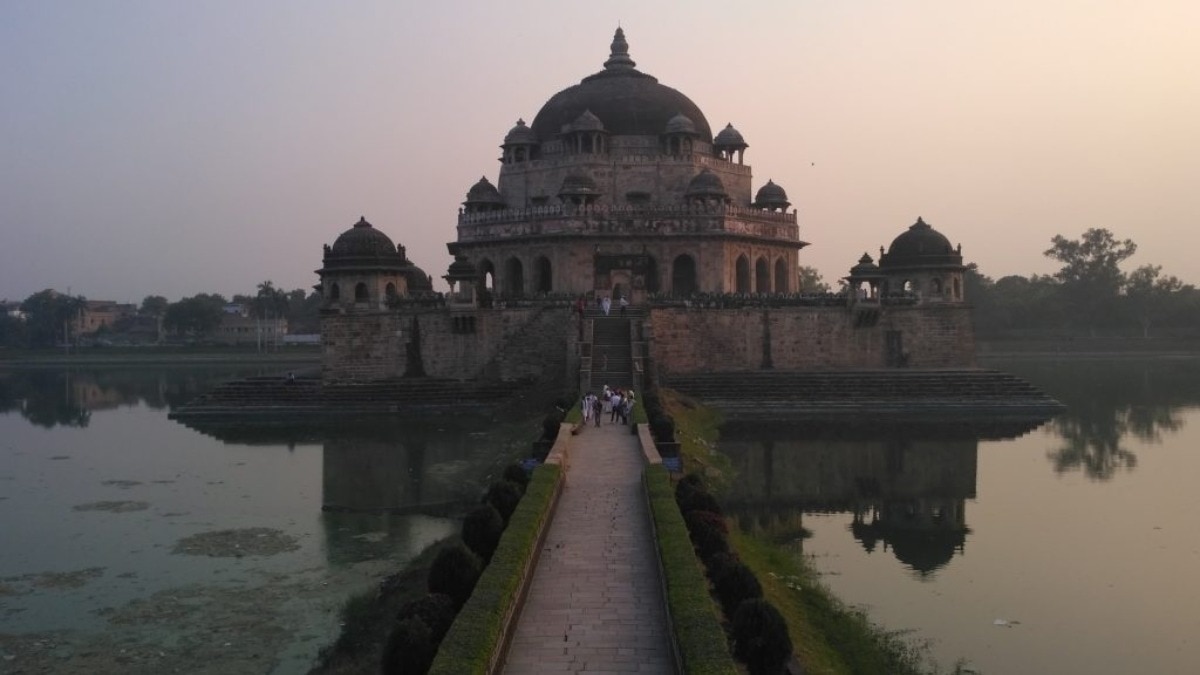
Rising 122 feet from the centre of a 22-acre artificial lake, the octagonal red sandstone tomb of Sher Shah Suri has stood in Sasaram since 1545. Built for the Pathan emperor who defeated the Mughals and founded his own empire, the monument is also credited with laying an administrative blueprint later used by both the Mughal Empire and the British Raj.
Alexander Cunningham, the first Director-General of the Archaeological Survey of India (ASI), famously expressed a preference for the Tomb of Sher Shah Suri in Sasaram, placing its architectural merit above even that of the Taj Mahal.
Now, an India Today RTI investigation has obtained ASI’s own records showing that stone is breaking off the monument’s dome, that the agency does not own the canals feeding the lake around the tomb, and that it cannot say whether the water lapping at the monument’s foundations has ever been tested.
The response, sent by ASI’s Patna Circle, came in reply to a nine-point RTI application filed by India Today seeking details on the tomb’s structural condition, management of its pond and compliance with a 2008 Patna High Court order.
What emerges is a monument that is, on paper, protected by the ASI, but in practice is caught in a jurisdictional gap between the agency responsible for safeguarding its structure and the authorities who control the water system around it.
Sher Shah Suri died in an accidental gunpowder explosion at the fort of Kalinjar on May 13, 1545. He had begun building his own tomb before his death, and his son Islam Shah completed it three months later. An inscription dates the finished monument to August 16, 1545.
Architect Mir Muhammad Aliwal Khan designed not just a tomb but an elaborate structure built around a water system. The mausoleum stands on a square stone plinth, surrounded by domed kiosks and stepped moorings, and rises from the middle of a lake nearly 1,130 feet long and 865 feet wide.
Visitors cross a wide stone bridge to reach it, passing the smaller tomb of Sher Shah’s concierge on the way. The main structure, octagonal in plan, is crowned by a 22-metre dome and corner chhatris that once shimmered with coloured glazed tilework.
For nearly 500 years, the lake has been as much a part of the monument as the sandstone itself. It is against this backdrop that the questions raised by India Today’s RTI — about a falling dome, an unmonitored pond and an unresolved court order — take on significance.WHAT ASI’S OWN FILES REVEAL
ASI’s Sasaram Sub-Circle recorded that at around 6 pm on August 9, 2026, a stone broke loose from the upper portion of the tomb’s main dome and fell, damaging the structure at that point.
Photographs filed with the incident report show fragments of broken stone scattered near the monument’s base. According to ASI, no visitor was injured. Source: ASI response to India Today RTI Source: ASI response to India Today RTI THE WATER SYSTEM LIES OUTSIDE ASI’S CONTROL
As per the original plan of the tomb, an inlet water channel around 1.8 km long brings water from the Sone River high-level canal to the artificial lake, while an outlet channel of around 2.1 km releases water back.
Over the years, however, both channels have become dilapidated and encroached upon. Residents in the area have also connected household drainage to the two channels, resulting in sewage water entering the artificial lake and polluting it with solid and liquid waste.
India Today asked ASI when the pond’s inlet and outlet canals were last cleaned, repaired or designated.
ASI’s response cut to the heart of the problem: the canals are neither protected nor acquired by the agency and therefore cannot be maintained by it.
It said: “The drainage system of the pond (inlet and outlet canal) is not protected or acquired by ASI and can not be maintained, repaired, cleaned or designated by ASI.”
The lake that defines the monument, in other words, sits within a water system that falls outside ASI’s control.NO WATER TESTS
India Today also asked ASI about water-quality testing since 2018, including the dates of testing, parameters examined and findings.
The response contained a single line: “Information not available.”
That means the agency could not provide details of any water-quality testing carried out over the period covered by the RTI.GARBAGE, HOSPITAL WASTE AND A WALL TO KEEP LOCALS OUT
ASI has also shared a letter dated September 14, 2026, from its Conservation Assistant to the District Magistrate of Rohtas.
The letter describes the inlet canal near Prabhakar Mor as a site where garbage from local shopkeepers, coconut vendors and other commercial activity is being dumped, along with biomedical waste from nearby hospitals.
According to the letter, the waste can be carried into the canal and tank by monsoon rainwater, potentially affecting the water-management system. It also flags the possibility that biomedical waste could degrade water quality and adversely affect fish in the tank.
The letter states that accumulated garbage around the outlet canal, inlet canal and Prabhakar Mor is causing a foul odour and creating an unhygienic environment for tourists and residents, including children, who frequent the area.
ASI has asked the district administration to stop the dumping, direct a health department inspection of biomedical waste disposal by local hospitals and take action against violators.
It also states that ASI has begun constructing a boundary wall fitted with an iron grille around the canal to prevent nearby residents and vendors from dumping garbage and waste there.
The letter was copied to the Municipal Commissioner, the SDO, the Chief Medical Officer, the Sone Minor Canal Division and ASI’s Superintending Archaeologist.
Asked about cleanliness at the site, Rohtas District Magistrate Deepak Kumar Mishra said, “Attention is being paid to cleanliness.”A FISHERMAN’S FIGHT, DATING BACK TO 2018
The ASI has also shared a letter concerning Vijay Kumar Singh, who held a licence to farm fish in the tomb’s tank from 2018 to 2020.
Singh alleged that in March 2018, the district administration filled the inlet canal with soil as part of a beautification project. According to his complaint, this cut off the tank’s water supply and destroyed his fish stock.
He alleged that the action violated a Patna High Court order and claimed that ASI took no action despite his verbal complaints.
The Patna High Court, in November 2008, had directed the ASI and the Rohtas district administration to take measures for the preservation of the monument.
The long-running dispute over the water system therefore predates the latest concerns over pollution, stagnant water and maintenance of the lake.SPENDING UP SHARPLY — BUT FOR WHAT?
ASI’s expenditure records for the tomb, its tank, walls, ghats and gateway show a steep rise in spending in the most recent year.
The expenditure figures raise questions about where the increased spending is being directed, particularly when the RTI response simultaneously flags unresolved issues involving the monument’s water system and structural condition.A PUMP PROJECT AND A STRUCTURAL STUDY — BOTH UNACCOUNTED FOR
Two of the RTI’s most pointed questions concerned a proposed pump station at Beda Canal to pipe fresh water into the lake and any technical study examining whether contaminated or stagnant water could be affecting the monument’s structure.
ASI’s answer to both questions was the same: “Information not available.”WHAT THE ROHTAS DM SAYS
Rohtas District Magistrate Deepak Kumar Mishra said the issue had come to his notice a few days ago.
He said the Water Resources Department would prepare a new project to bring clean water from the Beda Canal to Sher Shah’s pond.
On the dumping of medical waste and garbage around the tomb and near the inlet canal, the DM said the matter would be investigated and fines imposed on those responsible.
Regarding fishing in Sher Shah’s pond, Mishra said the water is currently stagnant and is not being properly purified or circulated. Keeping this in mind, the Water Resources Department has prepared a project and its implementation is underway.
Once the project is completed, he said, the water in the pond will be regularly exchanged, which would also help ensure the safety of the fish.
The DM also said several parts of the boundary and interior sections of Sher Shah’s Tomb in Sasaram have been damaged, with some stones breaking. He said parts of the boundary have been damaged and reiterated that the monument comes under the Archaeological Survey of India.
He added that a letter had also been sent for the repair of the deer park located in front of the tomb. The ASI is expected to take up the repair work in the coming days.- Ends