Fact check: What Trump got wrong in his sweeping UN address
Want to bookmark your favourite articles and stories to read or reference later? Start your Independent Membership today.
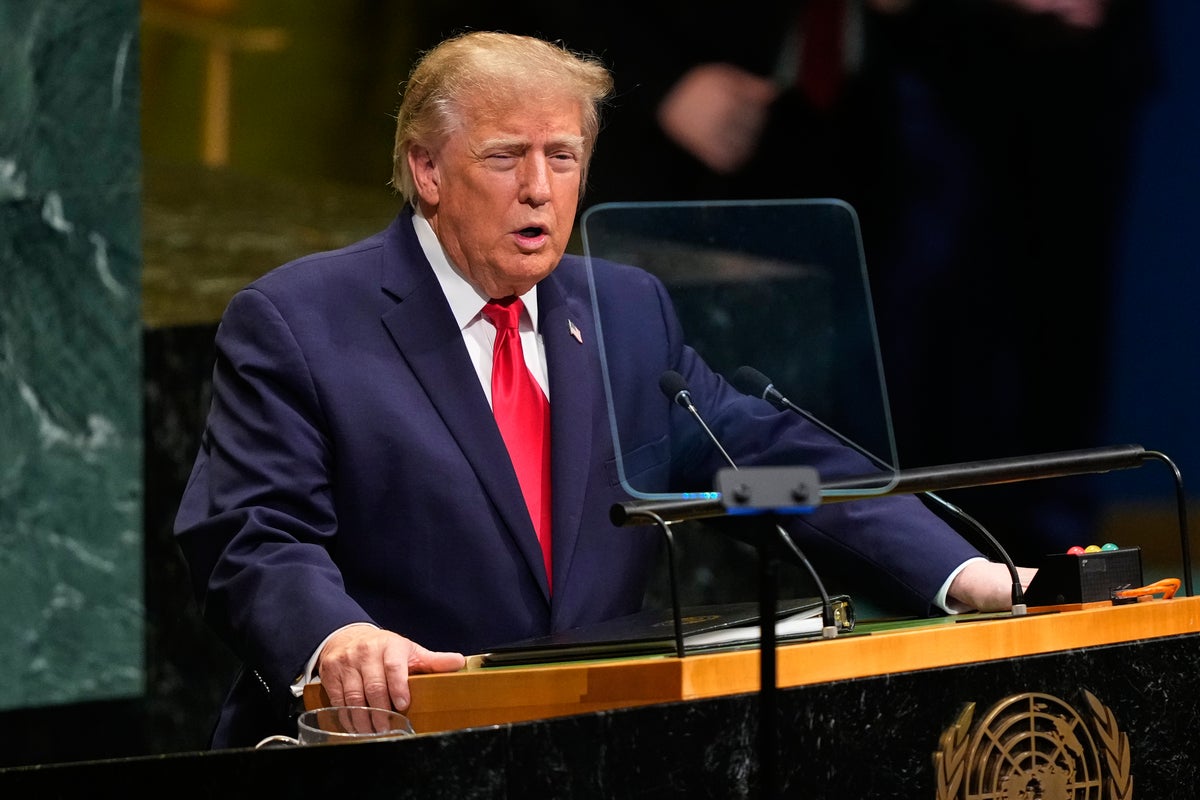
During his speech to the United Nations General Assembly on Tuesday, President Donald Trump delivered numerous inaccurate and misleading statements, several of which have become staples of his second term in the White House.
His remarks touched on U.S. munitions supplies, drug seizures, oil output and the economy.
Here is a breakdown of the key facts.
CLAIM: “We have more munitions than we could ever possibly even think of using, and we’re building them at levels that we have never done before.”
THE FACTS: Public reports and defense specialists challenge this assertion. Weapons stockpiles are shrinking, according to officials across the U.S. military, NATO, and the Middle East, and defense analysts warn that American defense manufacturers will need years to restock Tomahawk cruise missiles, as well as Patriot and THAAD missile interceptor systems.
In August, sources informed The Associated Press that American forces face a "beyond critical" deficit of sophisticated missile interceptors in Europe. Driven largely by President Donald Trump’s war with Iran, this strain has heightened fears regarding the vulnerabilities of NATO member countries to a potential Russian strike.
An American defense official highlighted that the most alarming deficit involves Patriot missile interceptors, designed to shoot down Russia's high-speed ballistic missiles. A NATO official corroborated reduced Patriot missile stockpiles among Western forces in Europe. Both individuals requested anonymity to talk about sensitive defense matters.
"The United States has enough munitions for any plausible scenario in the Iran war, but the depleted inventories have created a window of vulnerability for a potential Western Pacific conflict," the Center for Strategic and International Studies stated in a May report. "The time needed to rebuild those inventories has thus become a major concern."
CLAIM: “When you add the United States and Venezuela together, we have more than 60% of the oil in the world.”
THE FACTS: The math behind Donald Trump’s assertions fails to add up. Following a late August deal, a joint venture granted the U.S. 100-year rights to 17 Venezuelan oil fields holding 65 billion barrels in proven reserves. Overall, Venezuela is estimated to hold more than 303 billion barrels of crude oil in total reserves.
While the agreement expanded U.S. proven oil reserves by 46 billion barrels, experts note that Venezuela’s severely degraded energy infrastructure means new investments will take years before leading to significantly higher production levels.
Even setting those operational issues aside and using the highest available estimates, the combined resources would account for only about 22 percent of total global reserves, which stand at nearly 1.6 trillion barrels of crude oil.
In 2025, global crude production reached just over 27 billion barrels, according to OPEC’s 2026 Statistical Bulletin. The U.S. produced nearly 5 billion barrels of crude oil that year, while Venezuela generated 394 million barrels, bringing their combined output to almost 19.6 percent of world production.
CLAIM: “The United States has carried out dozens of strikes on cartel drug boats, destroying 97% of the drugs coming into the ocean and sea.”
THE FACTS: In recent months, Donald Trump has repeatedly made similar assertions featuring a variety of percentages. Analysts, however, emphasize that the true figure remains impossible to calculate, given the inability to determine how many illicit substances evade detection entirely.
When questioned in April about the origin of these statistics—after a Truth Social post in which Trump stated that 98.2% of narcotics transported along those routes were intercepted—the White House directed The Associated Press to Customs and Border Protection seizure records.
Those records indicated that interceptions across coastal and interior regions, including open waters, were 98.2% lower in November 2025 than in July 2025. Yet this comparison captures only two months rather than a broader trend and fails to assess overall trafficking volume.
"Drug seizure data measure interdiction activity, not actual trafficking volume," Dessa Bergen-Cico, a professor of public health at Syracuse University who studies drug trafficking, told the AP at the time. "As drug policy researchers have noted, no one knows how much goes uncaught, and changes in seizure data are insufficient to make definitive claims about policy outcomes."
Interdiction activity describes the process of stopping illegal drugs before they reach their intended destination.
Trump also used his UN speech to tout his record on jobs, international conflicts and investment in the US, making several claims that either lacked important context or overstated his administration’s achievements.
The president declared that “more Americans are working today by far than ever before.” While technically true, the claim needs context. The US economy adds jobs in most years as the population and economy grow, meaning employment regularly reaches new records. Jobs have increased in the US in 65 of the past 80 years.
Trump also claimed that more than 1 million new private-sector jobs had been created since he returned to office. The actual figure is about 807,000, putting it relatively close to the number he cited, although the increase is not particularly large by historical standards.
Turning to foreign policy, Trump repeated his claim that he had “settled eight wars” since taking office. While he has played a role in mediating disputes between several countries, his impact is not as clear-cut as he suggested. At least two instances he has cited as wars he ended were not wars, while Trump also launched the ongoing conflict between the US and Iran.
Trump also claimed his administration had secured $21 trillion in new investment commitments from around the world.
That figure appears to be greatly exaggerated and highly speculative. The White House’s own website puts the total at about $11.2 trillion — nearly $10 trillion below Trump’s claim — and even that figure appears to include some investment commitments made during the Biden administration.