Exam duty, then a long hunt for House 76: A Delhi BLO’s 12-hour grind - The Indian Express
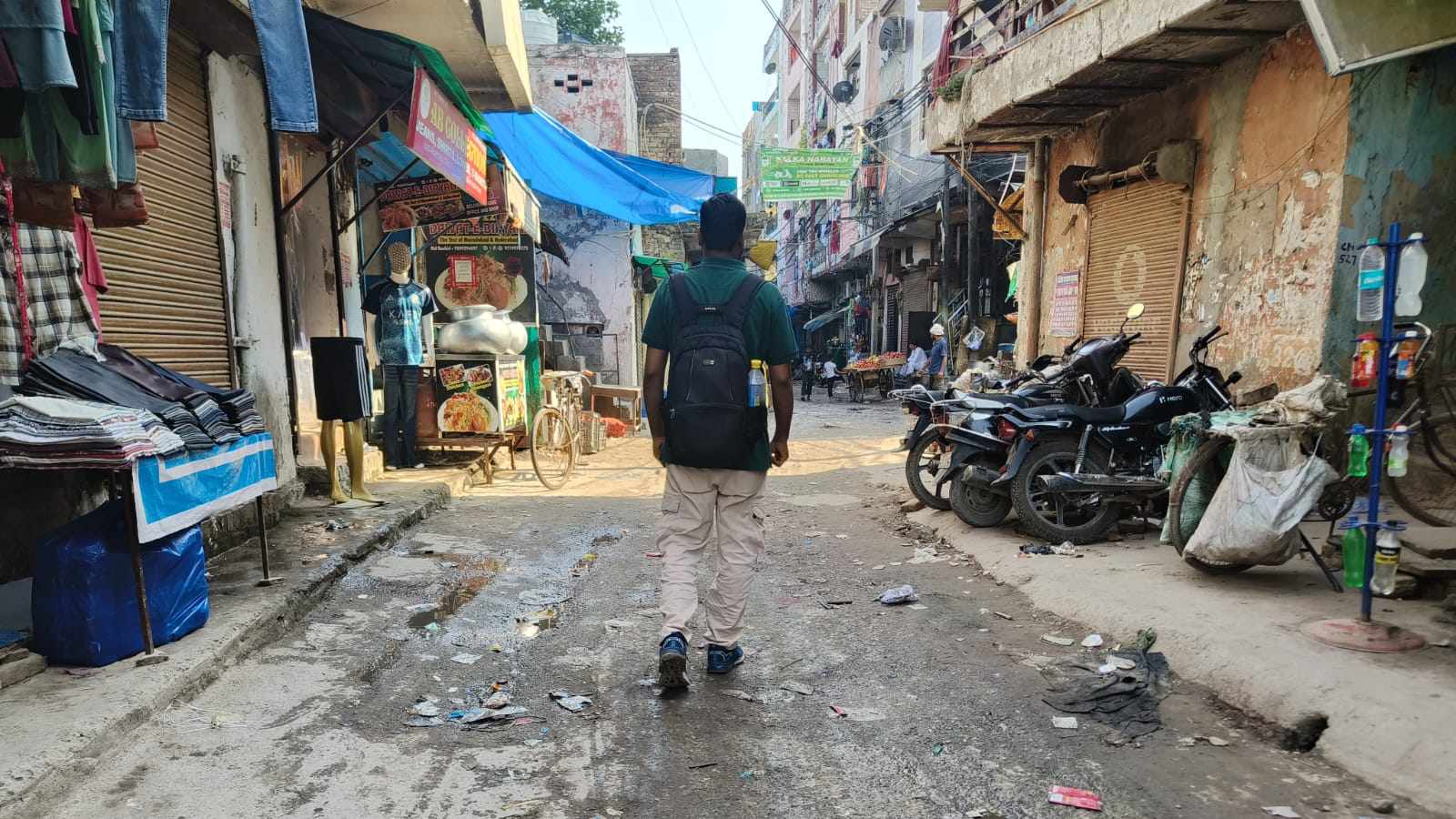
At 12.15 pm, Inamul Hasan finishes invigilating a three-hour examination at a government school in Sarai Kale Khan after spending his morning teaching Urdu to students from classes 6 to 10.
Fifteen minutes later, he is in the same neighbourhood, this time walking through its narrow lanes as a booth-level officer (BLO) for Delhi’s Special Intensive Revision (SIR). A bag of electoral notices — issued to residents to prove that they are eligible to stay on the final voter list to be released on December 4 — is slung over his shoulder.
Inamul has been working as a BLO in the area for around three months. But he has never seen the house in the narrow lanes of ‘Kale Khan’ — as the locals call it — where cars, bikes, tempos, cows, dogs and goats jostle for limited space and open drains run alongside broken roads and water-filled potholes.
The notice in his hand is for Shubham Basishta and two members of his family, Mamta and Geeta Devi.
His repeated calls to Shubham goes unanswered.
As Inamul keeps searching, a little further down the main road, he spots a shop banner indicating that House 76 is to the right. He enters the lane but finds no house numbers.
A resident tells him there is no House 76 on the street. The lane and adjoining streets appear to have just one house number — ’86T’.
“Our grandfather used to own one large khasra, 86T. It kept getting subdivided, but the houses were never registered,” the resident says.
“Shubham’s name sounds like someone who is a houseowner in the village, not a renter. Go back to the main street, go straight till the intersection and ask the owner of the samosa shop. He might know,” the resident tells Inamul.
The samosa shopowner has heard of Shubham but does not know where he lives. A grocery shop further down the road, he says, is owned by one of Shubham’s relatives.
A 200-m walk, and the shopowner says Shubham lives right on this street.
At the end of the street, local residents say they know a Shubham. One of them goes upstairs and calls him. But it is another dead end.
“This is not my form. I am not Shubham Basishta,” says the man.
Inamul has now spent a large part of his afternoon searching for one elector.
A nearby shopkeeper, Parvesh, recognises him as his BLO and arrives with a notice Inamul had given him a few days earlier.
“What documents do I need to bring for this?” Parvesh asks.
Inamul explains that any two documents from Aadhaar, PAN card, bank account proof, birth certificate or school marksheet are required.
Parvesh luckily has his Aadhaar card and bank passbook on him. “Great, I will do your hearing now only,” says Inamul.
As he gets to work, Inamul’s phone keeps ringing. Electors who have received notices want to know which documents they need, when and where they have to appear for a hearing and what they need to do next.
Parvesh’s son says he might have an idea where House 76 might be. He takes Inamul two streets away but to no avail. House 76 is still nowhere to be found.
Another resident then informs Inamul that Shubham’s relative owns a grocery shop down the street.
This time, Inamul gets lucky – the shop is actually owned by Shubham’s cousin.
Standing inside the cramped shop, Inamul fills out the acknowledgement forms for Shubham and his family, photographs each form, uploads it and takes a photograph of the recipient along with the notice.
“Is this the only work left for us? Should we shut our shops and do this all day?” the cousin asks irritably.
After three hours on the ground, Inamul has distributed five notices and conducted two hearings.
“How are we supposed to do this work standing on the streets in an area like this, where we can’t even find the houses?” he asks.
He has not brought lunch from home. He decides to go home, eat and return for another couple of hours.
Of the 519 electors assigned to him, 137 have been issued notices. He still has to serve notices to 30 people and hold hearings for another 100.
And SIR is only one part of his workload.
Inamul had woken at 5 am for namaaz, reached school by 7.30 am and spent the morning there. When he finally heads home around 6 pm, more than 200 examination papers are waiting to be checked.
Devansh Mittal is a Correspondent at The Indian Express, based in the New Delhi City bureau. He reports on urban policy, civic governance, and infrastructure in the National Capital Region, with a growing focus on housing, land policy, transport, and the disruption economy and its social implications. Professional Background Education: He studied Political Science at Ashoka University. Core Beats: His reporting focuses on policy and governance in the National Capital Region, one of the largest urban agglomerations in the world. He covers housing and land policy, municipal governance, urban transport, and the interface between infrastructure, regulation, and everyday life in the city. Recent Notable Work His recent reporting includes in-depth examinations of urban policy and its on-ground consequences: An investigation into subvention-linked home loans that documented how homebuyers were drawn into under-construction projects through a “builder–bank” nexus, often leaving them financially exposed when delivery stalled. A detailed report on why Delhi’s land-pooling policy has remained stalled since 2007, tracing how fragmented land ownership, policy design flaws, and mistrust among stakeholders have kept one of the capital’s flagship urban reforms in limbo. A reported piece examining the collapse of an electric mobility startup and what it meant for women drivers dependent on the platform for livelihoods. Reporting Approach Devansh’s work combines on-ground reporting with analysis of government data, court records, and academic research. He regularly reports from neighbourhoods, government offices, and courtrooms to explain how decisions on housing, transport, and the disruption economy shape everyday life in the city. Contact X (Twitter): @devanshmittal_ Email: devansh.mittal@expressindia.com ... Read More