Durban Chamber marks 170 years with call to rebuild business confidence - IOL
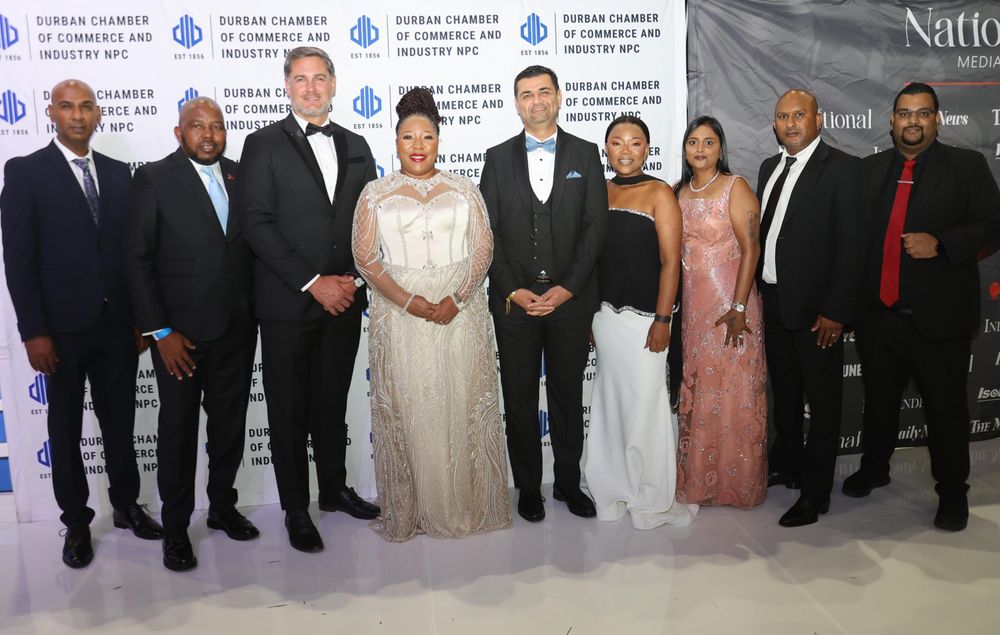
The Mercury executive editor Kuben Chetty, East Coast Radio managing director Mzuvele Mthethwa, Unilever chief executive Stefan Cloete, Durban Chamber of Commerce and Industry NPC chief executive officer Palesa Phili, Durban Chamber of Commerce and Industry NPC president Asheen Magjee, Durban Chamber of Commerce and Industry NPC deputy president Busi Dlamini, Azisa Consulting chief executive Natasha Naidoo, Azisa Consulting director Jerome Naidoo and Momentum FundsAtWork and Distribution head Nashalin Portrag at the Durban Chamber of Commerce and Industry NPC Annual Gala Dinner held at the playTSOGO Globe, Suncoast, yesterday.
As the Durban Chamber of Commerce and Industry prepares to mark its 170th anniversary, its chief executive says investment in the city continues despite declining confidence, but warns that ageing infrastructure and unreliable municipal services threaten future growth.
The Chamber held its annual gala dinner at the playTSOGO Globe, Suncoast, on October 28 under the theme “Building Confidence Together”.
Chief executive Palesa Phili said manufacturing investment, port developments and projects supported through the Presidential eThekwini Working Group revealed that business had not lost faith in the city.
“We continue to witness businesses that remain steadfast in their belief that Durban holds immense potential and will recover,” she said.
The Durban Business Confidence Index fell from a record 63.38 points in the fourth quarter of 2025 to 50.63 in the first quarter of 2026 and 48.82 in the second quarter. It was the first reading below the neutral 50-point mark since the second quarter of 2024.
Phili attributed the decline largely to national and international pressures, including changing inflation and interest rate expectations, geopolitical tensions, migration-linked protests and higher fuel costs. Durban nevertheless remained above the national business confidence index of 39 points for the same quarter.
The index measures business sentiment rather than actual investment spending. Although the Chamber highlighted developments in several sectors, it did not provide an overall value for recent investments or identify projects delayed because of weaker confidence.
Phili pointed to an R11 billion investment commitment associated with the 25-year concession for the Durban Container Terminal Pier 2, rather than money already spent on the project.
Durban recorded the biggest year-on-year improvement in the World Bank’s 2025 Container Port Performance Index, though it remained near the bottom globally.
Phili also said tourism was recovering from the effects of the Covid-19 pandemic, July 2021 unrest, 2022 floods and migration-linked protests.
But the cost of unreliable municipal services continued to weigh on business. Ageing pipelines and treatment facilities, alongside rising water demand, were placing the city's water and sanitation systems under severe strain.
“Durban’s infrastructure has improved compared to many years ago, but as organised business, we firmly believe greater attention is urgently required,” Phili said.
She said water interruptions had forced businesses to stop operations and purchase their own water when the municipality could not restore services promptly. These additional costs compounded the pressure on firms already facing higher operating expenses.
The second-quarter confidence survey found that 31.5% of respondents identified roads as the worst-performing municipal service, followed by environmental management at 27.4% and water supply at 26%. It also found that 71.2% believed complaints about poor services were unlikely to be resolved within a reasonable time, down from 77.4% in the preceding quarter.
Phili argued that greater capital investment was needed to replace deteriorating infrastructure.
EThekwini's adopted 2026/27 budget provides approximately R6.3 billion for capital expenditure out of R75.3 billion overall, representing about 8.4% of total spending.
“We therefore call on government to prioritise and increase investment in the capital budget to safeguard Durban’s future growth and resilience,” she said.
The municipality had previously said it is prioritising road repairs and improvements to water and sanitation services.
Looking ahead, Phili said the city needed reliable water and electricity at fair prices, secure roads and stronger public safety to attract investment. With local government elections approaching, businesses also wanted certainty and sufficient resources for a safe electoral process.
She warned that failure to address infrastructure and security would undermine tourism and investor confidence, even where opportunities existed for businesses to expand.
The Chamber also urged government to explore alternative revenue sources rather than relying heavily on municipal tariff increases. Phili called for stronger measures against illicit and cheap imported goods, saying cooperation between government and business needed to produce tangible results.
“What is needed is decisive action, not just continued discussion, as too many meetings end without meaningful implementation,” she said.
Established in 1856, the Chamber has spent generations representing Durban's commercial interests. Its anniversary theme emphasises the cooperation between business and government needed to overcome current challenges and build a more resilient economy.
For the coming years, Phili identified business process outsourcing, particularly call centres offering opportunities for young jobseekers, as a promising source of employment.
She also pointed to renewable energy, waste management and sustainable technologies as areas capable of attracting investment and helping Durban diversify its economy.
As investors increasingly prioritise sustainability, she warned that South Africa risked being left behind unless green industries received greater attention.