
Drone Warfare Is Exposing a NATO Weakness | Opinion
On August 16, a Spanish F-18 flying a NATO air policing mission shot down a drone that had entered Romanian airspace. Four days later, two Romanian F-16s were scrambled after a maritime drone was detected near the Neptun Alpha offshore platform, part of the Neptun Deep natural gas project and a critical asset for Europe’s energy security.
Neither incident resulted in loss of life. That is welcome news, but it should not give us false comfort.
What happened in the Black Sea points to a security problem NATO can no longer afford to ignore: How do we act when an unidentified threat approaches allied territory, seconds matter, but attribution may take hours or days?
This is the reality of gray-zone warfare. An adversary no longer needs to launch a conventional, full-scale attack to create disruption. A cheap drone that tests reaction times, approaches an energy installation or creates uncertainty about its origin and intent can already serve a strategic purpose. Making decision-makers hesitate is often the real aim.
That escalation is not theoretical. On September 13, a drone struck the locomotive of a passenger train traveling from Kyiv to Warsaw, just kilometers from the Polish border, minutes after a separate train carrying senior European officials, including former prime ministers of the United Kingdom and Sweden, had passed through the same area. No one was hurt. But the incident was not incidental: gray-zone tactics are reaching the transport corridors that connect Ukraine to NATO territory, and the people who depend on them, including senior European officials.
As Romania’s deputy prime minister for strategic partnerships and minister of justice, I worked for years on national security and Black Sea issues, including as co-chair of the U.S.-Romania Strategic Partnership Dialogue in Bucharest. That experience reinforced one non-negotiable lesson: uncertainty must never become an excuse for inaction.
NATO cannot afford to wait for definitive attribution before protecting its people. But speed must not mean improvisation. Commanders need pre-authorized rules based on a threat’s behavior, trajectory, proximity to protected assets and risk to civilians.
The goal is to give commanders a lawful basis for proportionate and timely action when a threat presents an imminent risk, not to turn every unidentified object into a target.
It is to make clear to any potential adversary that testing NATO’s airspace, critical infrastructure and decision-making will not produce hesitation or paralysis; that the alliance is prepared to act. That is deterrence.
Asking pilots or field commanders to solve complex legal and political equations in midair is unfair and dangerous. A fighter pilot has seconds to react. An intelligence team may need hours or days to establish where a system came from and who launched it. Designing our air defenses on the assumption that these timelines will naturally align is a recipe for failure.
This is as much a legal and political problem as an operational one. Under current peacetime arrangements, the authority to use force in defense of national airspace remains a national prerogative. We saw this in Poland, where the Polish Operational Commander decided to neutralize drones that posed a threat, with Polish and allied aircraft involved in the response.
Because each member state relies on its own arrangements, the alliance is left with a patchwork of national protocols. As a former minister of justice, I know that military authorization is of little use if the decision-making process is slowed by fragmented responsibilities or bureaucratic sign-offs.
NATO needs a fast-track operational protocol that defines, in advance, when and under what conditions commanders can engage a high-risk threat. When an unidentified object enters allied airspace or approaches critical infrastructure, the chain of command must be fast enough to match the threat.
The authority to act must be established long before a crisis begins, not negotiated on a secure line while a drone is heading toward a populated area or an offshore energy platform.
We also cannot ignore a blunt economic reality. Scrambling a multimillion-dollar fighter jet or launching a high-end interceptor to deal with a cheap, mass-produced drone cannot remain our default response. High-end systems are vital when lives or critical infrastructure are at serious risk. But NATO also needs a broader and more flexible tool kit.
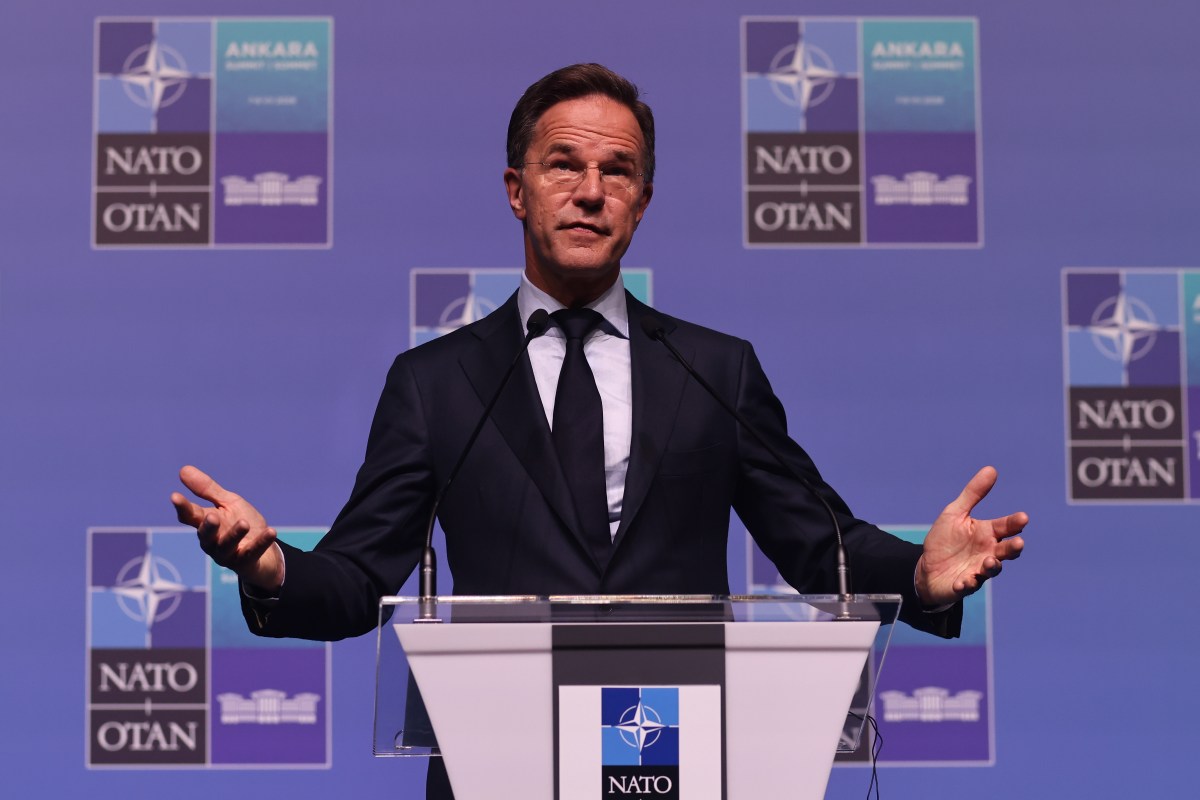
At the NATO Summit Defence Industry Forum in Ankara in July, Secretary-General Mark Rutte announced the NATO Drone Edge Initiative, under which allies will invest more than $40 billion in counter-drone capabilities over the next five years. This investment is significant. It now needs to be matched by a unified operational doctrine that translates these resources into clear rules of engagement.
The capabilities are already there. NATO’s European members need to bring them together into a layered air-defense system, combining sensors, command and control, electronic warfare, low-cost interceptors and short-range systems.
As technology matures, we must integrate directed-energy weapons into that tool kit. The alliance must match the tool to the threat. At the same time, we must develop the right tools to make countering these threats economically sustainable.
For Romania and our Black Sea neighbors, this is not an academic debate. Strategic energy assets such as Neptun Deep are vital to Europe’s energy security and resilience. Protecting them must be part of baseline defensive planning. The same applies to ports, power plants, communications infrastructure and military facilities across the alliance.
Romania has already demonstrated what practical cooperation can look like. In April, it hosted the first event in NATO’s LCI-X counter-UAS series at Capu Midia military training range.
However, these exercises must do more than test equipment. They must test decision-making: Who has the authority to act? How quickly can that authority be exercised? And what happens when the available intelligence is incomplete?
But deterrence depends on more than military capabilities. Allies also need shared situational awareness, a clear political decision-making process and timely communication to commanders and the public. In a gray-zone environment, fragmented information or contradictory messages can create the very uncertainty an adversary seeks to exploit. NATO must therefore rehearse not only how it will intercept a threat, but how it will see the same threat, decide what to do about it and communicate that decision clearly.
For those of us on NATO’s eastern flank, the gray zone is no longer an abstract concept. It is part of daily security.
The alliance already has the technology, the capabilities and the experience to respond. What it needs now is the political courage to give commanders clear rules and the authority to act when time matters more than certainty.
The next drone will not give us hours to debate. We must not waste those precious seconds figuring out what our rules are.
Ana Birchall is a former deputy prime minister for Romania’s Strategic Partnerships, minister of justice and minister delegate for European affairs. A graduate of Yale Law School, she works with Champions Speakers Agency as an international politics and geopolitics speaker.
The views expressed in this article are the writer's own.

