Dorothy and the masculinity we teach boys before they learn to love
Potta (female) is a Tamil word I cannot count the number of times I threw around as an insult as a child. Poda potta (Get lost, potta) was something we threw around casually, and Ambalaya iruntha itha senju kaatu (If you are a man, do it and show us) was the usual dare in reply, as if manhood were something you proved to an audience. I came from a society that thinks of itself as civilised and progressive, and it still managed to teach me all of this without ever saying it out loud. My PTE teacher once pulled me up for calling a friend potta. I grew up surrounded by women, and yet somehow I had learnt to use “woman” as an insult without ever questioning what that said about me.
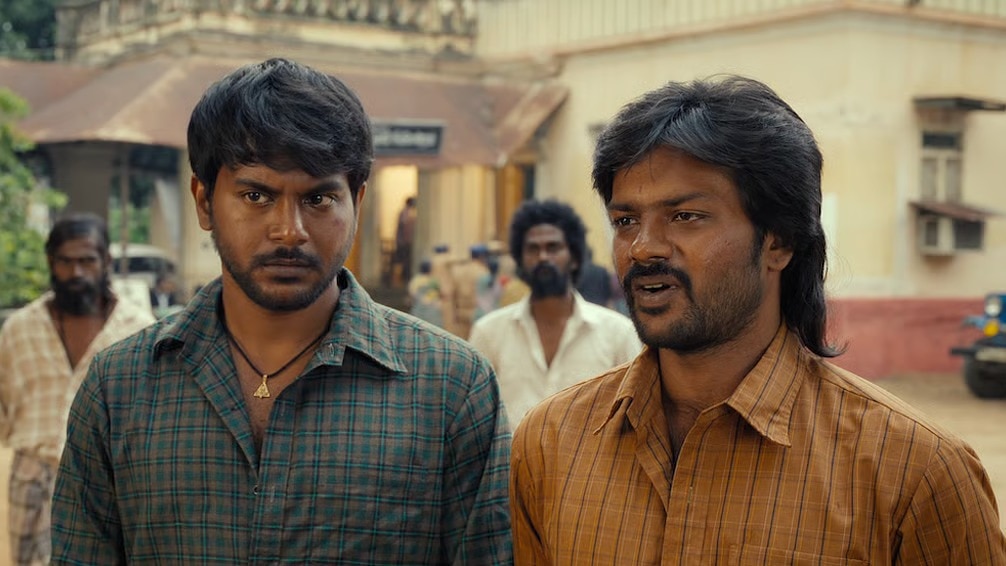
I did not walk into Dorothy with any of this on my mind. It came back to me in the dark, somewhere in the first half of Karthik Subbaraj's TIFF 2026 selection, when the film's two lead characters, Karthi (Rishikanth) and Subbu (Sananth), began repeating the old phrases: Pottachi maari azhuvatha (Don't cry like a woman), and don't lose yourself over a pottachi (woman, used as a slur).
I squirmed like a man watching a recording of myself. The film does not editorialise. It lets the boys talk, lets the village, set in the 1990s, live by that talk, and trusts you to do the remembering.
A major spoiler warning before we get into this: Dorothy has a few surprises tucked beneath its violence, tenderness and chaos. If you haven't watched it yet, this is your last chance to leave before we give away the very things that make the film what it is.
The first half plays close to horror, and it is the horror of the ordinary.
Subbu, the son of an upper-caste moneylender, and Karthi, whose widowed mother sells paniyaram (ball-shaped rice dumplings), become inseparable after Subbu, a Bruce Lee devotee, thrashes the seniors who bully Karthi. When the villagers gather around their great well to stare at an old woman's body, Karthi shudders. Subbu, barely in Class V, tells him not to bother: it is only a corpse; he has watched many women float up in that well, and his own mother and sister were among them. The film gives him no music to cry to, and the child does not cry either.
He then takes Karthi home and invites him to judge the family for himself, which is the cruellest sort of hospitality.
Subbu’s father, Whistle Veeraiya, played by K Muthukumar with frightening ease, asks Karthi's caste before anything else and sends him outside to eat. He paws a woman who has come to borrow money for her hospitalised son, and she cannot fight back. The grown brothers wave sickles at each other over lunch. Subbu's house felt to me like a gents' toilet, built by men for men, where anything soft would be treated as an intruder.
The tenderest scene in the film is placed directly against that house. Karthi's mother tells motherless Subbu not to worry, feeds him, and he breaks down in her lap. It is the first time he looks like the child he is. A boy needed nothing more than that lap, and a village had spent years making sure he never asked for it.
Then Dorothy, played beautifully by Keerthy Suresh, is brought home from Kerala by one of the brothers, and a house with no room for women suddenly has one. Subbu is drawn to her at once. He chats with her, helps with the chores, stands beside her in the kitchen making puttu (steamed rice and coconut cake), and the film allows him a few months of ease. Whistle Veeraiya is plainly unhappy about it and keeps yelling at Subbu for spending his days with her. Sananth as Subbu and Keerthy Suresh as Dorothy in director Karthik Subbaraj's Dorothy. (Photo credit: Movie still)
The ease does not last. One day, Karthi and Subbu race home to find the police outside and Dorothy hanging from the post at the centre of the house. I could not take my eyes off her, but I also wanted to look away. This was the woman who had brought tenderness into that house, now hanging dead in the middle of it.
The village is asked to believe it was suicide. Subbu, who has seen this before, does not. He goes to his father and brothers and looks over their arms and faces for wounds. He finds scratch marks. Dorothy had fought for her life before they hanged her.
Sananth plays the realisation with a grief that is almost unbearable. Subbu screams, breaks down and confronts his father and brothers, seemingly the only person in that house mourning Dorothy at all. Karthi has to pull him away. I cannot remember many scenes in recent cinema that have haunted me quite like this one.MANHOOD LESSONS
What follows shows how thoroughly that household has trained Subbu too. He sobs for days, then, while drinking, lashes out at a transgender woman who approaches him. Karthi is almost relieved to see his friend fight again, as if violence means Subbu is finding his manhood. What makes the scene harder to forget is that Subbu will soon sit at a bus stand himself, treated by strangers much the same way he has just treated her.
Then comes the hug. Subbu embraces a schoolmate who has been married off against her wishes and breaks down in her arms. Her father spots them, but cannot see Subbu's face. The girl is beaten after Subbu flees. He could have left it there. Instead, he returns and tells her father that he is her childhood friend, that the hug meant nothing more than affection between two friends.
The father doesn't believe him. He cannot imagine a man and a woman simply being friends, something so ordinary in the world outside that house. To him, there has to be something else.
Subbu apologises anyway. The man reaches for a sickle. Karthi steps in and kills him.
Karthi is almost irritated that Subbu apologised at all. It is the same lesson Subbu once taught him in the schoolyard: don't cry, don't back down, don't be a pottachi. Now Subbu is the one breaking every rule of the masculinity he helped teach Karthi.
Perhaps she has simply reached the point where she cannot keep pretending to be the person the house, the village and even Karthi want her to be. She locks herself in a room.
Veeraiya fears the worst. Subbaraj sets us up for the familiar image of a parent breaking open a locked room to find a hanging child. The door opens. Subbu is alive, in a saree, having just applied make-up. For the first time, the family sees her as she sees herself. But Veeraiya sees only shame. He worries about what the village will say and orders his sons to kill her for the sake of the family's honour. Yes, honour!
Karthi, now driving trucks, is chosen to do it, with Veeraiya holding both a murder and Karthi's widowed mother over his head.
Subbu, meanwhile, has to discover what the outside world makes of her. At a bus stand, a restaurant owner drives her away for asking for food. Moments later, a man with his wife and child asks her to bless his son before an exam and gives her enough money to eat. Subbaraj puts the two encounters almost next to each other and lets the contrast speak.
Later, in a dark underpass, Subbu meets Karthi's mother. She tells her she could have come and confided in her.
There were people ready to love Subbu. Nobody in that household, in that village, had made it safe for her to reach them.
Somewhere along the way, Dorothy stopped being a thriller for me. Karthi is supposed to kill Subbu, but every time he gets close, something in him refuses to go through with it. A scorpion, a hospital bed, and the film keeps interrupting the assignment, almost as if it is running out the clock on an ending we already know Karthi cannot bring himself to deliver.
It is a clever reversal of the opening: we begin with Karthi claiming he has killed her, and then spend the rest of the film watching everything that makes that increasingly impossible.
A hilltop is where Karthi finally has nowhere left to hide. They eat parotta, something the two have always shared since school days, and Subbu asks him to sit, look at the trees and let the noise around him disappear. Then Karthi tells her why he has come. He has been sent to kill her. A part of him still thinks he should. He still cannot understand what has happened to the person he knew.
And there is something deeply sad about that disgust when you remember where Karthi learnt it. Subbu was the one who taught him, as a boy, what it meant to be a man. Fight. Protect. Don't cry. Don't be a pottachi. Now Subbu has become the person Karthi has been taught to look down on, and he has to unlearn a lesson that his closest friend taught him in the first place.
Subbu tells him she had felt this way since school. She had simply been too afraid to tell the one person she could not afford to lose. Dorothy was the first person she trusted with it. When she tells Karthi that transgender people are a test of whether a society that claims to believe in humanity can actually practise it, I found myself thinking less about the speech than about the life she had just described. There had been people who could have loved her. There had been people she wanted to tell. What there hadn't been was enough safety to say it.
But the film's boldest move comes after acceptance.
Karthi tells a friend that he is in love with the person Subbu is now. He asks if that is wrong. He is told to listen to his heart, not his head. Then he puts on his best shirt, checks himself in the mirror and goes to meet her.
I immediately thought of Rajinikanth getting ready to meet Simran in Petta, in Ilamai Thirumbudhe. Rishikanth's resemblance to Rajinikanth makes the echo even harder to miss. It is the same little grammar of romance, a man getting dressed up because he is going to meet the person he loves. We understand that image instinctively. We have seen it a thousand times. We have cheered for it. So why does the emotion suddenly become difficult to accept when the person waiting at the other end is Subbu?
And then, the final shot. Karthi kisses Subbu on another hilltop, with Ilaiyaraaja's timeless How to Name It? playing. It is the cherry on top. After everything these two have been through — the friendship, the fear, the gun, the saree — the film ends with something so simple. A man kissing the person he loves.
Some felt the film should have stopped when Karthi lowered the gun and let Subbu keep the saree. I couldn't disagree more. Stopping there would have made Karthi's change of heart an act of charity, a man choosing to spare someone he cares about. The kiss makes it desire. It allows Subbu to be loved with the same tenderness, awkwardness and romance we instinctively extend to any other love story. Why should she be allowed acceptance, but not desire? The kiss is not a step too far. It is the ending Dorothy needed.GOD'S PLAYLIST
Muthumani was already a chartbuster before the film released, and I liked it when I first heard it. But after watching Dorothy, I heard it differently. It is sung to Subbu at the moment she is finally seen and recognised as the woman she has always known herself to be.
“Mannil ulla thaaykaagellam oru magalaaga piranthavale”, the daughter born to all mothers in the world. And then, almost as if answering that, Ilaiyaraaja sings what feels like Karthi's heart: “Vannakiliye unnai kaanaatha naal ingu naal illaye”, my day is incomplete if I cannot see you, and “Aruge iruntha pothu naanum vegu thoorathile”, when you were near, I was far away.
What a beautiful way to place a song. And what makes it even more affecting is that this is Ilaiyaraaja, the man Tamil audiences have called the God of music for decades, giving voice to this moment. I know it is probably too metaphorical, but I could not stop thinking about it. If we have made a God out of Ilaiyaraaja, and this is the music he chose to give this scene, then perhaps God really does not discriminate. We do.
Around all of this sits a film that knows how to entertain. Subbaraj keeps the commercial touches coming — the wedding reveal, the goat that headbutts the man who uncovers the Veeraiya family's secret and leaves him with a bloodied face, the humour, the violence, the sheer absurdity of it all.
Dorothy describes a world that hates tenderness and punishes people for following their hearts, which is exactly why it works. It is so entirely its own thing that it pushes the boundaries of Tamil filmmaking and, more interestingly, of how we watch Tamil cinema.
I kept thinking about that word I threw around so casually as a kid. Potta means woman. I wish I had watched a film like Dorothy when I was in school. Maybe I would have thought twice before using it as a slur. Maybe I would have understood much earlier that there was nothing insulting about being called a woman.
The views expressed in this piece are those of the author.- EndsALSO READ | If a man kissing a trans woman disturbs you, Dorothy is exactly the film you need