
Donald Trump’s ‘Donroe Doctrine’ Faces Biggest Test Yet in Brazil - Newsweek
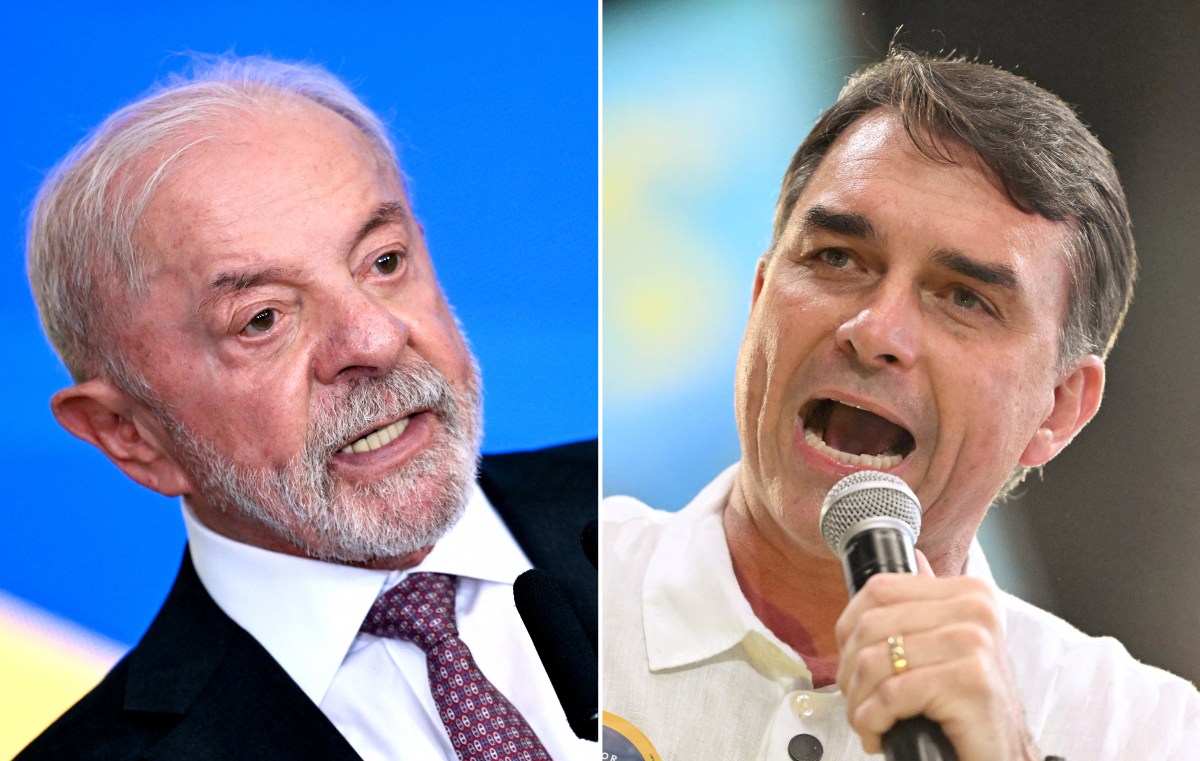
Brazilians head to the polls Sunday in an election that has turned into the most consequential test yet of President Donald Trump's push to remake Latin America in his image.
President Luiz Inácio Lula da Silva, 80, is seeking a fourth term against Senator Flávio Bolsonaro, the eldest son of former President Jair Bolsonaro, a Trump ally serving a 27-year prison sentence for plotting a coup after his 2022 defeat.
Polls show Lula ahead in the first round and the two men statistically tied in a likely October 25 runoff.
The stakes stretch well beyond Brasília. Over the past year, the Trump administration has hit Brazil with tariffs, sanctioned a Supreme Court justice, designated the country's two largest gangs as terrorist organizations and revoked the visa of Brazil's ambassador in Washington. A Bolsonaro victory would hand Trump the largest prize yet in a region where right-leaning allies have been winning one election after another.
"Brazil's election is hugely consequential for Trump's Latin America strategy," Benjamin Gedan, a Latin America expert at Johns Hopkins University, told Newsweek. "Trump likes to brag that his endorsement helped elect the president of Honduras, population 11 million. Brazil, population 214 million, is the real prize."
The administration's approach, which many have dubbed the "Donroe Doctrine" in a nod to the 19th-century Monroe Doctrine, treats the Western Hemisphere as a U.S. sphere of influence. Its priorities include fighting cartels, curbing migration, securing critical minerals and pushing back on China's economic footprint in the region.
Few foreign political families orbit Trump as closely as the Bolsonaros. Jair Bolsonaro, once called the "Trump of the Tropics," modeled his rise on Trump's bravado, questioned Brazil's electronic voting system and refused to clearly concede in 2022. Days after Lula's inauguration, his supporters stormed Brazil's Congress, Supreme Court and presidential palace in scenes that drew comparisons to the January 6, 2021, riot at the U.S. Capitol.
When Brazil's Supreme Court moved to try the former president, Washington stepped in. In July 2025, Trump ordered 50 percent tariffs on Brazilian goods, citing what he called a witch hunt against Bolsonaro, and the Treasury Department sanctioned Justice Alexandre de Moraes, who oversaw the case.
"I want to emphasize this, this is really unprecedented, that a U.S. government would sanction an independent Supreme Court justice in a democracy for trying someone who attempted a coup," Christopher Sabatini, a senior fellow for Latin America at Chatham House, told Newsweek. "I don't think we can emphasize that enough."
Bolsonaro was convicted that September.
His third son, Eduardo Bolsonaro, relocated to the United States and lobbied the administration for those measures. Flávio, tapped by his jailed father as the movement's standard-bearer in December, has made his own pilgrimages, including a CPAC appearance in Texas where he pitched Brazil's mineral wealth to the American right.
In May, the State Department designated the Primeiro Comando da Capital (PCC) and Comando Vermelho (CV), Brazil's two most powerful criminal organizations, as foreign terrorist groups, a step the Bolsonaro camp had lobbied Washington to take. In July, the administration imposed a 25 percent tariff on most Brazilian imports after a Section 301 trade investigation.
Brazil, for its part, denied visas that month to two senior State Department officials who planned to discuss "election integrity" in Brasília, with Lula accusing them of trying to meddle in the vote. Washington responded in August by revoking the visa of Brazil's ambassador, Maria Luiza Ribeiro Viotti.
The timing of each step lined up closely with the Bolsonaro family's legal and political calendar. The 2025 tariffs and the sanctions on Moraes landed while the former president stood trial. The gang designations followed Flávio's CPAC speech by about two months, and the visa fight broke out just weeks before the official campaign began in mid-August.
Lula's government has also pointed out that the United States runs a trade surplus with Brazil in rejecting Washington's complaints about unfair trade.
Brazil's vote caps a cycle in which Trump-aligned candidates have gained ground across the region. Argentina's Javier Milei, El Salvador's Nayib Bukele, Ecuador's Daniel Noboa, Paraguay's Santiago Peña, Chile's José Antonio Kast and Colombia's Abelardo de la Espriella, who won a June runoff with Trump's endorsement, have all embraced Washington's agenda, and Trump has openly claimed credit for some of their wins.
"That part of our hemisphere is really turning out to be very much different than it was. They've gone from being left to going right. They're all going right," Trump told reporters during a White House event on September 2.
The centerpiece of that alliance is the Shield of the Americas, a security coalition Trump launched in March in Doral, Florida, to coordinate intelligence and military operations against cartels. Brazil, Mexico and Colombia were absent from the summit. Colombia has since joined, signing on when de la Espriella took office in August after years of friction between Washington and his leftist predecessor, Gustavo Petro.
With Colombia on board, Brazil and Mexico, Latin America's two largest economies, are the most conspicuous absences from Trump's flagship coalition. Both are led by leftist presidents who have clashed with the White House over tariffs and sovereignty. Last month, Trump urged Shield members to formally designate 24 criminal organizations as shared terrorist threats, a list that includes Brazil's PCC and CV even though Brazil itself is not part of the group.
"Trump is unwilling, or perhaps simply incapable, of getting along with progressive leaders in the region," Gedan said. That leaves a hole in the strategy, he argued, when the presidents of the region's two biggest countries "are not in the MAGA fan club."
Whether Washington's heavy hand has helped or hurt Bolsonaro is one of the race's central questions, and the polling record points mostly in one direction.
Lula's standing improved after Trump's 50 percent tariffs in 2025, as the president cast the fight as a defense of Brazilian sovereignty and refused to negotiate over the Bolsonaro case. Trump later rolled back tariffs on many Brazilian food products amid rising grocery prices at home.
The pattern repeated this summer. Datafolha's first poll after the new 25 percent tariff in July showed Lula widening his runoff lead to 48 percent to 43 percent. Flávio, whose brother had lobbied for the 2025 measures, ended up making the case against further tariffs during a trip to Washington. The race tightened only later, once the campaign shifted to crime, the economy and a federal investigation into Lula's eldest son.
"Trump's tariffs, sanctions and terror designations have been a political and electoral gift to Lula," Michael Shifter, a senior fellow at the Inter-American Dialogue, told Newsweek. "U.S. interventionism activates Brazilian national sentiments and has given Lula the sovereignty issue that has some traction even beyond his constituency on the left."
Patricio Navia, a clinical professor of liberal studies at New York University, sees a smaller effect. The tariffs have weighed on Brazil's economy, which cuts against the incumbent, he noted, while Lula has spent the campaign reminding voters of Flávio's ties to Trump.
"The net impact of Trump policies is probably not going to matter that much," Navia told Newsweek.
A Bolsonaro presidency would move Brazil much closer to Washington, though China would set the outer limit. China is Brazil's largest trading partner and the top buyer of its soybeans, iron ore and oil, and the country's powerful agribusiness and mining sectors depend on that demand. None of the analysts who spoke with Newsweek expected Flávio to cut Brazil loose from Beijing.
"Like his dad, the 'Trump of the Tropics,' Flávio would bend over backwards to demonstrate his loyalty to Trump and to Trump's global far-right alliance, including on culture-war issues," Gedan said. "But he knows where his bread is buttered."
A Flávio government could deliver on minerals and trade. He has floated a free trade agreement with the United States and told the CPAC crowd in March that Brazil could help end American dependence on China for rare earths, an offer that could become his main bargaining chip for tariff relief.
Ted Piccone, a nonresident senior fellow at the Brookings Institution, told Newsweek that Flávio would pursue deals with the administration wherever he could, "short of crossing red lines with his 'beef, Bible, bullets' coalition." He also flagged the Amazon, warning that a Bolsonaro government could roll back Lula's anti-deforestation efforts "in favor of Trump's push for cheaper beef imports and higher production of fossil fuels."
The sharpest break would likely come on security. Flávio has promised a harder line on crime, and analysts expect his government would edge toward the approaches of Bukele in El Salvador and Noboa in Ecuador. The U.S. terrorist designations of the PCC and CV give Washington a legal framework for deeper involvement. Brazil's Foreign Ministry warned lawmakers in July that the designations could expose the country to unilateral U.S. military action.
Security is the one area, Shifter said, where "Washington's alignment with Bolsonaro could produce a radical shift in policy."
A Flávio government "would quite definitely join the Shield of the Americas," Sabatini said, opening the door to U.S. cooperation with Brazil's armed forces against organized crime. "This is a country that until 1985 had a military government."
A fourth Lula term would leave Brazil as the most prominent holdout against the administration's regional realignment.
"A Lula victory would not represent the US 'losing Brazil', but it would compromise any attempt to build a hemispheric bloc of like-minded governments," Gustavo Flores-Macías, dean of the University of Maryland's School of Public Policy, told Newsweek.
Lula's foreign policy rests on keeping ties with Washington, Beijing, Europe and the Global South at once, he said, and another term would make it harder for the U.S. to contain Chinese influence in the hemisphere.
Piccone said Lula, together with Mexican President Claudia Sheinbaum, would lead regional efforts "to forestall or mitigate the most dangerous elements of Trump's Donroe Doctrine." Still, he cautioned that "the ongoing consolidation of right-wing governments favorable to Trump will allow him to exert considerable influence in the region, more than we have seen in decades."
The relationship would start from a low point. Washington has no confirmed ambassador in Brasília, with Brazil withholding approval of Trump's nominee, Daniel Perez, and Brazil's envoy in Washington has been serving without a valid U.S. visa since August. Brazil's Congress, elected the same day as the president, could also limit Lula's room to maneuver if the opposition gains ground.
Shared interests give both sides reasons to keep talking anyway. The United States runs a trade surplus with Brazil, and Washington wants access to Brazil's deposits of rare earths, graphite, nickel and niobium as it tries to reduce its reliance on Chinese supply chains.
If no candidate wins a majority Sunday, the race moves to an October 25 runoff, and the three weeks in between will test whether the White House stays on the sidelines. Trump, who endorsed candidates in Honduras and Colombia, has been notably quiet about Brazil's race so far.
"Trump's going to go hard," Sabatini said of a possible runoff. "He really, for various reasons, wants to complete a sweep of the hemisphere, if you will, of all the Trumpista candidates."
The first test may come on election night. Sabatini warned that the Bolsonaro camp has borrowed heavily from Trump's playbook on contested results, and said it will be worth watching how it responds if Flávio loses.
"Question the electoral process," he said, describing that playbook. "If you don't win, question it early and a lot, and if you don't win, well, then you mobilize your followers."
Contact Newsweek editors on this story: Jason Lemon and Sam Wilson.


