
Donald Trump Has a McApproval Problem - Newsweek
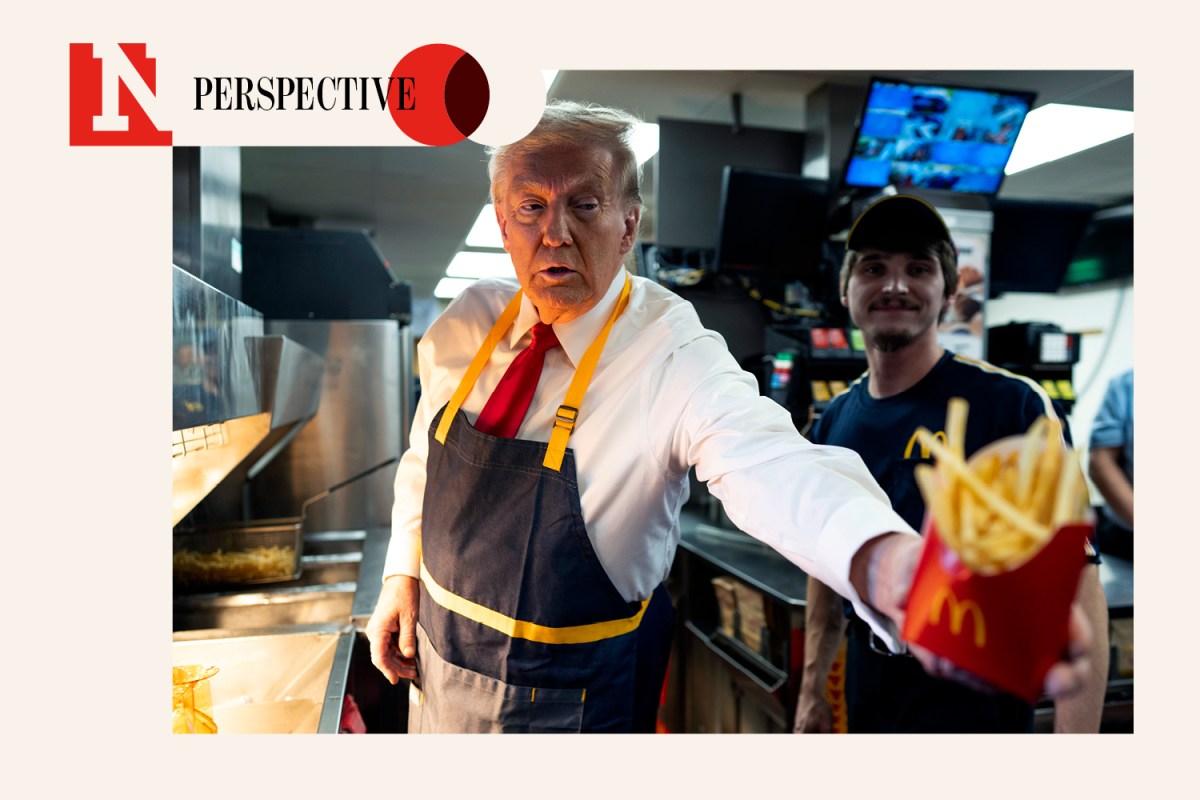
Whether Ronald is lovin’ it or not, President Donald Trump has become associated with McDonald’s, and not just because they share a name. Trump loves McDonald’s as a brand, as a beacon of American success, and as a meal.
Trump even took to the fryer and the drive-thru window for a 2024 campaign stunt, tossing fries to serve a carefully vetted flow of hungry McDonald’s customers. When promoting his "no tax on tips" policy, Trump’s DoorDash order was, naturally, a McDonald’s.
And when the Clemson Tigers came to the White House in 2019 to celebrate their national college football championship win, Trump laid on a veritable McFeast for them all; literally, a huge McDonald’s order spread across a table, among other fast food chains.
Two numbers have defined the second term for both: what McDonald's is worth, and what America thinks of the president. Today, the pair has arrived at a similar place by different routes, though politics is the thread that links them.
McDonald's closed at $248.24 on Friday, September 18, down 14 percent from the $288.70 its shares fetched at the end of January last year.
Over the same 20 months, Trump's approval rating, on Silver Bulletin's polling average, has fallen from 49.9 percent to 38.4—a drop of 11.5 points. But they did not fall neatly together.
First, a little technical throat clearing. Both lines in our chart above are drawn in standard units—each series measured as its distance from its own average across the period—to enable a poll number and a share price to share an axis. The chart wouldn’t be viable otherwise.
Read that way, the two numbers spent 2025 moving independently. Approval fell steeply from its inauguration high while McDonald's climbed, and, across that year, the two correlate at −0.32, so not at all.
Then, from January 2026, they descend together, and for those nine months, the correlation is 0.90. That appears to be more convincing evidence of a relationship between the two.
But two series both sloping downward across the same stretch will correlate at roughly that level whether or not anything connects them, so we shouldn’t read too much into it.
And the test that strips the shared trend out is whether their month-to-month movements align, and they don’t. On monthly changes, the relationship vanishes in every window.
So, what the chart shows isn’t one line predicting the other. McDonald’s performance does not predict Trump’s approval, or vice versa.
Because the two lines on the chart have no statistical relationship, the obvious takeaway is that they have nothing to do with each other. Really, it’s just two clowns of differing types having a rough time; coincidence, not correlation.
But the truth is more interesting. These are two readings of the same bigger picture squeeze, which is why their stories are connected, largely caused by the actions of one of them. You can guess which.
We should begin with what has happened to McDonald's customers during that period.
The war with Iran initiated by Trump has pushed crude above $100 a barrel and the national average for gasoline past $4 a gallon, hitting Americans right in the pocket. Diesel, partly affected also by Russia-Ukraine, is well north of $6.
The Trump administration's tariffs, rebuilt after courts struck down earlier versions, also took effect in July on goods from more than 80 countries, raising costs. The Budget Lab at Yale put the cost to the average household at roughly $1,100 a year.
Moody's chief economist Mark Zandi has estimated the war alone is costing households more than $1,200. The reality is that import tariffs are a tax paid for by domestic consumers, be they consumers or businesses. It may protect American producers. But it comes at a cost.
Both Iran and tariffs are policy choices made by Trump. And both land hardest in the U.S. on the people who drive to work and count what they spend on lunch.
McDonald's has openly said so. Chief executive Chris Kempczinski told analysts in May that elevated gas prices and inflation were the "core issue" at that time, and traffic from lower-income customers was still falling.
By the second quarter, U.S. comparable sales had slowed to 0.8 percent growth. The chain that sells to the squeezed consumer was itself being squeezed.
Beyond sales, the financial squeeze arrives on the other side of the McDonald’s counter, too.
Ground beef has climbed every month since May, to $6.92 a pound in August, with the national herd at its smallest since the 1950s. Trump is increasing imports to address this.
Meanwhile, ranchers are also paying more for diesel and fertilizer because of the war, and nearly 60 percent of farmers told the Farm Bureau in April that their finances were worsening.
McDonald's cannot price its way out because the customers who would be forced to absorb an increase are the ones who have already stopped coming as often as they once did.
So the president's policies flow downhill into McDonald's revenue, and you can see how that is weighing down the fast food giant’s stock price. But why has Trump's approval rating flatlined rather than sunk even deeper?
Because Trump’s approval rating has largely stopped responding to anything. He has probably found his floor.
Look at who moved in the polling. In the inauguration-week Gallup poll, Republicans approved of Trump by 91 percent, independents by 46, Democrats by six. In the most recent Ipsos survey, those figures are 82, 25, and five.
The Republican number has given up nine points across 20 months. Independents have collapsed by 21 as Trump pursued contentious policies like the Iran war, tariffs, and mass deportations. Democrats were already at the floor on day one with Trump.
The Presidency Project's own analysis of partisan polarization puts Republican approval at 78 to 79 percent through mid-2026 and concludes a base that solid has let Trump "overwhelm opposition and ignore majority disapproval."
With roughly three in 10 adults identifying as Republican and four in five of them still approving, the topline is held up by arithmetic. It cannot fall much further without the base cracking. For now, Trump’s base has not substantially cracked.
McDonald's also blames itself for a good deal of the sales weakness.
On its August earnings call, management put roughly two-thirds of the quarter's U.S. traffic shortfall down to its own botched value-menu rollout—a "bad trade," the chief executive called it—and replaced the head of its U.S. business.
Still, there’s no escaping Trump’s hand over the McDonald’s fryer. Voters may have ordered something from the Trump value menu. But he’s giving them a different meal than they asked for, then charging them double for it. And that’s his McApproval problem.


_2026_09_21_17_31_01.jpg)