
Democrats To Flip 3 Senate Seats in Major Swing, New Poll Shows - Newsweek
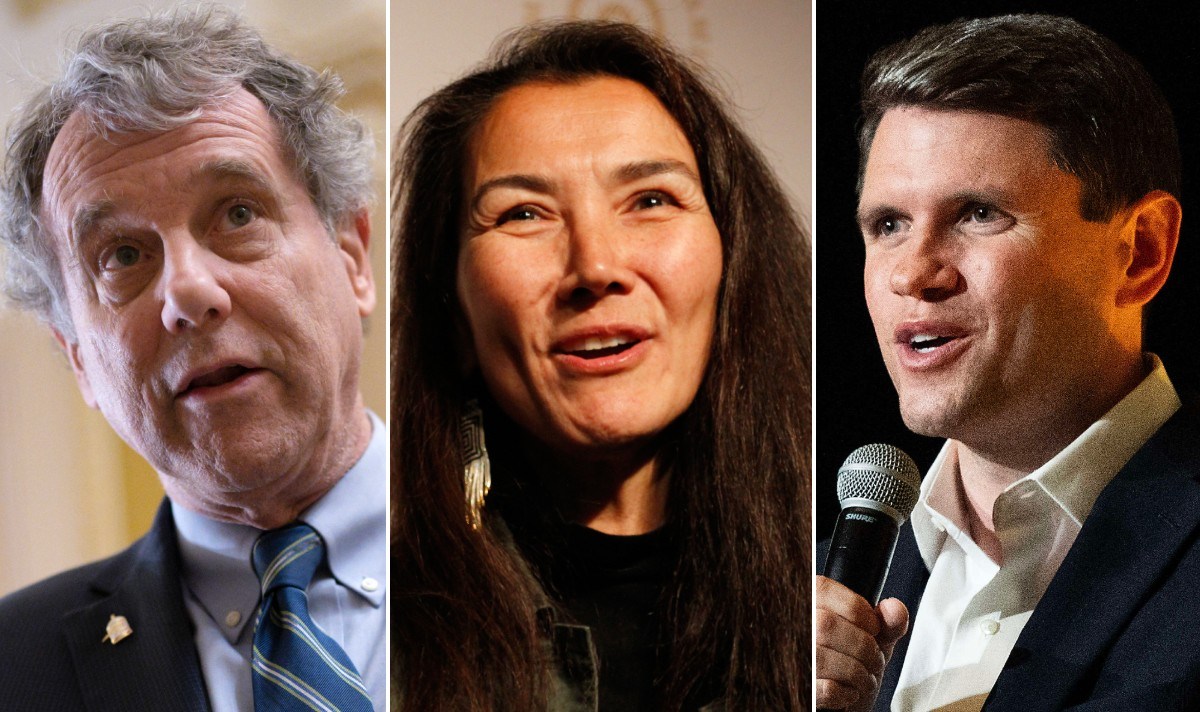
Democrats lead Republican opponents in Alaska, Texas and Ohio, according to New York Times/Siena polling released October 3 across five closely watched Senate contests.
The findings place three GOP-held seats within Democratic reach as voters prepare to determine control of the Senate in November. Mary Peltola, James Talarico and Sherrod Brown would each gain a seat for their party if the results were replicated on Election Day.
Newsweek contacted the Republican and Democratic candidates for every Senate campaign polled via email for further comment.
The emerging map gives Democrats several possible routes through states with sharply different electorates, from heavily urban Texas to sparsely populated Alaska.
Yet two advantages fall inside the polls’ margins of sampling error, making the figures evidence of competitive races rather than certain victories.
Republicans currently hold a 53-47 Senate majority, so Democrats must protect every seat they hold and gain four Republican-held seats for outright control.
That makes contests in Alaska, Iowa, Ohio and Texas potential building blocks of a majority, rather than isolated state races; a 50-50 split would leave Republicans with effective control through Vice President JD Vance’s tie-breaking vote.
Peltola has the largest Democratic lead among the races. She receives 50 percent against Republican Senator Dan Sullivan’s 43 percent in Alaska.
That seven-point gap exceeds the survey’s plus or minus 5.1-point margin of sampling error.
The poll questioned 504 likely voters from September 24 to October 1, using English-language telephone interviews and one completed online response after a text invitation.
Peltola still describes herself through fish camp and family life: she says she grew up catching salmon with her father on the Kuskokwim and later raised seven children while spending summers preparing fish.
Fishing runs through Alaska’s economy and the traditions and daily lives of its Indigenous communities.
Both candidates have therefore sought to make it an important campaign issue in this race.
At a September fisheries debate held by the Kodiak Chamber of Commerce, Peltola said: “I’m the only candidate on this stage who’s an Alaskan fisherman. Fish is in my blood, earned over generations on the water.”
Meanwhile, Sullivan recently joined in one of Alaska’s lighter annual rituals, Fat Bear Week competition, throwing his support behind reigning champion 'Chunk', and writing: “May the fattest bear win!”
Peltola’s position gives Democrats an opening in a state where personality and candidate appeal can matter alongside party identification. For Alaskans, the choice is also familiar: a former Democratic representative against a sitting Republican senator.
Texas produces the most politically significant result, with Talarico reaching 51 percent against Paxton’s 45 percent.
The six-point Democratic advantage comes from 615 likely voters surveyed in English and Spanish between September 21 and 30.
Its margin of sampling error is plus or minus 4.5 points, putting the measured lead narrowly beyond that range. Crossing 50 percent matters because Talarico’s support is not dependent on a large pool of undecided voters in the reported result.
Paxton, however, remains close enough that differences in turnout or late movement could alter the outcome.
Talarico, a former sixth-grade teacher and Presbyterian seminarian, recently launched a Teachers for Talarico group with an endorsement video from Bill Nye.
He describes his time teaching in a low-income San Antonio neighborhood as central to why he entered politics.
Paxton presents himself as the son of an Air Force veteran who built his own law firm and is now a father of four and grandfather of five.
In a privately recorded fundraiser remark first reported by The New York Times earlier this week, he showed a more candid side, saying Republican numbers after the party convention were “not good,” though his adviser disputed the framing of the recording.
Brown’s Ohio campaign presents a different story: a former senator seeking a return to Washington against Republican Jon Husted.
Brown records 49 percent to Husted’s 46 percent among 616 likely voters contacted from September 22 to October 1.
That three-point edge sits inside the poll’s plus or minus 4.5-point margin of sampling error. Ohio should therefore be understood as statistically competitive, not as a confirmed Democratic gain.
Husted’s campaign previously told Newsweek that it did not comment on public polling.
Brown has spent recent weekends holding small events in places including Sandusky, Newark, Westerville, Columbiana and Warren, telling voters that many Ohio families see “more money going out the door than coming in.”
Husted recently joined other Ohio lawmakers in seeking federal aid after tornadoes, flooding and a derecho (wind) damaged communities across the state, urging rapid assistance so affected residents could “begin the process of rebuilding.”
He has also promoted his Ratepayer Protection Act, which would require state regulators to consider rules making large data centers cover the cost of power plants and grid upgrades needed to serve them, rather than shifting those expenses to households and small businesses.
The measure passed the House 417-3 but failed to clear the Senate’s 60-vote threshold on September 30.
Democrats do not control every contest in the five-state group.
Hinson takes 48 percent against Turek’s 47 percent in Iowa.
The survey reached 606 likely voters from September 22 to October 1 and has a margin of sampling error of plus or minus 4.6 points, leaving neither candidate with a statistically conclusive advantage.
Turek brings an unusual résumé to the race as a Paralympic gold-medal-winning wheelchair basketball player.
At a recent fuel-cost roundtable, he said that despite traveling around Iowa, he had yet to meet a voter who wanted “another forever war.”
Hinson, meanwhile, said last week she personally texted House Speaker Mike Johnson to pressure him to bring lawmakers back to Washington to address fuel prices, while calling for an immediate end to the Iran war. “I stand ready to jump on a plane,” she said.
The Iran war has become especially potent in Iowa, where more than a third of residents live in rural communities and farmers depend heavily on diesel.
Record fuel prices have left Hinson trying to reconcile her earlier votes against restricting the conflict with her subsequent call for it to end.
Kansas is even tighter. Hamilton and Marshall each receive 45 percent, while Graham stands at 3 percent.
That poll questioned 605 likely voters from September 22 to 30 and carries a plus or minus 4.6-point margin of sampling error.
A tied race leaves the Libertarian vote, and those not backing a named candidate, particularly relevant to the outcome.
A first-time candidate and prominent United Methodist pastor, Hamilton is pitching himself as a faith-driven moderate capable of assembling an unusual coalition of Democrats, independents and disaffected Republicans.
The incumbent Republican and former obstetrician, Marshall, is seeking a second Senate term by emphasizing his support for farmers and rural Kansas, while navigating voter concerns over fuel costs, immigration enforcement and his alignment with President Donald Trump.
The polls were conducted by cellular and landline telephone, then weighted to account for factors including party, race, age, gender, education, turnout history, region and modeled 2024 presidential preference.
Siena said the samples were drawn from voter-file records and adjusted to reflect the likely 2026 electorate.
The five-state sample carried an overall margin of sampling error of plus or minus 2.1 percentage points.
Newsweek’s reporters and editors used Martyn, our AI assistant, to produce this story. Learn more about Martyn here.
Contact Newsweek editor on this story: Edward Pearcey.
