
Delhi air quality turns very poor as stubble-burning share rises, AQI hits 348
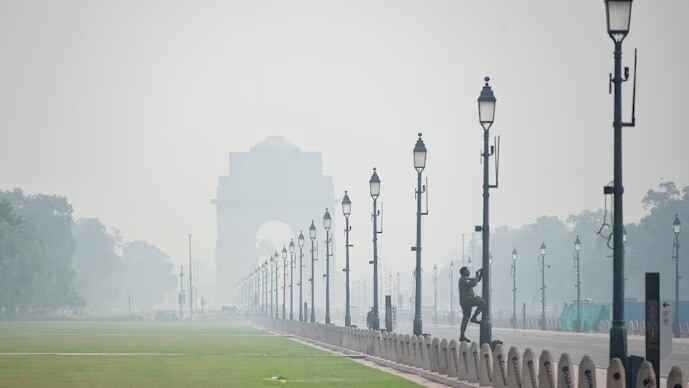
Delhi's air quality worsened on Tuesday, with the Air Quality Index rising to 348 in the 'very poor' category, news agency Press Trust of India reported. Stubble burning is expected to account for an increasing share of the city's PM2.5 pollution over the next three days.
Delhi's AQI rose from 261 on November 1 to 324 on November 2 and 348 on November 3. A forecast by the Decision Support System for air quality management in Delhi, under the Ministry of Earth Sciences, showed that the contribution of stubble burning to the city's PM2.5 concentration was likely to increase from 8.583 per cent on November 2 to 15.301 per cent on November 3.
The contribution is expected to rise further to 20.057 per cent on November 4 and 22.207 per cent on November 5. The forecast for the next three days is based on past data on fire counts and emissions.
The increase comes amid continued detection of farm fires in neighbouring states. Satellites detected 219 paddy residue-burning incidents across the monitored states on November 2, including 98 in Punjab, 67 in Rajasthan, 48 in Madhya Pradesh, four in Uttar Pradesh and two in Haryana.
No residue-burning incidents were detected in Delhi or Uttarakhand that day, according to the Consortium for Research on Agroecosystem Monitoring and Modelling from Space Lab at the ICAR-Indian Agricultural Research Institute, as cited by PTI.
A total of 3,535 farm-fire incidents were detected between September 15 and November 2 this year. Punjab recorded the highest number at 1,612, followed by Rajasthan with 738, Madhya Pradesh with 614, Uttar Pradesh with 349, Uttarakhand with 176, Haryana with 44 and Delhi with two.
However, data from the laboratory showed a significant decline in farm-fire incidents over the years. During the corresponding period in 2020, 51,822 incidents were detected across the states and regions covered by the bulletin.
The number fell to 24,583 in 2021 and stood at 26,490 in 2022, before declining to 18,991 in 2023, 9,668 in 2024 and 4,993 in 2025.
Punjab, which continues to account for the highest number of farm fires this season, recorded 1,612 incidents till November 2, compared with 2,262 during the corresponding period last year and 41,176 in 2020.
Haryana also recorded a sharp decline, with 44 incidents this season, compared with 122 in 2025 and 2,606 in 2020.
The data was compiled using satellite monitoring under the standard method for estimating crop residue-burning incidents. It indicates a sustained decline in detected farm fires compared with previous years, even as such fires continue to contribute to Delhi's particulate pollution during the post-harvest season.
The stubble-burning period runs from September 15 to November 30. Delhi recorded its first farm-fire incident of the season on September 19 and the second on October 24.
While stubble burning is forecast to account for a rising share of Delhi's PM2.5 levels, the city's worsening air quality is affected by several pollution sources. The contribution of farm fires also varies with weather and wind conditions.- Ends


