Decade of discovery by the 'sky eye' from SW China's mountains
By continuing to browse our site you agree to our use of cookies, revised Privacy Policy and Terms of Use. You can change your cookie settings through your browser.
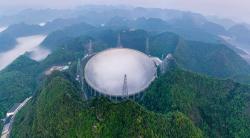
Nestled in a natural karst depression in Pingtang County, southwest China's Guizhou Province, the Five-hundred-meter Aperture Spherical Radio Telescope – known to the world as FAST, or "China Sky Eye" – marks its 10th anniversary in 2026. As large as 30 football pitches and composed of 4,450 reflector panels, it has quietly reshaped humanity's understanding of the universe from its mountain cradle.
The FAST sits in a natural karst depression in Guizhou Province, southwest China.
Before FAST became a global scientific landmark, however, one question demands attention: Why Guizhou?
In many ways, FAST is a masterpiece co-authored by human ambition and natural geology.
The late astronomer Nan Rendong, FAST's founding visionary, spent 12 years searching for the perfect site. Carrying over 300 satellite remote-sensing maps, dressed in work clothes and wielding a bamboo pole as a walking stick, he trekked through nearly a hundred karst depressions across Guizhou. The irreplaceable answer nature provided – a near-perfect spherical karst depression.
Construction documents for FAST alongside the handwritten notes of the late astronomer Nan Rendong.
The natural karst depression minimized large-scale excavation during construction, protecting the surrounding environment while saving an estimated 500 million yuan in costs. Beyond cost, the surrounding mountains form a natural electromagnetic shield, insulating the telescope from the radio noise of modern life. Crucially, karst's exceptional drainage ensures the highly sensitive electronic equipment never sits in standing water. These four advantages – natural shape, electromagnetic quiet, rapid drainage, and geological stability – remain irreplaceable.
The construction of FAST inside a natural karst bowl.
Yet anyone who has followed FAST's journey would know that its significance cannot be reduced to its engineering marvels. Since beginning formal operations in January 2020, FAST has opened its doors to the global scientific community, producing a cascade of breakthrough discoveries in pulsar hunting, gravitational wave detection, and fast radio burst research. In its most recent complete observation year, the telescope logged over 5,400 hours of observation time and generated more than 17.5 petabytes of new scientific data.
The feed cabin – the "pupil" of FAST – suspended above the giant dish, key to capturing signals from the cosmos.
Many observers attribute FAST's prolific output to its unparalleled sensitivity – unsurprising for an instrument often described as the most sensitive radio telescope on Earth. Yet this alone does not fully capture the depth of its contribution.
In January 2026, an international team led by the Purple Mountain Observatory captured, for the first time in history, a sharp spike and subsequent drop in the Faraday rotation measure of a repeating fast radio bursta – finding published in the journal Science that provided the strongest evidence yet that such mysterious cosmic flashes originate from binary star systems. A fast radio burst lasts only milliseconds but releases energy equivalent to the sun's total output over an entire week; understanding their origins has been one of astrophysics' great unsolved puzzles.
Temporal evolution of the Faraday rotation measure of fast radio burst FRB 20220529.
Looking ahead, FAST is not resting on its laurels. A major upgrade plan is now underway: dozens of 40-meter-diameter antennas will be built within a 30-kilometer radius, forming a giant synthesis aperture array with FAST at its core. This transformation – from a single "eye" to a compound one – will overcome the inherent resolution limitations of single-dish telescopes. As FAST chief engineer Jiang Peng puts it, observing the universe with FAST alone is like sketching a celestial body with a thick pencil; the completed array will be more like capturing it with a high-resolution digital camera.
An artist's rendering of the giant integrated aperture array with FAST at its core.
From the United States to the Netherlands, from Australia to Japan, scientists around the world keep turning their eyes toward this giant dish deep in the mountains, not merely to solve an equation of the cosmos, but because one impulse unites us all: the irrepressible human urge to look up and ask if we are truly alone.
From a remote karst depression to the frontier of global astronomy, from solitary giant to the heart of a new array, FAST's story continues to unfold – one observation at a time.
(Wang Yaojun and Tian Yinxing contributed to the story. All photos via UpGuizhou.)