Council of Europe Head Warns ‘We Are Not Well-Prepared’ for War With Russia - Newsweek
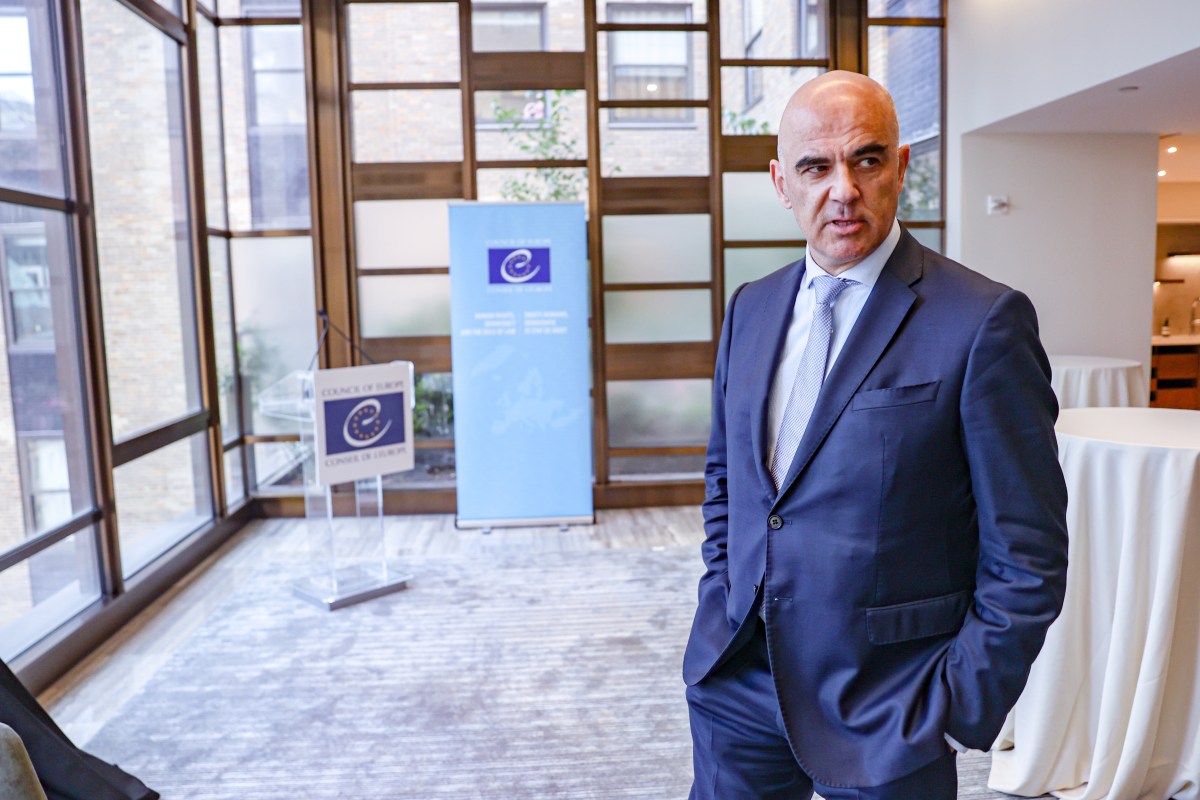
The head of Europe's oldest and largest intergovernmental organization told Newsweek that the continent may not be adequately prepared for the kind of modern, hybrid warfare associated with a potential clash with Russia amid rising tensions.
In an interview on the sidelines of the United Nations General Assembly in New York, Council of Europe Secretary-General Alain Berset said that European countries must "evolve to confront, to face, the challenge of hybrid threats."
At this time, he said, "we are not really well-prepared for this, to be honest."
Berset, a two-time former Swiss president who has served as chief of the 46-member Council of Europe since September 2024, pointed to transformations in the Russia-Ukraine war as an example of how war has changed so drastically in recent years, with tanks and other methods of conventional warfare swapped out for drones capable of carrying out death and destruction at further range, lower cost and far less direct accountability.
And the hybrid threat landscape is not limited to the battlefield at a time when not only drones, but also online interference campaigns, have increasingly penetrated across Europe, exploiting a wave of political upheaval that risks upending the liberal consensus.
"It is evolving quite rapidly, and we need to adapt to this," Berset said. "But I think the main point about hybrid threats is not only the drones and the threats while flying over country and so on. The most important thing in this context I think it is about information and about infrastructure and information manipulation and information interference."
On this front, he acknowledged "some weaknesses, probably in the energy systems, in the security system, in infrastructure in general." And here, too, he felt Europe was still in the process of catching up.
"And I think maybe we are not well-prepared for this," Berset said. "But it is an evolution."
While recognizing the scale of the present challenge, Berset pointed to some clear indications that Europe was on the right track.
"On the very short term, I think we are maybe seeing that there is a gap between what is needed and what we have," Berset said. "But at the same time, if we consider the recent evolutions, let's just say the last two or three years, I mean the institutional evolution is huge.
"The decisions, for example, to become much more independent and strong in armament and defense has been taken and it is evolving and it's a good thing."
Defense spending among the 27 European Union member states—all of which are also in the Council of Europe—is projected to exceed $516 billion this year, a 75 percent increase from just five years ago. The EU's ReArm Europe Plan/Readiness 2030 campaign also aims to pledge up to $800 billion in additional defense spending.
But there is another budget need Berset identifies to secure the values of human rights, democracy and rule of law for which the Council of Europe has striven since its founding in 1949.
"We need the same resolve through the investment for democratic security and democratic values and strong institutions," Berset said.
The task is particularly urgent, Berset argued, as while "we are seeing right now strong investments in armies, different armaments" across Europe, "at the same time we are witnessing a strong backsliding in democratic values and the quality of debates everywhere."
The risk of this trajectory, he warned, could create a situation in the coming years in which "over-armed countries" have "no democratic control" to restrain them, thus satisfying security needs but lacking the kind of institutions that uphold the Council of Europe's long-standing mission.
The solution he provides is to enhance investment in the combined concept of "democratic security."
"It means to have a comprehensive approach where we have democratic institutions in a country able to control what's happening and not having an extremist group winning elections somewhere because of manipulations, or a lot of other reasons, and then taking control of super well-armed armies," Berset said.
Yet, already, political forces seeking to undermine the status quo have gained considerable ground across Europe.
The most notable example of late is the historic showing by the far-right Alternative for Deutschland (AfD) party in northeastern Germany in this month's state elections, bringing the group to the precipice of obtaining a majority that would empower nationalist forces in the country for the first time since World War II.
The phenomenon is far from isolated. Right-wing movements with varying ideological standings but often united through nationalistic and populist tendencies have secured major momentum in other European nations as well, including Austria, France and the Netherlands.
Berset recalls that "this is not the first time that something like this is happening" in Europe, looking back to previous manifestations of disruptive political movements over the past century. In fact, he said such processes were part of the "living body" that constitutes European democracy.
He argued that the strength of that democracy was rooted in its capacity to "absorb shocks," of which the continent—like much of the world—has undergone many in recent years.
"We have huge sequence of crisis, since the financial crisis, rise of inequalities, debt crisis, difficulties for the states to deliver for the citizens, the war in Ukraine and what it meant for Europe in 2014 to have the invasion of Crimea," Berset said. "Then we have the rise of so-called populist parties, then we had the COVID crisis."
Add to that the "acceleration also with social media, communication, AI and with all the consequences and the information," including deepfakes and experts forecasting a 10 percent to 20 percent chance of human extinction, and Berset said it was only natural that citizens may become disillusioned.
"It is for the people, for the citizens, really complicated right now to understand what does this mean exactly and where is the world going," Berset said. "What does it mean for myself from my perspective, for my children?
"When I was young, it was bright. It was quite clear. It was like a highway. Now, it's impossible to predict what will happen in three or five years."
But Berset emphasized that the strategy being pursued by the Council of Europe was "not trying to fix the past," but rather meet modern challenges with a new set of tools that could reinvigorate and reinforce democratic principles without compromising on free-speech tenets.
"It is a balance not easy to find," Berset said. "Because the first reaction when we are not well prepared is to police speech, is to ban parties, is arrest people, and everything is OK, but you are creating the next wave of problems with this."
One factor that separates the current crisis from Europe's previous bouts with internal and external threats since World War II is a shift in the position of the United States.
While President Donald Trump has pushed in favor of European rearmament, he has done so as part of a campaign to shift the burden of security to allies while simultaneously launching frequent salvos of criticism toward the kind of liberal politics he associates with his Democratic rivals at home.
At times, this has manifested in direct endorsements of nationalist movements, such as the AfD, whose first-place results he hailed as a popular reaction to "horrible immigration rules and regulations."
In other instances, Trump has openly questioned U.S. security commitments in Europe, threatening to withdraw from NATO and downplaying fears of a looming Russian escalation despite a growing chorus of warnings being issued by European leaders.
Berset, who recently traveled to Washington to discuss the state of ties with the U.S., an observer on the Council of Europe, acknowledged that, "we have all been surprised by this new way of doing politics," describing his impression of Trump's approach as a means of "maybe making the world a bit unstable, not to create instability, but to create a context where things are moving and it is possible to make some deals."
But he reiterated that the transatlantic relationship remains both crucial and strong, rooted in decades of history, shared goals and a lack of alternatives, with Berset questioning the utility of any pivot toward the likes of China and Russia or their growing BRICS bloc.
"I think that it is an evolution and I think there is no way back and also no necessity to have a way back," Berset said. "The question is, and it is for the U.S. and for Europe and for others, what can we do to create a stable and productive environment?
"Because this instability that we have now, I'm not sure that it is very productive on the long term for the economic development."
That said, Berset also found that the combined weight of Europe's own power today was "quite strongly underestimated." Even with diverging worldviews, political orientations and histories among countries, he saw the reality of 27 EU nations predominantly adhering to one currency and maintaining a shared set of laws as a sign that regional countries had the capacity to act as a united front.
And, with concerns of Russian hostility rising, Berset said it was his hope that European governments could ultimately overcome their differences to address a range of issues, "taking into account the hard realities, geography, energy access, health, education, defense and security and demographics."
"Maybe it's too optimistic," Berset said. "But I think that if we just have a look at the history, optimism was in the very most cases the right option."
Contact Newsweek editors on this story: Tom O'Connor and Dave Siminoff.
/file/dailymaverick/wp-content/uploads/Nicolson-FeesMustFall-reloaded.jpg)