Commentary: China opens door to 100,000 American students. The US must do more to get them there - CNA
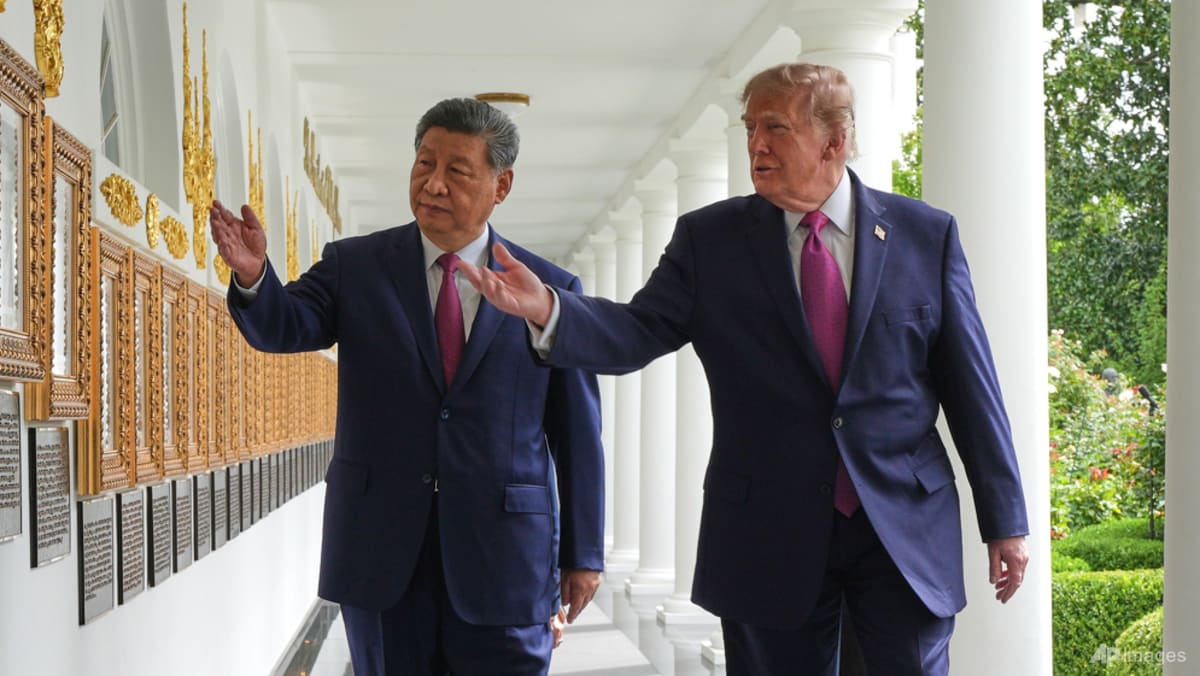
If Americans head to China for educational exchanges, their experience and expertise could benefit more than the US, says Kevin Chen from the S Rajaratnam School of International Studies.
US President Donald Trump and China's President Xi Jinping walk along the Colonnade of the White House, on Sep 24, 2026, in Washington. (Photo: AP/Jacquelyn Martin)
This audio is generated by an AI tool.
Kevin Chen 02 Oct 2026 06:00AM Bookmark Bookmark Share WhatsApp Telegram Facebook Twitter Email LinkedIn Set CNA as your preferred source on Google Add CNA as a trusted source to help Google better understand and surface our content in search results. Read a summary of this article on FAST. Get bite-sized news via a newcards interface. Give it a try. Click here to return to FAST Tap here to return to FAST FAST SINGAPORE: If the United States sees China as its most consequential strategic rival, it needs people who understand how China thinks and works.
So when Chinese President Xi Jinping invited 100,000 American students to study in China over the next five years during the Washington summit with US President Donald Trump last week, the pledge deserved some context.
At its peak around 2012, there were nearly 15,000 Americans studying in China. These numbers declined over the past decade amid the COVID-19 pandemic and political tensions. In 2026, there were fewer than 2,000.
Granted, not all returning students will become China experts. However, a shrinking pool of Americans with firsthand experience of China will weaken the US’ ability to develop, use and retain expertise needed to manage the relationship. Relying on second-hand information raises the risk of miscalculation.
CNA Games Guess Word Crack the word, one row at a time Buzzword Create words using the given letters Mini Sudoku Tiny puzzle, mighty brain teaser Mini Crossword Small grid, big challenge Word Search Spot as many words as you can Show More Show Less KNOWING YOUR RIVALFamiliarity with Mandarin and time spent on the ground can reveal what official statements and second-hand accounts cannot. They can give analysts a “fingertip feel” for how China works.
The story of the first Fulbright academic exchange program scholar, Derk Bodde, showcases the value of firsthand experience. While in Beijing from 1948 to 1949, he wrote about the founding of the People’s Republic of China, providing a rare insight into how Chinese citizens reacted to the change in government.
Compared to assumptions that the revolution was a mere extension of Soviet influence or forced on an unwilling populace, Bodde chronicled the excitement that surrounded the end of Nationalist rule, and how Chinese people both welcomed and critiqued the Communists.
Since then, American scholars who studied in China have worked in government and academia, guiding policy directly or providing expert testimony before Congress such as to inform legislation or assist in oversight processes.
As China continues developing at a rapid pace, it becomes harder to understand from afar. It makes it important for more Americans to not just speak and understand Mandarin, but to also grasp the historical and social context that comes with lived experience of China.
Yet the solution is not as straightforward as announcing that China is ready to welcome American students.
There are two issues at hand: Funding cuts limit opportunities for young Americans to study in China, while employment risks deter them from taking such opportunities.
Previous generations of scholars could count on programmes such as the Fulbright Program, the Boren Awards and the Critical Language Scholarship to support studies in China. Yet, this infrastructure has been hollowed out. The Fulbright Programs in China and Hong Kong were terminated in 2020 due in part to Hong Kong’s new national security law, while other programmes had their funding reduced.
Title VI funding for area studies and language programmes across the US was halted in late 2025, with universities told that these were “not a priority of the [Trump] Administration”. US universities have also ended or scrutinised partnerships with Chinese counterparts due to concerns over links to the Chinese military.
American students are not immune to this atmosphere of suspicion, with some citing political risks as deterring them from studying in China. A US-China Education Trust report noted the “widespread perception” that studying in China would prevent returning students from obtaining security clearance for government work.
Even if these programmes were restored and American students overcame their reservations, it remains unclear how they can contribute to strategic conversations amid cuts at key government research units.
In March 2025, the Pentagon’s Office of Net Assessment (ONA) was ordered to be “disestablished” and rebuilt to align with “the Department’s strategic priorities”. The ONA focused on long-term strategic threats and led studies on China’s military rise.
More recently, the US Air Force’s China Aerospace Studies Institute (CASI) – which published unclassified research on the People’s Liberation Army’s (PLA) air, space and missile forces –reported that funding for its civilian employees was eliminated. Its director said this move would effectively end the institute.
The loss of expertise and specialised research and pathways for young Americans working in China studies undermine the strategic analysis ecosystem that supports American policymaking.
It benefits more than just the US if American students take up Mr Xi’s pledge for more educational exchanges.
When Washington misreads China, Asian countries can end up living with the consequences, ranging from supply chain shocks over key products to all-out conflict. Such miscalculations would also narrow the room for regional governments to manoeuvre and secure their own interests.