CNA Explains: How does haze reach Singapore and what do air quality readings tell us? - CNA
Smoke from fires hundreds of kilometres away can take days to reach Singapore, with wind conditions affecting how it travels and disperses. CNA looks at how air quality is measured, and why what people see and smell may not always correspond with pollution readings.
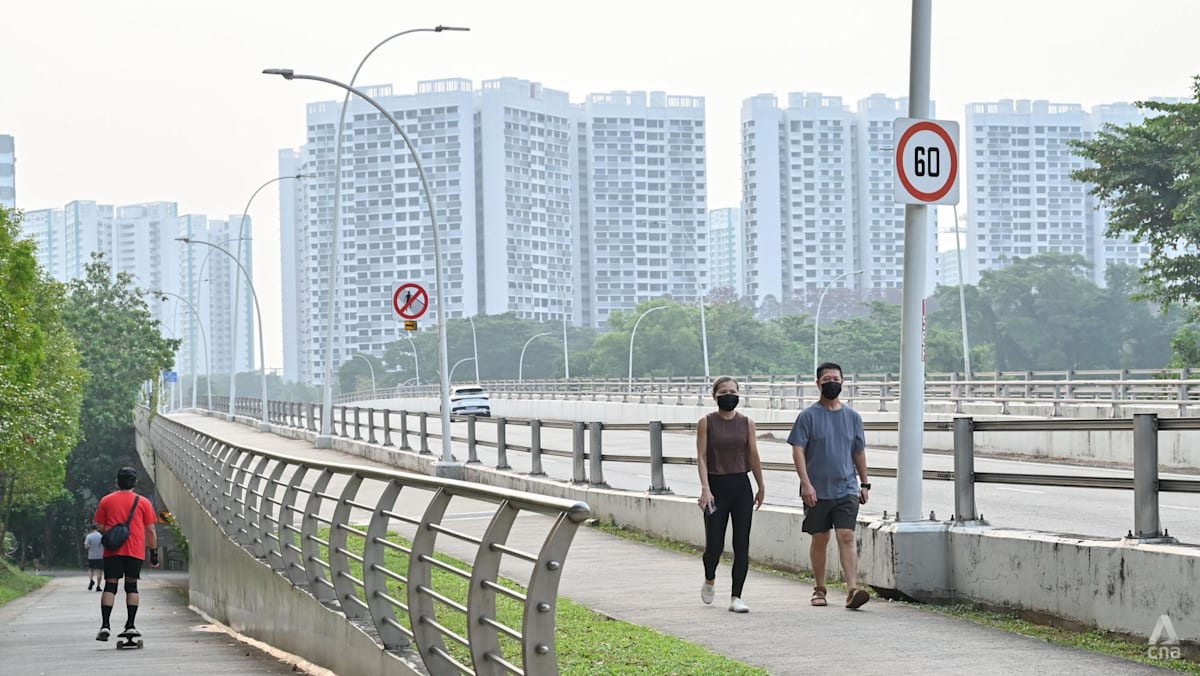
People wearing masks walk along Sengkang East Way, near Sengkang Riverside Park, against a hazy skyline on Sep 19, 2026. (Photo: CNA/Alyssa Tan)
This audio is generated by an AI tool.
Caitlin Ng , Gladys Wee & Marcel Pereira 22 Sep 2026 05:03PM Bookmark Bookmark Share WhatsApp Telegram Facebook Twitter Email LinkedIn Set CNA as your preferred source on Google Add CNA as a trusted source to help Google better understand and surface our content in search results. Read a summary of this article on FAST. Get bite-sized news via a newcards interface. Give it a try. Click here to return to FAST Tap here to return to FAST FAST SINGAPORE: Singapore’s air quality hit new highs last week, with the Pollutant Standards Index (PSI) reaching 154 in the central region.
The hazy conditions have prompted schools and companies to limit the outdoor exposure of students and workers.
But why can one part of Singapore experience worse haze than another? And why can the air sometimes smell smoky even when pollution readings are relatively low?
Prevailing winds can carry airborne particles hundreds of kilometres from their source.
Assistant Professor Wang Jingyu, a climate and environment researcher at Nanyang Technological University’s National Institute of Education, said wind direction affects whether smoke is carried towards Singapore, while wind speed affects how quickly it gets here.
Using southeasterly winds of about 5 metres per second as an example, he said smoke from Central Kalimantan, about 1,000km from Singapore, could take up to three days to arrive.
CNA Games Guess Word Crack the word, one row at a time Buzzword Create words using the given letters Mini Sudoku Tiny puzzle, mighty brain teaser Mini Crossword Small grid, big challenge Word Search Spot as many words as you can Show More Show Less A drone view of a house while smoke rises from a wildfire burning in Palangka Raya, Central Kalimantan province, Indonesia, August 14, 2026. (Photo: REUTERS/Ajeng Dinar Ulfiana) “If the fire location is directly located at the upwind side, and the wind speed is strong, smoke can arrive faster,” he said.
The travel time varies depending on where the smoke originates.
Professor Rajasekhar Balasubramanian from the Department of Civil and Environmental Engineering at the National University of Singapore’s College of Design and Engineering said smoke from Sumatra could take about one to two days to reach Singapore, assuming wind speeds of about 3m to 4m per second.