
China Shock 2.0: Why Europe fears trade crisis could fuel the far right and industrial decline - CNA
China’s growing exports are putting pressure on European manufacturers, but Chinese investment also brings jobs and technology. Experts speak to CNA’s When Titans Clash about some of the thorny questions facing Europe’s leaders.
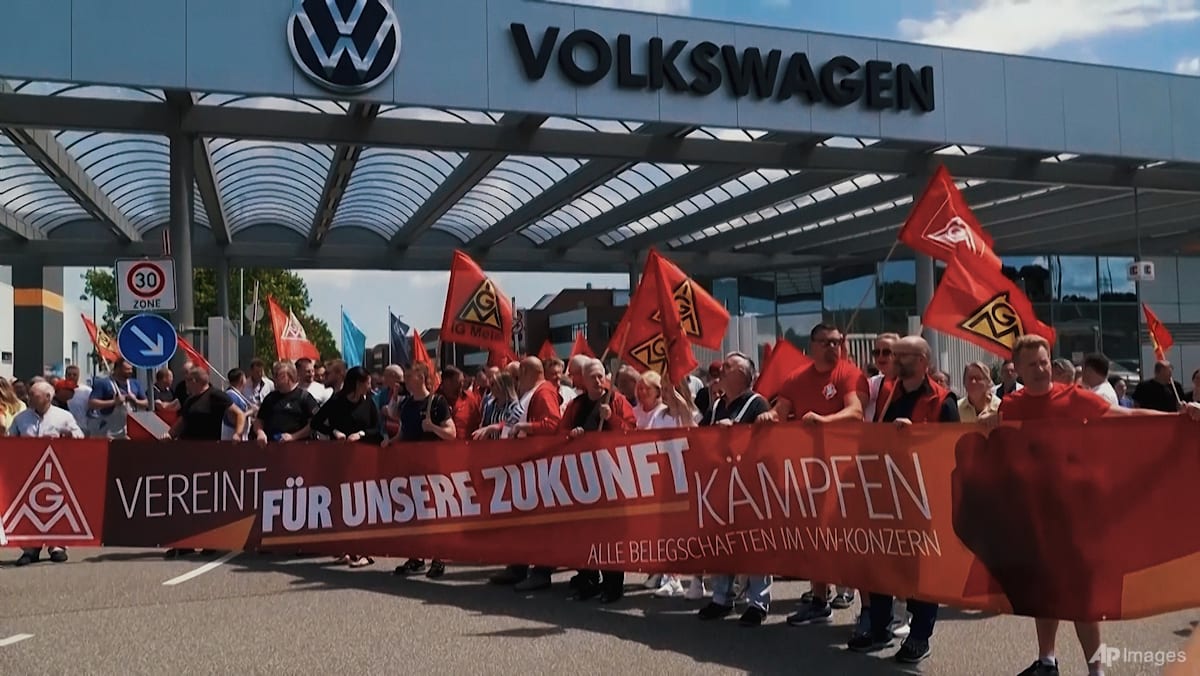
Screenshot of AP video showing a protest outside Volkswagen’s plant in Zwickau, Germany, in July. The company is one of many cutting jobs in Europe’s industrial heartlands amid competition from Chinese manufacturers.
This audio is generated by an AI tool.
Pearl Forss 06 Nov 2026 06:00AM (Updated: 06 Nov 2026 07:59AM) Bookmark Bookmark Share WhatsApp Telegram Facebook Twitter Email LinkedIn Set CNA as your preferred source on Google Add CNA as a trusted source to help Google better understand and surface our content in search results. Read a summary of this article on FAST. Get bite-sized news via a newcards interface. Give it a try. Click here to return to FAST Tap here to return to FAST FAST SINGAPORE: He played a central role in negotiating China’s entry into the World Trade Organization (WTO). Then he became the director general of the global trade body.
Now a trade and economic adviser, Pascal Lamy has sounded a warning note about the political consequences if Europe’s trade deficit with China — at 1 billion euros (US$1.1 billion) a day — continues to widen.
“Look at the speed of the surge of Chinese exports. If you project this (for) five, 10 years from now, this is simply unsustainable,” he tells CNA’s When Titans Clash.
“The EU (European Union) has come to the conclusion that serious measures now have to be taken. Otherwise, we’ll have huge social problems, which will translate into huge political problems, which will make xenophobic political forces in Europe stronger.”
CNA Games Guess Word Crack the word, one row at a time Buzzword Create words using the given letters Mini Sudoku Tiny puzzle, mighty brain teaser Mini Crossword Small grid, big challenge Word Search Spot as many words as you can Show More Show Less Pascal Lamy was the European Commissioner for Trade before he headed the World Trade Organization. Just in September, the Alternative for Germany party won a regional election. The result raises the prospect of Germany’s first far-right state government since World War II. Far-right parties are also making gains in France, Spain and Italy.
In Paris, the protests that have spiralled out of control are symptomatic of a larger problem confronting Europe — a polycrisis with fiscal pressure on governments, soaring energy prices, two wars and industrial decline.
Many European leaders blame part of the industrial decline on a China Shock 2.0. They point to the trade deficit, alongside Germany’s loss of 10,000 to 15,000 manufacturing jobs every month, as evidence of the growing pressure on European industry.
This mix of unemployment, populism and a large trade deficit with China is something the world has seen before in another election.
United States President Donald Trump’s 2016 election campaign alleged that China was causing the US’ economic woes and loss of millions of manufacturing jobs, hollowing out American industry.
Economists and policymakers debate how much Chinese competition is responsible. But politically, the fear of industrial decline is becoming potent. “It plays (out) in some countries or in some regions (in Europe) like it did in the US,” observes Lamy.
“The Chinese should understand that if these extremist forces would come to power, their attitude vis-a-vis China would be much tougher than whoever runs the European system with, let’s say, the traditional centre-left or centre-right parties.”
As Europe and China continue their trade negotiations and approach a critical moment in their economic relationship, When Titans Clash explores some of the thorny questions European leaders face.
WATCH: Europe’s China dilemma — Trade war or economic partnership? (45:28)


