
China-ASEAN at 35: What keeps the partnership moving forward
By continuing to browse our site you agree to our use of cookies, revised Privacy Policy and Terms of Use. You can change your cookie settings through your browser.
Nanning City, in south China's Guangxi Zhuang Autonomous Region, is ready to welcome guests from across China and ASEAN as the 23rd China-ASEAN Expo gets underway on Thursday.
The event comes as China and ASEAN mark the 35th anniversary of their dialogue relations and the fifth anniversary of their comprehensive strategic partnership. Over the past three and a half decades, China and ASEAN have built one of the most dynamic and substantive examples of regional cooperation in the Asia-Pacific.
What has kept the partnership moving forward amid a changing global landscape?
Chinese President Xi Jinping has said that China and ASEAN have "explored a bright path of good-neighborliness and win-win cooperation, taken strides toward building a closer community with a shared future and made important contribution to the cause of human progress."
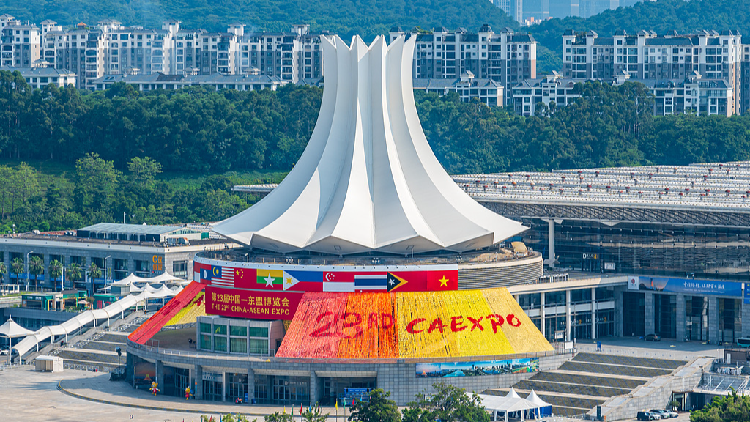
The venue of the 23rd China-ASEAN Expo is seen at the Nanning International Convention and Exhibition Center in Nanning, south China's Guangxi Zhuang Autonomous Region, September 8, 2026. /VCG
The relationship has steadily evolved from dialogue to a comprehensive strategic partnership.
China and ASEAN began their dialogue process in 1991. China became an ASEAN full dialogue partner in 1996, and the two sides established a strategic partnership for peace and prosperity in 2003. In 2021, they announced the establishment of a comprehensive strategic partnership.
Head-of-state diplomacy has played an important role in building mutual understanding. Since 2013, Xi has visited ASEAN member states on multiple occasions, while leaders from across the bloc have also made frequent visits to China.
These interactions have helped strengthen strategic trust and provided political guidance for practical cooperation. In 2025, China and ASEAN adopted the Plan of Action to Implement the ASEAN-China Comprehensive Strategic Partnership for 2026-2030, setting out a roadmap for deeper cooperation in the years ahead.
For China and ASEAN, cooperation is not an abstract concept. It is a shared priority reflected in trade, investment, infrastructure and industrial cooperation.
According to the Chinese Ministry of Commerce, bilateral trade exceeded $1 trillion for the first time in 2025, reaching $1.05 trillion, up 7.4% year on year. China has remained ASEAN's largest trading partner for 17 consecutive years, while ASEAN has been China's largest trading partner for six years.
The momentum has continued into 2026. In the first seven months, bilateral trade reached $744.41 billion, up 24.7% year on year.
Investment and connectivity have also deepened. As of July 2026, two-way investment between China and ASEAN and the cumulative value of contracted projects completed by Chinese companies in ASEAN had each exceeded $515 billion. Major projects have turned closer economic ties into tangible connectivity, from the East Coast Rail Link in Malaysia, which was more than 94% completed, to the Jakarta-Bandung High-Speed Railway in Indonesia, which had carried more than 15 million passenger trips.
In China, the Pinglu Canal in Guangxi, a landmark project linking the Xijiang River system with the Beibu Gulf, officially opened to navigation on Wednesday. The new waterway is set to enhance connectivity between southwest China and ASEAN markets. Xi has attached great importance to the canal's construction, giving important instructions on multiple occasions and calling for it to be built to high standards and with high quality. During an inspection tour of Guangxi in December 2023, Xi was briefed on the construction progress in front of a sand-table model of the canal.
Meanwhile, the China-ASEAN Free Trade Area 3.0 is expanding cooperation into digital and green development, standards and supply chains, while the Regional Comprehensive Economic Partnership (RCEP) continues to support regional economic integration.
A cargo vessel departs for Nanning Port along the Pinglu Canal in Qinzhou City, south China's Guangxi Zhuang Autonomous Region, September 16, 2026. /VCG
Economic interdependence has been accompanied by expanding cooperation on peace and security.
For 35 years, China and ASEAN have promoted dialogue and consultation as ways to build trust and manage differences. Cooperation has developed through ASEAN-led mechanisms, including ASEAN Plus Three, the East Asia Summit, the ASEAN Regional Forum and the ASEAN Defence Ministers' Meeting Plus.
The two sides have also worked together on practical security challenges, from maintaining peace and stability in the South China Sea to combating telecom fraud and online gambling, and from disaster management to emergency response and rescue.
The launching ceremony of ASEAN-China Year of People-to-People Exchanges is held in Fuzhou, southeast China's Fujian Province, on February 2, 2024. /VCG
Ultimately, the durability of China-ASEAN relations depends on connections between people. Over the past 35 years, exchanges in education, tourism, culture, media, youth and other fields have expanded steadily.
The ASEAN-China Year of People-to-People Exchanges 2024-2025 saw more than 160 exchange activities. The ASEAN-China Education Cooperation Week alone facilitated the signing of 2,203 education cooperation agreements, while youth programs, cultural festivals and tourism exchanges brought people from both sides closer.
Travel has also become easier. China has established full mutual visa exemption with Singapore, Thailand and Malaysia, further facilitating people-to-people exchanges.
As President Xi has noted, the gains in China-ASEAN cooperation stem not only from their geographical proximity and cultural affinity, but also from making the right historical choice in keeping with the trend of the times: respecting each other and acting by the basic norms of international relations; cooperating for win-win results and following a path of peaceful development; looking out for each other and honoring the principle of amity, sincerity, mutual benefit and inclusiveness; upholding inclusiveness and mutual learning and jointly contributing to open regionalism.
These principles will continue to guide China and ASEAN toward a closer community with a shared future.

