Carney government tables sweeping bill to overhaul environmental and labour rules - Toronto Star
The federal government tabled new legislation Monday to make sweeping changes to environmental and labour rules, in Prime Minister Mark Carney's latest effort to remove what he sees as barriers to development in pursuit of his pro-growth agenda.
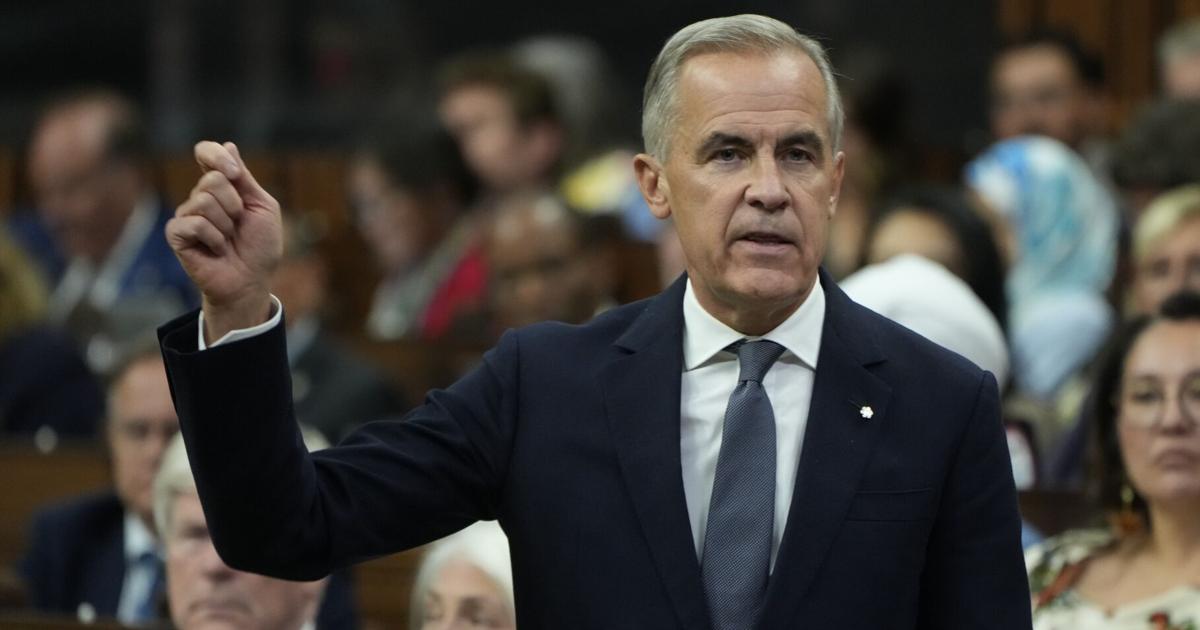
Prime Minister Mark Carney speaks in the House of Commons on Sept. 21, 2026.
OTTAWA — The federal government provoked fierce opposition from some environmental and labour groups on Monday after tabling legislation to make sweeping changes that remove what Prime Minister Mark Carney sees as barriers to development in pursuit of his pro-growth agenda.
Clocking in at more than 230 pages, Bill C-39 would enact many of the controversial changes to environmental and labour rules that the Liberal administration floated earlier this year, and comes as the prime minister promises some of the “most consequential” legislation in decades as his government grapples with the ongoing trade war with the United States and tries to bolster the economy through deeper commerce with other countries.
Government officials and cabinet ministers touted the legislation — which was applauded by at least one major business organization — as a way to create certainty for investments in development projects. They also said the bill will improve the process for collective bargaining after several major labour disruptions in which the Liberal government used a contentious power in the Canada Labour Code to intervene and end a work stoppage.
“This legislation will give our country the tools we need to build more, better, and more efficiently,” Transport Minister Steven MacKinnon said Monday.
Transport Minister Steven MacKinnon says Bill C-39 will fast-track project approvals and cut down on review times. (Sept. 21, 2026)
Environmentalists, however, argued the proposals gut regulations designed to protect nature, while prominent union groups charged the bill is an attack on workers’ constitutional right to strike.
“It attacks everything Canadians hold dear,” said Julia Levin, associate director of national climate at the organization, Environmental Defence.
A major aim of the bill is to codify a faster federal review process of proposed development projects like mines, pipelines, ports and transport infrastructure. Officials who briefed journalists about the legislation said the goal is to ensure a federal government review takes no longer than one year, though the bill does not impose a hard time-limit that can’t be surpassed.
Among the environmental changes are new rules to allow companies to pay offset fees if their projects harm fish habitats and new ministerial powers to weaken conditions-of-approval if the federal cabinet deems it in the “public interest.” The government also wants to allow construction to begin before a project is approved if the government deems it in the public interest, and to create special regions where proposed developments can be streamlined.
It would also create special zones called “regions of national interest” where approvals for projects can be “streamlined” in certain areas, officials said, and follows recent changes that mean cross-border oil pipelines, gas-fired power plants, oilsands facilities and other projects will no longer be subject to the existing federal impact assessment process.
The new law will also create a government body that makes sure individual Indigenous groups are consulted through a single process for each proposed project under review, instead of several processes with various government departments, officials said. Single projects would also no longer need permits from different parts of the government, but will receive a single decision issued by the federal environment minister.
”(Carney) has gone through with everything in this ‘Bulldoze Nature’ bill,” Levin said. “It will really have terrible outcomes for Canadians.”
The new bill is also meant to improve labour rules to add “guardrails” to the use of controversial powers under Section 107 of the Canada Labour Code, which allows the federal cabinet to intervene to stop strikes and lockouts without passing back-to-work legislation through Parliament, officials said.
The federal government has used that section — which the NDP and major labour organizations want to remove — to end work stoppages repeatedly in recent years, including to end an Air Canada flight attendants’ strike in August 2025 and labour disruptions at Canada’s two main railway companies in 2024. Those cases sparked union backlash over concerns the government was violating workers’ right to strike.
Bill C-39 would create a new process so that a special mediator would try to resolve an impasse before a strike or lockout is allowed to proceed. Before invoking Section 107 to end a strike or lockout, the federal labour minister would need to consider the special mediator’s report on the situation, and only proceed to intervene if they conclude doing so is in the “national interest,” the bill says.
Factors involved in that decision would include whether the work stoppage is having a “significant impact” on the Canadian economy, whether it is causing “serious social disruption,” and — according to government officials including the labour minister — whether it would impact the right to strike.
Ottawa also wants to create new regulations to force the start of collective bargaining sooner in certain circumstances, such as if the previous round of talks resulted in a work stoppage.
Labour Minister Patty Hajdu said the changes will make it harder for the federal government to intervene and end strikes, while adding transparency to a future decision to use Section 107.
Labour Minister Patty Hajdu says her government’s new economic legislation will strengthen labour rights through its changes to the Labour Code, not weaken them as critics had suggested. (Sept. 21, 2026)
“We’re actually strengthening their rights,” Hajdu said of the Supreme Court-recognized right to strike, before stating that “with that right comes the responsibility” for unions in certain sectors to be striving for a resolution, especially in sectors that are crucial to the economy.
Breaking news, interactive polls, video, and voice notes. Star stories you’ll want to share, delivered where you’re already chatting. Follow the Star on WhatsApp.
In proposing possible changes during consultations earlier this year, the government had alluded to recent strikes and lockouts at ports in Vancouver and Montreal, as well as simultaneous work stoppages at Canada’s two major railroads.
“Everyone wants, including unions, to work in workplaces that are functional,” Hajdu said. “In certain consequential industries, the relationship is very frayed. And we believe that we can do better as a country.”
Bea Bruske, president of the Canadian Labour Congress, said after the bill was tabled that there is no reason for Section 107 to exist, and that the new proposed “guardrails” don’t make an attack on the rights of workers any better.
“In this moment in time, putting any guardrails around the ability to actually withdraw your labour and to be able to get a fair deal is unfair, quite frankly,” she said.
“If you want to force workers off a picket line and to go back to work, table legislation in the House of Commons, have the debate, and help workers understand where their MPs stand.”
On Parliament Hill, NDP Leader Avi Lewis argued the government is actually giving itself more power to intervene in labour disputes, claiming this will “guarantee more conflict around major projects, not less.”
Some business groups, however, were quick to voice approval for the changes.
In a statement before the legislation was tabled, Pascal Chan, vice-president of strategic policy and supply chains at the Canadian Chamber of Commerce, hailed the expected creation of new “dispute resolution tools” for labour disputes and the preservation of controversial government powers to end strikes and lockouts when “the wider economy is at risk.”
Error! Sorry, there was an error processing your request.
There was a problem with the recaptcha. Please try again.
You may unsubscribe at any time. By signing up, you agree to our terms of use and privacy policy. This site is protected by reCAPTCHA and the Google privacy policy and terms of service apply.
Alex Ballingall is the Deputy Ottawa Bureau Chief for the Star. Reach him via email: aballingall@thestar.ca
Ryan Tumilty is an Ottawa-based reporter covering Parliament Hill. Reach him at rtumilty@thestar.ca and follow him on X: @ryantumilty.