Canada PM Mark Carney Says Trump White House Gift Came With Strange Warning - Newsweek
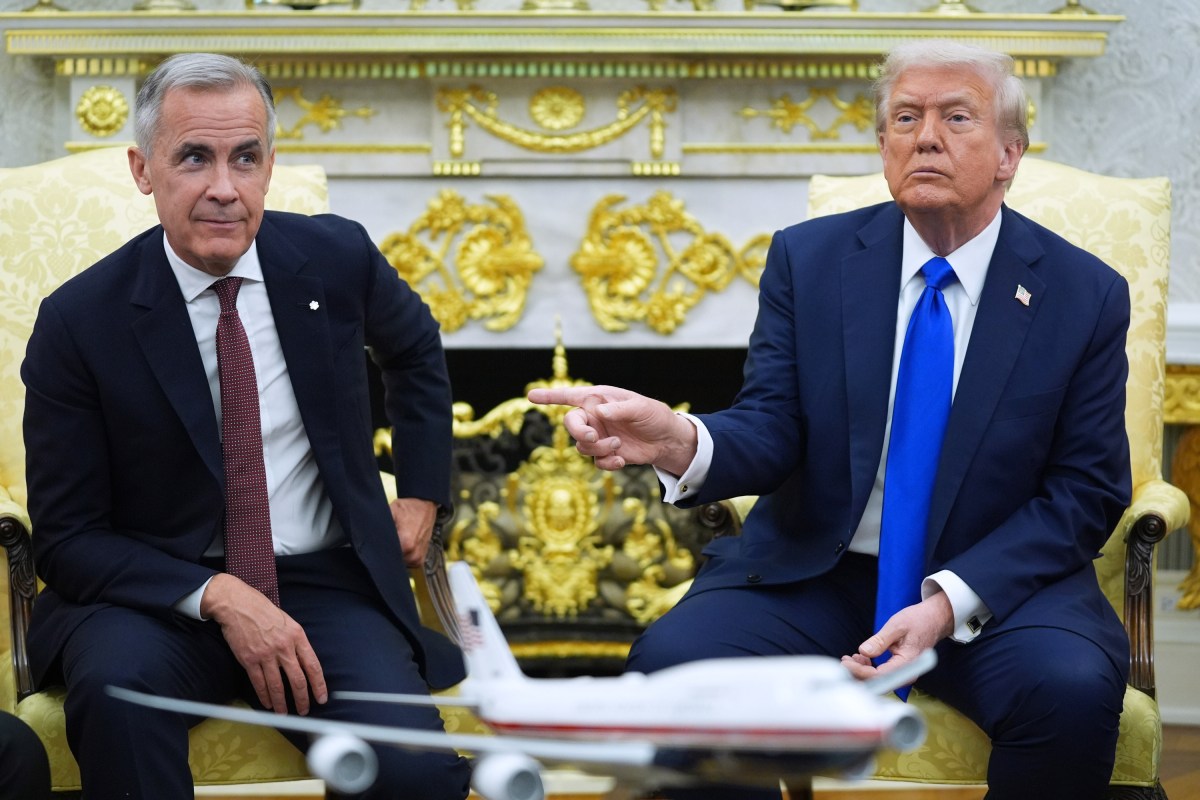
Canadian Prime Minister Mark Carney joked Tuesday that President Donald Trump once gave him a box containing gold keys to the White House, along with an unusual warning that captured the current state of relations between the neighboring countries.
Speaking at the Canada Investment Summit in Toronto, Carney recounted receiving a ceremonial key from his hometown of Fort Smith, Northwest Territories, before contrasting it with a gift he later received from Trump. According to Carney, Trump presented him with a box of gold keys to the White House and remarked that if he brought one of the keys, "They'll let you in."
Carney then added that Trump followed up with a darker punchline: "Maybe they'll shoot you."
"And that sort of sums up the relationship," Carney told attendees. "In Canada, you get the key. In the U.S., they might shoot you."
Carney said Trump presented him with the key during a tense May 6, 2025, White House meeting that focused on tariffs, trade disputes and the future of U.S.-Canada relations.
Newsweek has reached out to the White House via email on Tuesday evening for comment.
The remark drew attention as Carney delivered a broader speech about Canada's economic future amid a prolonged trade dispute with the United States.
While emphasizing that Canada and the U.S. will "always be neighbors," Carney signaled that Ottawa is prepared to take a long-term approach to negotiations with Washington rather than rush into a new trade agreement. He said Canada intends to emerge from the trade conflict as a stronger and more independent economy.
"And to our American friends, let me say this: We will always be neighbors," Carney said Tuesday. "When those opportunities return, Canada will be an even better partner — stronger, more resilient, more independent."
Without mentioning Trump by name, Carney also appeared to criticize the U.S. president's approach to international trade, arguing that relationships are increasingly being replaced by transactional, zero-sum thinking.
"Our reputation — as a reliable, predictable partner — has rarely been more valuable in a world where transactions are replacing relationships, and zero-sum is favored over win-win," he said.
The comments come against the backdrop of escalating tensions between Ottawa and Washington. Trade talks between the two countries collapsed last month before the United States imposed 50 percent tariffs on around $20 billion worth of Canadian goods, prompting retaliatory measures from Canada. Washington has since announced additional restrictions affecting Canadian products.
Trump has repeatedly used tariffs as leverage against trading partners and has frequently urged manufacturers to relocate investment and production to the United States. He has also periodically revived his suggestion that Canada could become the "51st state," a proposal Canadian leaders have rejected.
Despite the tensions, Carney noted that roughly 80 percent of trade between the two countries remains tariff-free and said a mutually beneficial agreement remains possible.
"There is a mutually beneficial arrangement that can be had," he said. "When it is the right time to strike that deal, we'll be ready to do that."
The prime minister headed to Europe following the summit, where he is scheduled to address the European Parliament as Canada continues efforts to deepen economic ties beyond its largest trading partner.
What began with Trump's tariffs and repeated talk of Canada becoming the 51st U.S. state has evolved into a broader economic confrontation, with Washington and Ottawa now trading tariffs, restrictions and increasingly pointed rhetoric.
The dispute began in earnest in March 2025, when the Trump administration imposed 25 percent tariffs on Canadian goods, along with a 10 percent tariff on Canadian energy and potash. Washington later imposed separate tariffs on Canadian steel, aluminum and automobiles, prompting Ottawa to respond with its own countermeasures.
Trump's trade policies were accompanied by repeated suggestions that Canada could become the 51st state, a proposal Canadian leaders have rejected. Trump and Carney met at the White House in May 2025, where tariffs, trade and the future of the bilateral relationship were central issues.
After periods of negotiation and partial de-escalation, the dispute intensified again this summer after trade talks broke down.
The United States imposed a 50 percent tariff on $27.6 billion of Canadian goods effective August 22, with Canada announcing matching tariffs on the affected U.S. products effective September 8. The Canadian measures cover about $20 billion in U.S. imports and include steel, dairy, appliances, agricultural equipment, pulp and paper and electronics.
The latest escalation has moved beyond tariffs. On September 7, Trump said Canadian aircraft manufacturer Bombardier should no longer be allowed to sell its planes in the United States unless it begins manufacturing them in the country.
"NO MORE SELLING BOMBARDIER IN THE UNITED STATES!" Trump wrote on Truth Social, adding that if the company wants access to the U.S. market, "they must build here."
The following day, Washington announced further restrictions affecting Canadian products, including some dairy products, motorcycles and most alcoholic beverages, after Canada's retaliatory tariffs took effect.
Trump also directed the General Services Administration to begin removing Canadian-origin products from certain federal purchasing schedules, adding another front to the dispute.
The increasingly contentious trade relationship has also produced more personal rhetoric from senior officials.
Treasury Secretary Scott Bessent criticized Canada's response to the Trump administration's measures, comparing the country to a "little yippy dog" while discussing Ottawa's retaliatory tariffs. Reuters reported the comment as part of a broader dispute over Canada's use of targeted trade measures.
The exchange adds another layer to a dispute that has increasingly involved not only tariffs and market access, but competing arguments over sovereignty, economic dependence and how the two countries should conduct their relationship.
Carney has framed the trade conflict as an opportunity for Canada to reduce its economic dependence on the United States and attract investment from other markets.
Speaking Tuesday, he told investors that Canada and the U.S. would "always be neighbors," while saying Canada could emerge from the dispute "stronger, more resilient, more independent."
He also criticized a global shift toward transactional, zero-sum economic relationships, saying Canada's reputation as a reliable and predictable partner had become increasingly valuable.
Despite the dispute, Carney said about 80 percent of trade between the two countries remains tariff-free and that a mutually beneficial agreement with Washington remains possible. "When it is the right time to strike that deal, we'll be ready to do that," he said.
Carney traveled to Europe following the Toronto summit, where he is seeking deeper economic ties with the European Union as Canada looks to diversify beyond its largest trading partner.
About 80 percent of U.S.-Canada trade remains tariff-free, according to Carney, but the portion affected by the dispute has grown as both countries have imposed new measures.
Washington imposed 50 percent tariffs on roughly $20 billion worth of Canadian goods after the latest round of negotiations collapsed. Canada responded with retaliatory measures targeting U.S. products. The United States has since announced additional restrictions, widening the dispute beyond the original tariff fight.
Carney has argued that Canada cannot simply wait for the old economic relationship to return. "We know that nostalgia is not a strategy," he said Tuesday.
The Canadian government is instead seeking deeper economic relationships elsewhere. Carney traveled to Europe following the Toronto summit and is scheduled to address the European Parliament as Ottawa explores closer ties with the European Union in areas including energy, defense, artificial intelligence and critical minerals. Despite the increasingly bitter rhetoric, Carney has continued to leave the door open to an eventual agreement with Washington.
The gold keys Carney says Trump gave him may sound unusual, but the exchange of gifts between world leaders is a longstanding part of presidential diplomacy.
The National Archives notes that every U.S. president since George Washington has received gifts of state, with the practice becoming a regular feature of modern international relations. Such gifts can be symbolic gestures meant to mark a visit, reflect a country's culture or simply acknowledge the personal interests of the recipient.
And the gifts can be decidedly unconventional.
During Barack Obama's presidency, foreign leaders presented him and his family with everything from artwork and jewelry to more unusual objects. Among the examples documented from his administration were a horse sculpture and even "crocodile insurance." Saudi Arabia's gifts to the Obama family in one year included a gold-plated replica of the Makkah Clock Tower and jewelry valued at hundreds of thousands of dollars.
Joe Biden's presidential gift records have been similarly eclectic. In 2024, Indian Prime Minister Narendra Modi gave Biden a sterling-silver train set valued at $7,750, while the president of the United Arab Emirates gave him a road bicycle and two crates of dates. Biden's most valuable reported gift that year was a $19,000 painting from Angola's president.
Trump has received plenty of personalized gifts of his own. During his second term, foreign leaders have frequently given him golf-related presents, including clubs and bags, reflecting his well-known interest in the sport. Japan's prime minister gave Trump a putter once owned by former Prime Minister Shinzo Abe, while Ukrainian President Volodymyr Zelenskyy gave him a putter associated with a wounded Ukrainian soldier.
Other gifts presented to Trump have ranged from elaborate calligraphy and porcelain from China to more unusual objects. In 2025, reports on his diplomatic gifts included items such as a samurai helmet, a gold crown and a golden pager, alongside much more conventional diplomatic presents.
The most eye-catching example of Trump's recent gift haul, however, was not something that could easily fit in a White House display case. Qatar offered the United States a luxury Boeing 747-8 aircraft, estimated at roughly $400 million, for use as Air Force One. The proposed gift prompted renewed scrutiny over the rules governing foreign gifts to U.S. officials.
Foreign gifts to U.S. presidents are subject to federal rules and disclosure requirements. Valuable gifts are generally transferred to the National Archives or another government custodian unless the recipient follows the applicable procedures to retain them.
Against that backdrop, Carney's account of receiving a box of gold White House keys fits into a much older tradition of diplomatic gift-giving. What makes his gift unusual is not necessarily the ceremonial key itself, but the warning he says accompanied it — "Maybe they'll shoot you."
The Associated Press contributed to this story.