Can Quezon City rediscover its history? - Rappler
Already have Rappler+? Sign in to listen to groundbreaking journalism.
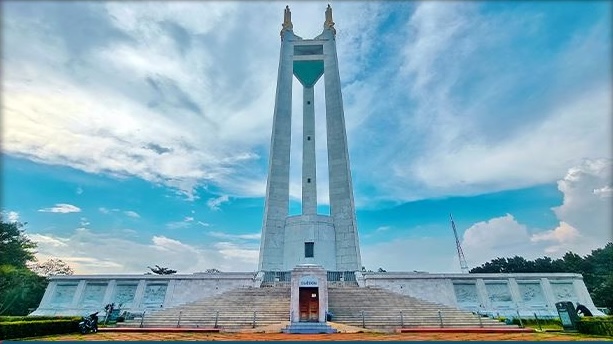
LANDMARK. The Quezon City Memorial Circle is located on Elliptical Road in Diliman, Quezon City.
This is AI-generated. Read the article for full context. Report any errors.
Quezon City’s cultural identity has long suffered from a split personality: one side driven by commercial expansion and the other buried beneath its historical roots.
So in defining its cultural heritage, Quezon City Mayor Joy Belmonte hopes to address one question: “How do you find the real soul of a city built from a blueprint?”
Long before stepping into public office, Belmonte studied archaeology at University College of London in the 1990s alongside the late Filipino archaeologist Dr. Victor Paz. That training taught her to read a city like an excavation site.
”People aren’t really aware [of the city’s cultural heritage] because they don’t really identify with Quezon City, and maybe that’s the problem — that it’s a created city,” said Belmonte.
University of the Philippines’ faculty archaeologist Ligaya Lacsinan, who has been with the institution since 2021, noted that lack of awareness stems directly from how the city was created.
Belmonte shared that during focus group discussions to brand the city, they discovered that for some, QC meant being “jologs” or someone who has a tacky taste or outdated fashion; some just see it as a city “named after Quezon;” while some just associate it with “shopping malls.”
Residents’ perceptions of the city also differ depending on the communities they identify with, Belmonte said.
The mayor pointed out that the city’s microgeographies have been linked to various meanings or activities, like the internet satires on New York, Cubao; vintage hunting at Cubao Expo; Sunday jogging at UP Diliman; or the nightlife in Tomas Morato.
“This disconnect manifests in the way our citizens speak in microgeographies,” Belmonte said.
Established in 1939, Quezon City is only 87 years old, younger as a city than places like Manila and Cebu. But a relatively recent development does not equate to lack of history.
Belmonte admitted that Quezon City was once negatively associated with informal settlements.
“[During the] ’70s and ’80s, Quezon City was called ‘the squatter capital of the Philippines,’” she said.
Yet, the original vision for the city, which has 142 barangays and 6 districts, was different.
Former Philippine president Manuel L. Quezon envisioned a “City of Man,” a green, human-centered capital designed for ordinary working-class families — a contrast to Manila’s imperial Burnham Plan, a 1900s urban design created by American architect Daniel Burnham.
The QC plan, also known as the Frost Plan, remains visible today in the city’s quadrangles, sprawling public parks, and pioneer socialized Projects from 1-8.
Belmonte pointed to the city’s planned public spaces and residential communities as evidence of that vision.
“Kaya dun sa original plan ni Robert Frost, meron tayong Quezon Memorial Circle (The Quezon Memorial Circle is in the original plan of Robert Frost),” she said.
Today, the city’s green spaces remain among its most visible features, including three parks: the La Mesa Eco Park, Ninoy Aquino Parks and Wildlife, and UP Diliman Balara Filters Park.
Beyond its parks and urban landscape, Quezon City also traces its hidden heritage in archaeological and historical sites scattered across its neighborhoods.
Belmonte noted how Quezon City’s roots lie directly within the Novaliches sector.
”Our oldest prehistoric remains are from Novaliches, the La Mesa Watershed,” Belmonte said.
The city extended a direct pledge to the UP School of Archaeology to fund new local excavations and construct a dedicated city museum.
“Baka gusto niyo maghukay sa La Mesa watershed, habang mayor pa ako, gawin natin (While I’m still the mayor, you might want to do the excavations at the La Mesa watershed),” Belmonte said.
“We would love to show in a museum that we have prehistoric culture in Quezon City.”
Heritage, though, is not limited to archaeological artifacts. Historical memory can also be preserved in places associated with figures from the Philippine Revolution.
In Balintawak and Banlat, for instance, Melchora “Tandang Sora” Aquino is remembered for nursing wounded Katipuneros during the revolution.
Belmonte recounted the time how her administration worked hard to reclaim Tandang Sora’s birthplace from urban decay.
By 2025, the site launched the Museum of Women’s history to what we now know as the Tandang Sora Shrine.
“Time naman ng dad ko (former Quezon City mayor and representative Sonny Belmonte), he set up a shrine at nilipat namin ang labi ni Tandang Sora doon sa Tandang Sora Shrine,” Belmonte recalled.
(During my father’s time, former Quezon City mayor and representative Sonny Belmonte, he set up a shrine and transferred the remains of Tandang Sora to the Tandang Sora Shrine.)
The city also commemorated late president Quezon’s pre-World War II humanitarian initiative — saving over 1,000 Jewish refugees fleeing the Holocaust — when it inaugurated a park in the Quezon Memorial Circle in 2018.
In celebrating Quezon’s legacy, the city government moved Quezon’s actual residence from Gilmore Street to the Memorial Circle with the help of Jerry Acuza, who started the Las Casas Filipinas de Acuzar known for moving old houses.
The move was a loan, a meticulous preservation effort, Belmonte shared.
“On loan po sa akin ang lahat ng mga damit, gamit ng Quezon family (All the clothes and artifacts of the Quezon family are on loan to me),” she said.
Other historical sites within the city’s neighborhoods include San Pedro Bautista Church in Frisco and the Pugad Lawin area in Bahay Toro.
The Ang Sigaw ng Pugad Lawin monument, created by National Artist Napoleon Abueva in 1988, also serves as a physical reminder of Andres Bonifacio and the Katipuneros’ “punitin ang sedula (tear up the cedulas)” rebellion on August 23, 1896.
Belmonte highlighted how historical consensus reframes Quezon City as a true cradle of the Philippine Revolution, citing historian Professor Xiao Chua.
“You have to call yourself the birthplace of the nation,” Belmonte recalled Chua saying.
Belmonte encouraged professionals, students, and artists to participate in shaping the city’s historical narrative through initiatives such as Bayanihan QC, a volunteer program to help the city’s projects and activities.
The Heritage Trail passports initiative also encourages residents to visit historical sites across Quezon City.
“Every time you go to one of these sites, you stamp your passport and you get something free kapag natapos mo lahat (when you complete it),” Belmonte shared.
For residents, understanding Quezon City’s heritage may ultimately come down to seeing familiar places differently.
UP Anthropology graduate Nadia noted that the fast pace of urban life often blinds residents to what lies right beneath their feet: “We in QC are too busy living our lives, we kinda miss these invisible things that are actually obvious.” – Rappler.com
Jade Tan is a Rappler intern studying AB Journalism at University of Santo Tomas.