
Blue Origin unveils 20-metre solar tower to power future Moon bases
Getting electricity on the Moon is one of the biggest challenges standing between short visits and a long-term human presence.
Now, Blue Origin has unveiled a tall solar power system designed to capture sunlight from some of the Moon's most sunlit locations, and turn that energy into a wider power network for future lunar operations.
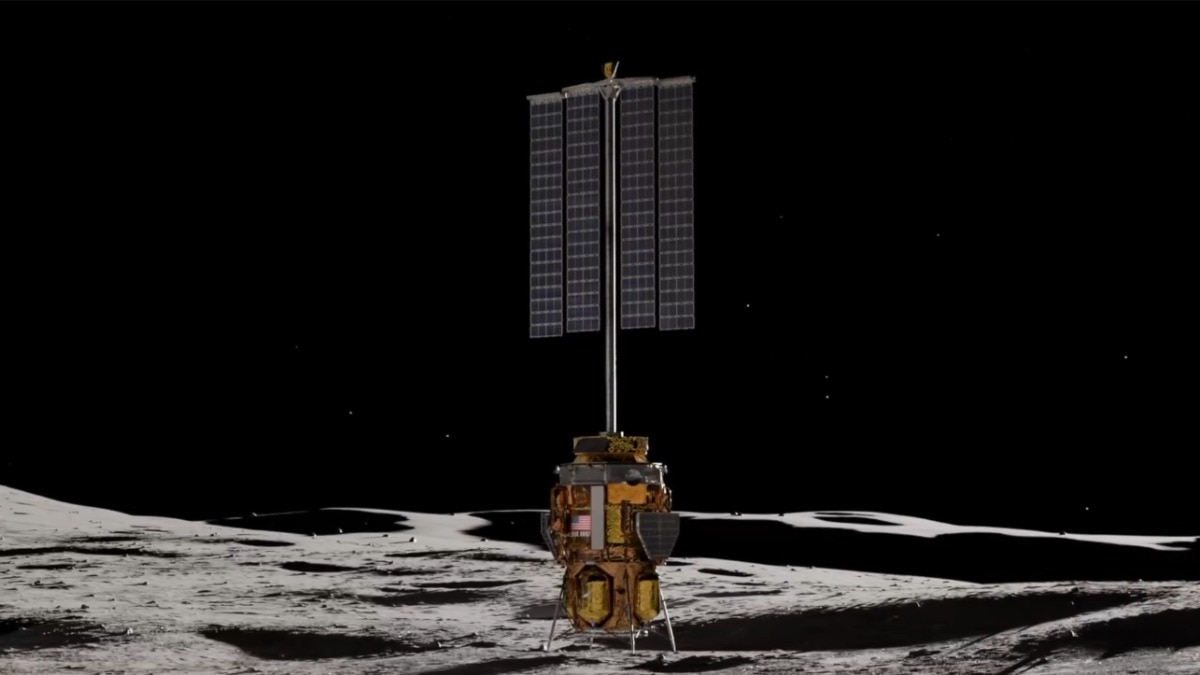
Called the Power Tower, the system is a vertically deployed solar array designed to stand about 20 metres tall and generate more than 10 kilowatts (KW) of power for operations near the lunar South Pole.
Blue Origin says its modular design could eventually allow multiple towers to work together, sending electricity beyond the lander to other equipment on the lunar surface. Power changes what’s possible on the lunar surface.Our Power Tower is a 20-meter-tall, vertically deployed solar array system designed to provide more than 10 kilowatts of power for Moon Base operations at the lunar South Pole. Its modular architecture will support future pic.twitter.com/I1BwBnxKAv— Blue Origin (@blueorigin) September 25, 2026
The Moon is a difficult place to generate continuous solar power.
Away from the poles, a lunar day and night each last roughly two weeks, meaning solar panels can spend long periods without direct sunlight.
The South Pole is far more different.
Because the Moon is tilted by only about 1.5 degrees, the Sun remains very low on the horizon there. The surrounding terrain creates a landscape of permanent shadows and high points that receive sunlight for unusually long periods.
Some ridges and crater rims can remain illuminated for more than 90% of the year, making them attractive locations for solar power.
The Power Tower is designed to take advantage of precisely this geography. By raising solar arrays high above the lunar surface, the system can reach sunlight that may be blocked at ground level by surrounding terrain. An artist's concept shows two lunar rovers charging at the Power Tower. (Photo: Screengrab/Blue Origin) FROM LANDER TO LUNAR POWER GRID
The Power Tower is designed to sit on the top deck of Blue Origin's Blue Moon MK1 lunar lander, and, after landing, the structure deploys vertically and unfolds its solar arrays.
Blue Origin has already demonstrated a full deployment in an analogue lunar environment.
Earlier demonstrations showed the deployed structure reaching about 26 metres in total height when mounted on the lander, while the company now describes the Power Tower itself as a 20-metre system.
The bigger idea is what happens after that first tower.
Its modular architecture is intended to let future systems expand the power network, potentially supplying rovers, scientific instruments and other surface equipment farther from the lander. An artist's concept of a number of working Power Towers forming a grid on the lunar surface. (Photo: Screengrab/Blue Origin)
That particular approach fits right into the shift that has come to redefine lunar exploration in recent years, one that promotes building infrastructure that can support repeated and longer missions rather than treating every Moon landing as an isolated visit.
Nasa itself identifies reliable surface power as essential for sustained lunar exploration, alongside communications, resource use and other infrastructure.
For the Moon, therefore, the Power Tower is an attempt to solve one of the most basic requirements of living and working there.
A way to keep the power running when Earth is hundreds of thousands of kilometres away.- Ends


