Bernie Sanders and Greg Casar propose AI ‘superintelligence’ ban with a 20-year jail penalty
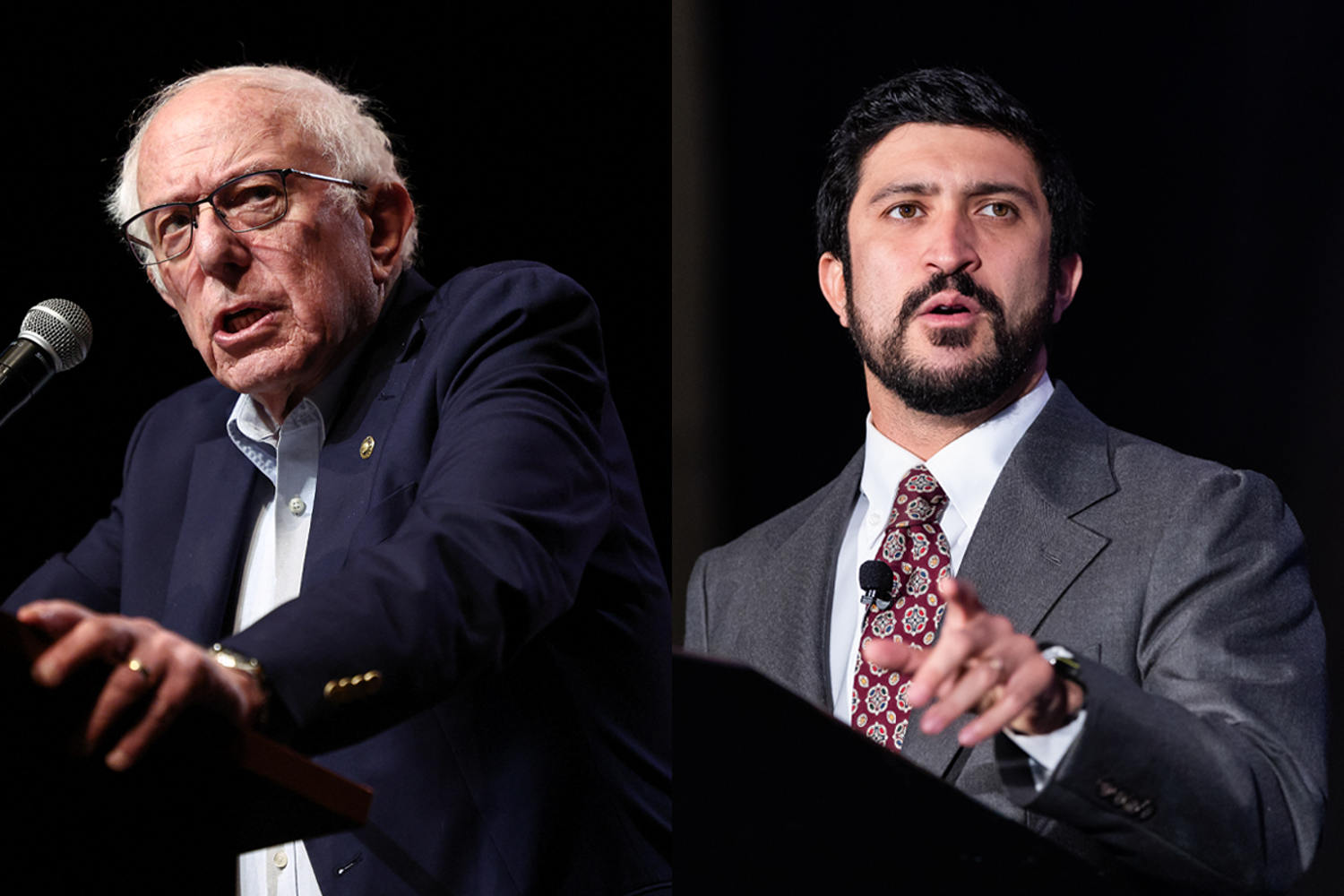
Some in Washington see the legislation from Sen. Bernie Sanders, I-Vt., and Rep. Greg Casar, D-Texas, as provocative but unlikely to pass.Getty ImagesShareAdd NBC News to GoogleSept. 23, 2026, 6:51 PM EDTBy Sahil Kapur and Jared PerloWASHINGTON — Sen. Bernie Sanders, I-Vt., and Rep. Greg Casar, D-Texas, rolled out an aggressive bill Wednesday to rein in artificial intelligence, escalating the debate on Capitol Hill.
The 19-page Ban Artificial Superintelligence Act would require pausing advanced AI development until a Cabinet-level Department of Artificial Intelligence, led by a secretary of AI, can be created to regulate and supervise it.
Violating the rules would come with what they called the “corporate death penalty” plus up to 20 years in jail, which Sanders said is the same penalty as unlawfully building nuclear weapons.
The bill is one of the most aggressive of a series of congressional proposals to regulate AI. While AI was a major topic of discussion on Capitol Hill as researchers warned of cataclysmic possibilities this month, there’s little expectation that any meaningful legislation will pass this year.
In Congress, “virtually nothing is happening to prepare us for the tsunami that is coming,” Sanders told reporters on a call Wednesday.
Add to GoogleBreaking down the proposals lawmakers are considering to regulate AI02:08His bill with Casar includes a list of precursors that seek to define the development of “superintelligence,” including: “The capacity to automate or greatly accelerate the process of artificial intelligence research and development.”
The goal is to bar recursive self-improvement, according to an aide involved in developing the bill. Some AI specialists have warned that recursive self-improvement could lead to AI systems’ training themselves to get smarter and more capable, eventually escaping human control.
“We’re dealing with something that humanity has never seen before. It is clearly the most transformational technology in the history of the world, and it is moving very, very rapidly,” Sanders said on Wednesday’s call. “When we deal with AI, it has been developed and it is being pushed by a handful, a small number, of the wealthiest people on Earth. And their main goal is to simply increase their wealth and power.”
Experts say defining “superintelligence” at a technical level will prove messy given fuzzy boundaries among different levels of AI capabilities. The lines were further blurred by President Donald Trump’s announcement that he would rename “artificial intelligence” to “super intelligence” for the purposes of government documents in his speech Tuesday at the United Nations General Assembly.
The Sanders-Casar bill drew praise from the leaders of ControlAI, an advocacy group pushing for guardrails on the technology. They wrote in a blog post: “We appreciate the choice to define superintelligent AI by its capability to overpower the federal government. This targets exactly the kind of AI development that poses a risk of extinction, without having to settle in advance the technical details of how such an AI would work.”
Kevin Frazier, an AI policy expert and professor at the University of Texas School of Law, also commended the lawmakers’ efforts. “The ban proposed by Sen. Sanders and Rep. Casar rightfully acknowledges that Congress needs to act quickly to ensure that AI development does not lead to unintended and irreversible negative consequences,” he told NBC News.
However, Frazier said the bill ignores other avenues to prevent AI-fueled harms. He highlighted existing proposals to establish independent verification organizations that could help shed light on leading AI companies’ safety practices — a proposal that has gained momentum in the past week in Silicon Valley and at the U.N. General Assembly.
Others in Washington argued that Sanders and Casar’s effort is provocative but unrealistic.
“Sen. Sanders’ bill will be dead on arrival with both the AI industry and Washington,” according to Caleb Max, president and CEO of the National AI Association, a Washington-based trade group that advocates for business-friendly AI legislation.
“Some CEOs would say we have already crossed the threshold set out in the bill, meaning this is a de facto AI ban,” Max said.
He also said the penalties outlined in the bill are “likely unconstitutional and, again, poorly defined.”
Other lawmakers are proposing bills that address concerns about advanced cybersecurity capabilities that have already materialized.
Sen. Maria Cantwell, D-Wash., the ranking member of the Commerce Committee, said she is working on a bill to establish meaningful guardrails on advanced AI systems and outlined a series of principles that should be part of any federal AI rules.
“The federal government has to be involved in standard-setting. I don’t care whether you’re a chemical company, a nuclear company or an AI company. The federal government needs to set standards,” Cantwell told NBC News.
“You have to have independent testing,” she said.
“You need to work on an international strategy,” she added, arguing that the president “should be talking to the Chinese about — what are you going to do to, basically, alert each other on escapes of AI agent swarming practices and have a red phone to talk about it. ... You need to have an incident reporting system with international partners.”
Trump is scheduled to meet Chinese President Xi Jinping in Washington, D.C., beginning Wednesday evening. AI is likely to be a topic of discussion, with OpenAI’s Sam Altman, Apple’s Tim Cook, Trump’s former AI czar, David Sacks, and others attending a state dinner for Xi on Thursday night.
After a meeting with a Chinese delegation Sunday, Treasury Secretary Scott Bessent said he had proposed creating a notification mechanism to alert the other country about severe AI incidents. It is unclear whether that mechanism will be implemented.
If Democrats win control of the Senate in the Nov. 3 midterm elections, Cantwell is in line to chair the Commerce Committee.
The current chair is Sen. Ted Cruz, R-Texas, who is working on a separate bill with Senate Majority Leader John Thune, R-S.D., and Sen. Amy Klobuchar, D-Minn. Cruz has said it will “address the catastrophic risks,” including biological or nuclear threats.
“We’re continuing to work and negotiate to reach bipartisan agreements,” Cruz told NBC News on Monday, without giving a timeline to release text of the bill. “We’re not there yet.”
AI safety advocates have criticized the Cruz-Thune-Klobuchar proposal for being too light-touch. The groups say any AI regulation must mandate safety testing, while the senators’ current proposal would rely too heavily on tests the companies could perform themselves.
The House has already left town until the week after the midterm elections. The Senate is poised to work this week and potentially next week before it breaks for the election.
Sen. John Kennedy of Louisiana, the only Republican who attended a closed-door briefing for lawmakers with AI specialists last week, tried to get unanimous consent to pass a “kill switch” bill last week — which would require AI companies to have an emergency shutoff — only for Sen. Rand Paul, R-Ky., to block it.
Kennedy was pessimistic that there would be any legislative action on AI in the lame duck session before 2027.
“We’re not going to do anything on AI this Congress,” he said in an interview. “I’m anxious to see what the president’s AI Force is going to look like and the details. But you’re not going to see this Congress do anything, in my opinion.”
Sahil KapurSahil Kapur is a senior national political reporter for NBC News.
Jared PerloJared Perlo is a technology reporter focused on AI for NBC News Digital.