Bayesian crew unaware of safety risk before deadly sinking, British report finds - The Independent
Want to bookmark your favourite articles and stories to read or reference later? Start your Independent Membership today.
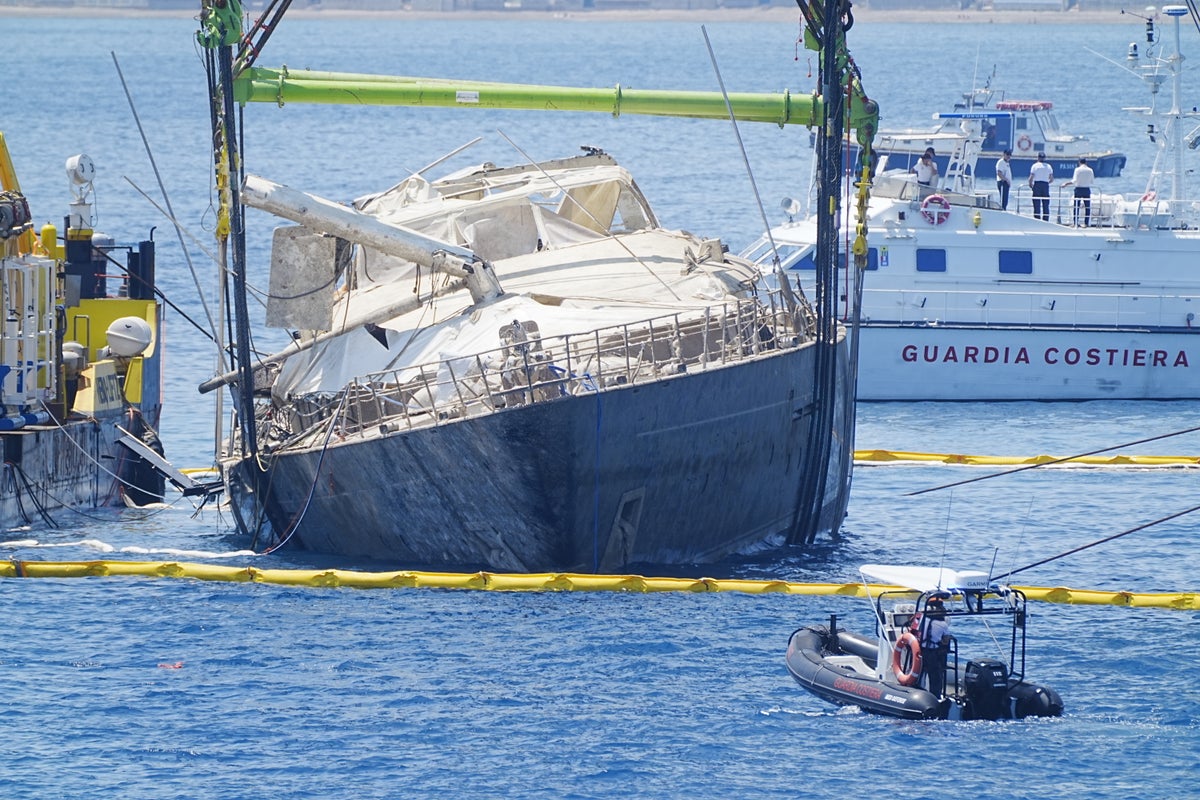
Crew members aboard the Bayesian superyacht were unaware of a severe safety vulnerability that left the vessel exposed to fierce winds before it sank off Sicily, claiming seven lives, British investigators have said.
British technology entrepreneur Mike Lynch, 59, and his daughter Hannah, 18, were among the seven victims who died when the 56-metre (184ft) vessel sank off the Sicilian coast on August 19 2024.
The final report into the tragedy by the Marine Accident Investigation Branch (MAIB), released on Thursday, appears to conflict with recent Italian reporting, where experts for the prosecution reportedly attributed the disaster to crew error rather than defects in the yacht.
Meanwhile, survivors Charlotte Golunski and James Emslie, who escaped the sinking alongside their young daughter, asserted in High Court legal filings that significant safety failures in the vessel’s design and the crew's actions caused the disaster.
The family are opposing legal attempts by two firms connected to the yacht, Revtom Ltd and Camper & Nicholsons International Ltd, to cap the total compensation they might be ordered to pay.
They state that those on board were forced to "scramble to safety on their own with very limited assistance from the captain and crew who had ultimate responsibility for their safety".
Matthew Chapman KC, for the family, said: “In the circumstances, they knew or are likely to have known that the continued operation of the yacht, including in the prevailing weather conditions, exposed passengers to a probability of death or personal injury and, notwithstanding such knowledge, they permitted the yacht to be operated, in weather of the kind that was forecast and experienced at the time that the yacht was lost.”
The barrister said that the companies were reckless because they had “actual knowledge that defects in the design, construction and operation of the yacht would probably result in the loss of life, the suffering of personal injury and the consequential losses and expenses”.
The MAIB investigated as the Bayesian was registered in the UK.
Simon Graves, the MAIB’s principal inspector, told the Press Association: “The crew were reacting to the situation they found themselves in.
“The weather forecasts for that day gave generally reasonable weather with the possibility of thunderstorms, but none of the weather forecasts described the weather that they actually experienced.”
He added: “Unfortunately, they were overtaken by events and the speed of the knockdown.
“They went from being in a calm situation to a violent storm to being knocked over in a very short space of time, which gave them very little time to react.
“Once the vessel had been knocked down, they set off the emergency rescue beacon, they released the life raft.
“They managed to get some of the guests out of the vessel into the life raft and gave them the best chance of survival.”
Mr Graves said the British and Italian investigations had different purposes and could reasonably reach different conclusions.
He said: “The two investigations are entirely separate, and it’s quite reasonable that they will come to different conclusions because their objectives are different.”
The MAIB’s final report found that the yacht was hit by winds of around 80mph, knocking it onto its side in less than 15 seconds.
It was pushed beyond the angle from which it could straighten itself and sank just 18 minutes later.
Investigators found that the yacht’s vulnerability to strong winds had never been assessed for the conditions in which it was anchored, with its sails down and its retractable centreboard raised.
The centreboard is a large underwater structure that helps a sailing vessel remain stable.
Because the risk had never been assessed, the crew did not know how easily the yacht could be knocked over in those conditions, the report said.
Mr Graves explained: “Bayesian had a vulnerability and from the design stage all the way through, there was no requirement to assess this vulnerability.
“So this vulnerability had not been identified.”
The Bayesian was anchored near the Sicilian fishing village of Porticello on the night of August 18 2024, with 12 guests and 10 crew aboard.
The captain had instructed those keeping watch to wake him if winds exceeded 20 knots, around 23mph, or if the anchor began dragging.
At 3am, the wind was still light, although lightning and storm clouds appeared to be getting closer.
At 3.44am, a crew member on watch posted a video of the approaching storm on social media.
Just 11 minutes later, winds had increased to around 35mph.
The captain was woken at around 4am, and the crew began preparing the engines so they could move the vessel.
But at 4.06am, the wind suddenly surged to around 80mph.
The yacht was knocked onto its side, throwing people and furniture across the decks.
Investigators believe the extreme weather was most likely caused by a downburst — a powerful blast of air from a thunderstorm that hits the sea and spreads out with enormous force.
David Robertson, the lead investigator of the sinking, said the crew had not been properly warned about this danger.
He told a press briefing on Wednesday: “The forecast didn’t mention the chance of violent winds, crew training hadn’t covered it, and guidance didn’t cover it.
“All of that combined to limit the crew’s ability to recognise the developing hazard and take timely action.”
Investigators concluded that flooding did not cause the initial capsize.
Water only became a major problem once the yacht was already lying on its side, the report said.
The report also revealed the desperate struggle to escape as the vessel began sinking.
Five people were injured “either by falling or from things falling on them”, while the deck hand was “thrown into the sea”, the report said.
Two guests used furniture drawers “as an improvised ladder” to escape their cabin.
The skipper instructed guests and crew on an area of the deck to “swim clear of the mast and boom as the vessel was sinking”.
Survivors later made their way onto a life raft released from the Bayesian.
They went on to be rescued on a small boat dispatched by the yacht Sir Robert Baden Powell, which was also at anchor nearby.
But none of the Bayesian’s life rafts automatically floated free and inflated during the sinking, the report found.
The crew had to release a raft manually.
The captain and another crew member also swam back towards the sinking yacht in an unsuccessful attempt to release another raft.
Mr Graves praised the actions of the crew after the yacht was knocked down.
He said: “The safety of the people who were able to leave the vessel at that point relied heavily on the training experience and not least the initiative of the crew members who were on board.”
The investigation was carried out alongside a criminal probe in Italy, where captain James Cutfield, chief engineer Tim Parker Eaton and deckhand Matthew Griffith are under investigation over potential charges of multiple manslaughter and culpable shipwreck.
British investigators said that Italian prosecutors had restricted access to some witnesses and evidence.
The report says: “It is possible that the circumstances depicted in this report may alter following disclosure of evidence withheld by the Italian authorities.”
However, Mr Graves said he was satisfied with the British investigation.
He said: “We are content with our investigation, the investigation that we’ve undertaken, and the information we’ve used to feed into it.”
He explained that the MAIB’s purpose was to prevent future accidents rather than establish criminal blame.
The report also found that alcohol consumption had not contributed to the sinking.
Rob Loder, chief inspector of Marine Accidents said: “Our investigation found that Bayesian had a vulnerability to high winds that was not recognised, because the yacht had never been assessed at anchor with its sails down.
“The extreme winds that night were also not explicitly forecast, so the crew had no warning of the risk.
“MAIB has published a safety flyer for the industry and a report which makes recommendations covering vessel design standards, crew training and how rare but severe weather is represented in forecasts.
“I urge everyone with a part to play, including regulators, training providers and weather services, to read our report and act on it, so that a tragedy like this is not repeated.”
Inquest proceedings in the UK are looking at the deaths of Mr Lynch and his daughter, as well as Morgan Stanley International bank chairman Jonathan Bloomer, 70, and his wife, Judy Bloomer, 71, who were all British nationals.
Fifteen people, including Mr Lynch’s wife, Angela Bacares, were rescued.
Mr Lynch and his daughter were said to have lived in the vicinity of London and the Bloomers lived in Sevenoaks, Kent.
The Maritime and Coastguard Agency is also investigating the sinking.