Battle for the metros: ANC and DA fight as MK storms eThekwini | LGE 2026 - IOL
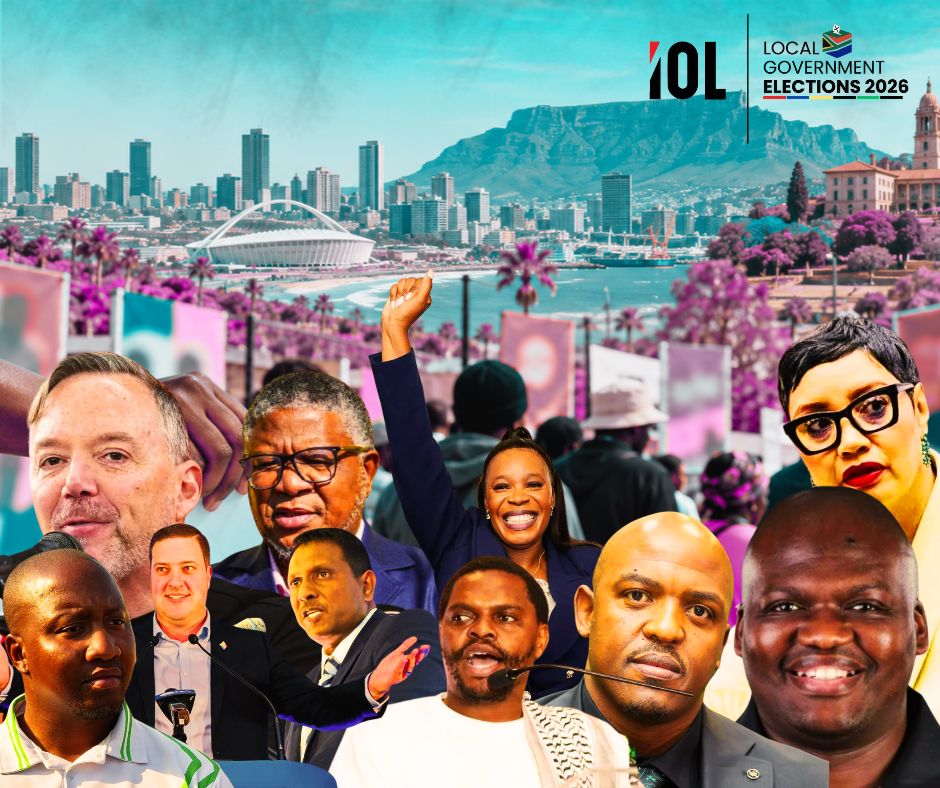
With just over a month until South Africa's November 4 Local Government Elections, the battle for the country's major metros is intensifying. Ipsos polling shows closely contested races involving the ANC and DA in several cities, while MK has recorded 55% support among voters expressing a party preference in eThekwini. Coalition negotiations could again prove decisive after the votes are counted.
With just over a month to go before South Africans head to the polls on November 4, the ANC and DA are facing closely contested races in several major metros, while the MK Party has emerged as a major contender in eThekwini.
The Democratic Alliance (DA), Economic Freedom Fighters (EFF), ActionSA, uMkhonto weSizwe Party (MKP) and several other parties have announced candidates for key mayoral races, including Johannesburg, Tshwane, Ekurhuleni and eThekwini.
But while opposition parties are increasingly putting names and faces to their campaigns, the African National Congress (ANC) has yet to announce its final mayoral candidates for any of the country's eight metropolitan municipalities.
Instead, after months of speculation and an unusually public selection process, the ANC unveiled 42 potential candidates in August, leaving its national officials to make the final selections.
The party is therefore entering the final stretch of the campaign with its mayoral line-up still unresolved in several key battlegrounds.
The latest Ipsos polling paints different pictures across the metros. The ANC and DA are closely matched in Johannesburg, Ekurhuleni, Nelson Mandela Bay and Buffalo City, while the DA records 46% support in Cape Town.
MK recorded 55% in eThekwini, while the EFF reached 27% in Buffalo City. ActionSA recorded a double-digit support in Johannesburg, Tshwane and Ekurhuleni.
The Ipsos findings are based on interviews with 3,600 South Africans conducted in June and July. The polling firm cautioned that the figures should not be interpreted as a prediction of the final election outcome.
UKZN political analyst Dr Siyabonga Ntombela identified Johannesburg, Ekurhuleni and Nelson Mandela Bay as metros where the contest could be particularly close.
The races could also have significant implications for coalition governments, with analysts saying the final council make-up may be as important as which party comes out on top.
The ANC and DA remain closely matched in Johannesburg, with ActionSA also recording double-digit support in the Ipsos poll.
Ntombela said the DA had made gains in the metro following Helen Zille's mayoral candidacy.
“DA is making inroads with Zille's mayoral candidacy placing it neck and neck against ANC,” Ntombela said.
A Polymarket prediction market tracking the next Johannesburg mayor also had Zille at 67.5% in the October 1 snapshot, followed by Frank Chikane at 14.7%, Lukhona Mnguni at 7.4%, Herman Mashaba at 4%, Loyiso Masuku at 3.9% and Dada Morero at 1.5%.
Johannesburg has 75 parties contesting the proportional representation ballot.
Political analyst Professor Theo Neethling, a research fellow in the Department of Political Studies and Governance at the University of the Free State, said the level of fragmentation meant no party should assume it would secure an outright majority in the major metros.
“I believe it is currently defensible to say that no single party can assume or take for granted an outright majority in most of the major metros,” Neethling said.
“This is particularly true for Johannesburg, Tshwane, and Ekurhuleni, where no party has managed to govern alone since 2016.”
Ntombela said the DA was the “favourite” in Tshwane, citing various polls that placed the party between 31% and 43%.
“The DA could convert a near-tie into a clear lead,” Ntombela said.
Meanwhile, UKZN political analyst Zakhele Ndlovu also said the DA was likely to grow its support in Johannesburg and Tshwane.
Ipsos recorded double-digit support for ActionSA in Tshwane.
Ekurhuleni remains difficult to assess between the ANC and DA, with ActionSA also recording double-digit support.
“It is unclear between ANC and DA who will emerge victoriously. However, ActionSA is likely to bolster the DA votes with its double-digits support,” Ntombela said.
Ndlovu said the MK Party could also make gains in Ekurhuleni, adding another element to the contest.
Neethling said Ekurhuleni was one of the metros where no party could take an outright majority for granted.
The political picture is different in eThekwini, where Ipsos recorded 55% support for MK among voters who selected a party.
In the 2021 local government election in eThekwini, the ANC received 42.02% of the vote, followed by the DA on 26.62% and the EFF on 10.48%.
“MK will have the lion's share, but will need one or two smaller parties to co-govern with. The prospect of an outright majority is dimly-lit,” Ntombela said.
“The ANC led in 2021, and MK is now the frontrunner,” he added.
Ndlovu said MK's performance in KwaZulu-Natal could result in its mayoral candidates leading a significant number of municipalities, but that this would depend on its post-election negotiations.
The metro has 69 parties contesting the PR ballot.
Neethling said eThekwini should be treated with more caution because the ANC had historically held a strong position there, while the 2026 election landscape was far more fragmented.
“Recent polls even suggest a shift in the balance of power, though polls do not predict the final outcome,” he said.
Cape Town remains the strongest metro for the DA in the Ipsos polling, with the party on 46%. Ipsos said the DA could potentially exceed 50% as campaigning continues.
Ntombela said the DA was comfortably placed.
“DA is comfortable at 46% polling result. Chances of a coalition government are slim to none,” he said.
He also said the DA was likely to lose some ground marginally in Cape Town.
Nelson Mandela Bay is among the metros where Ipsos identified a competitive ANC-DA race, although it cautioned that the findings should be treated carefully because of the relatively small sample size.
Ntombela gave the ANC the edge, but said the DA was close behind.
“I will give it to the ANC, albeit the DA is right behind it. I draw this inference from the provincial election outcome,” he said.
He also identified Nelson Mandela Bay as one of the three metros, alongside Johannesburg and Ekurhuleni, where he expected significant competition.
In Mangaung, Ntombela said the DA was ahead of the ANC but cautioned that the gap could narrow before election day.
“DA is ahead of the ANC but this gap might close leading up to the election,” he said.
He said the DA could overtake an ANC that was far ahead in 2021, although he cautioned that polling in the metro was uncertain.
Ipsos also warned that its Mangaung findings should be treated with caution because of the relatively small sample size.
Ipsos recorded 27% support for the EFF in Buffalo City, its strongest result among the metros surveyed, while identifying the ANC and DA as the other main contenders.
Ntombela said the EFF was the strongest party in the metro.
Ipsos cautioned that its Buffalo City findings should be treated carefully because of the relatively small sample size.
Ndlovu said the IFP, ActionSA and EFF could be significant in determining coalition formation in KwaZulu-Natal, Mpumalanga and Gauteng.
He also said eThekwini, Johannesburg and Pietermaritzburg could see significant political shifts compared with 2021.
Neethling cautioned against singling out any one smaller party, including the EFF or PA, in advance as the key coalition player.
With 75 parties on the PR ballot in Johannesburg, 70 in Tshwane, 67 in Ekurhuleni and 69 in eThekwini, he said the potential role of smaller parties was part of the broader fragmentation.
A party holding a relatively small number of seats could, if larger parties failed to secure a majority, become the “missing link” in a coalition, Neethling said.
He said the precise composition and stability of post-election coalitions would be difficult to predict because it would only become clear which combinations could form a majority once the final seat allocation was known.
He identified Johannesburg, Tshwane, Ekurhuleni and eThekwini as the four metros where coalition outcomes would be particularly significant.
“The result does not merely determine who comes first; it determines who possesses sufficient negotiating power to assemble a workable majority after the election,” Neethling said.