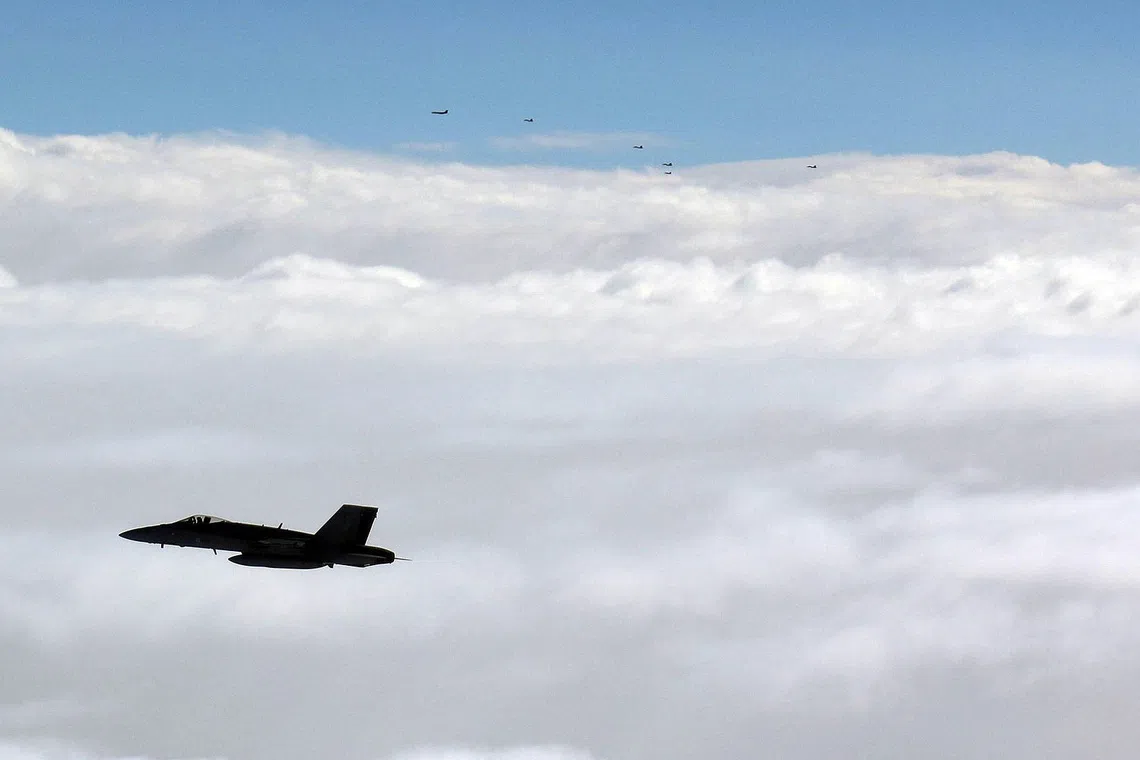
B2 for Putin, B1 for Xi: Does US tease visiting rivals with stealth bombers?
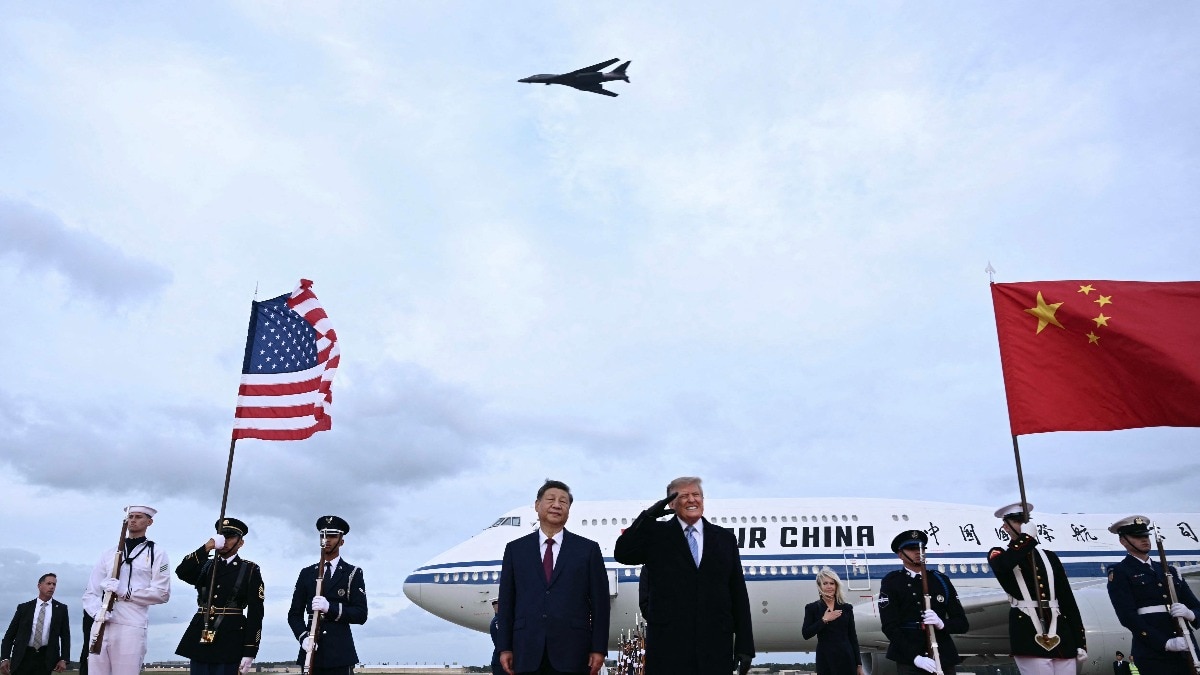
Just over a year after US President Donald Trump welcomed Russian President Vladimir Putin with red carpets, military salutes and a flypast, he has extended a similar welcome to his other major counterpart, Chinese President Xi Jinping. Both welcomes carried a strong ceremonial element. But the aircraft deployed on the two occasions have drawn attention, and seemingly carry symbolism too.
When Putin arrived in Alaska in August 2025 for talks on ending the Russia-Ukraine war, a B-2 Spirit stealth bomber and F-35 fighters flew overhead as the two leaders met. Now, in 2026, when Xi arrived at Joint Base Andrews on September 23, two B-1B Lancers thundered overhead during his welcome ceremony, with the US Air Force later flying a B-2 with four F-22s over the White House as part of the military spectacle.
Washington was putting its immense airpower on display before two countries that are global powers and are among America's major strategic rivals.
Conservative US influencer Nick Sortor called the B-1 flyover during Xi's arrival a "surprise Supersonic Bomber" appearance and called the display of the spectacle "legendary".
"LMAO," Sortor posted on X. "A surprise SUPERSONIC BOMBER flyover at President Trump's welcome ceremony for Xi Jinping just caught EVERYONE off guard. It was a B-1 Lancer with FULL afterburner, RIPPING through during the Star Spangled Banner. Freaking legendary," the conservative US influencer added in his post.
Political commentator and internet personality Mario Nawfal described the B-1Bs roaring overhead as a "dramatic display of American airpower".
The symbolism becomes more interesting when Putin's visit and Xi's visit are placed side by side.
On August 15, 2025, Putin landed in Anchorage, Alaska, for a high-stakes meeting with Trump over Russia's war in Ukraine. The Russian leader received an unusually elaborate welcome, including a red carpet, F-22 Raptors lining the flight path and a flyover by a B-2 Spirit accompanied by four F-35 fighters.
The summit came after months of Trump pushing for an end to the Ukraine war and amid intense negotiations with Moscow. The talks ultimately ended without a ceasefire or peace agreement.
That made the military display particularly noteworthy.
Former US intelligence officer Naveed Jamali then had told CNN that the timing was itself a form of communication. "Everything is about posturing and communicating," he said, arguing that the B-2 showed Putin that Trump was negotiating "from a position of strength".
"We have a B-2 bomber. They [Russia] do not." The former intelligence officer described the flyover at that precise moment, when the two leaders were on the red carpet, as strategic messaging designed to reinforce the American position during negotiations.
The aircraft was seemingly a visual reminder of the capabilities available to Washington while Trump was sitting across the table from the Russian president.CHINA'S XI JINPING GOT THE B-1, THEN THE B-2 WELCOME
Xi's arrival in Washington came in a very different diplomatic setting.
Trump personally greeted him at Joint Base Andrews, an unusual protocol gesture, for a three-day state visit focussed on trade, rare earths, artificial intelligence (AI) and broader US-China relations.
As Xi stood alongside Trump during the welcome ceremony, two B-1B Lancers flew overhead while the US national anthem played. A day later, the US intensified the visual spectacle. A B-2 Spirit flew over the White House accompanied by four F-22 Raptors. That makes the Xi episode more than simply a B-1 flypast.
The B-1 is a long-range bomber capable of high-speed conventional strike missions, while the B-2 is America's stealth bomber designed to penetrate heavily defended airspace. The F-22, meanwhile, is one of the US Air Force's most advanced air-superiority fighters.
Taken together, the display showcased several layers of American airpower, including speed, long-range strike, and stealth.US'S MESSAGE BEYOND THE BOMBERS
Russia, China and the United States are the world's three major nuclear-armed superpowers. Moscow and Beijing have a deep strategic partnership, even as they maintain their own interests and differences. The broader message by the US is perhaps less about one specific aircraft and more about capability.
The United States possesses operational stealth bombers such as the B-2 and the newer B-21 programme, alongside sophisticated fighter aircraft such as the F-22 and F-35.
Russia has a formidable strategic bomber fleet, including the Tu-160, while China operates the H-6 family and is developing the H-20 stealth bomber. But the US has capabilities in service that neither Russia nor China currently fields in exactly the same operational form.
This distinction matters because military power is not only about how many aircraft a country has. Stealth, range, precision weapons, electronic warfare, survivability and the ability to project force over long distances all form part of the strategic equation.FROM PUTIN TO XI, FOR THE US, OPTICS MATTER
The two flypasts by the US, therefore, tell two related stories.
For Putin, the B-2 appeared against the backdrop of negotiations over Ukraine. Geopolitical and defence analysts saw the display as a possible reminder that Trump was negotiating with a major military power from a position backed by America's strategic arsenal.
For Xi, the B-1 and subsequent B-2, F-22 display came amid negotiations with China's leader over trade, technology, rare earths and the broader balance between the world's two largest economies.
Retired US Air Force General Glen VanHerck offered an important insight during the Putin summit while speaking to Virginia-based monthly journal Air & Space Forces Magazine. He said Putin likely had thoughts about "counter-messaging" after seeing a nuclear-capable bomber and fifth-generation fighters during his US visit. The retired air force general noted that Putin wanted to demonstrate that Russia could still conduct military operations far from its coastline and globally.
That is the nature of great-power diplomacy, as demonstrated by the US. On one side, Washington displays its capabilities; on the other, its counterpart calculates what that display means. In high-stakes diplomacy, the theatre itself can be a message.
And Washington appeared keen to make sure both Moscow and Beijing saw the same thing overhead. The United States wants its military power to be part of the conversation is what became clear.- Ends