
ASX starts RBA day higher; Airlines soar, energy stocks slide as oil prices tumble
The Australian sharemarket opened higher ahead of the Reserve Bank’s interest rate decision, helped by a slump in oil prices amid renewed hopes for diplomatic efforts to end the war in Iran.
The S&P/ASX 200 was up 29.2 points, or 0.3 per cent, to 8885.70 at around 11am AEDT, with eight of its 11 industry sectors in the green. Gold miners gained and airlines soared, while energy stocks plunged. The ASX fell 0.6 per cent on Monday. The Australian dollar was trading at US69.96¢.
The RBA announces its decision at 2.30pm AEDT, with financial markets and economists expecting the central bank to deliver its fifth rate hike this year amid persistent inflation.
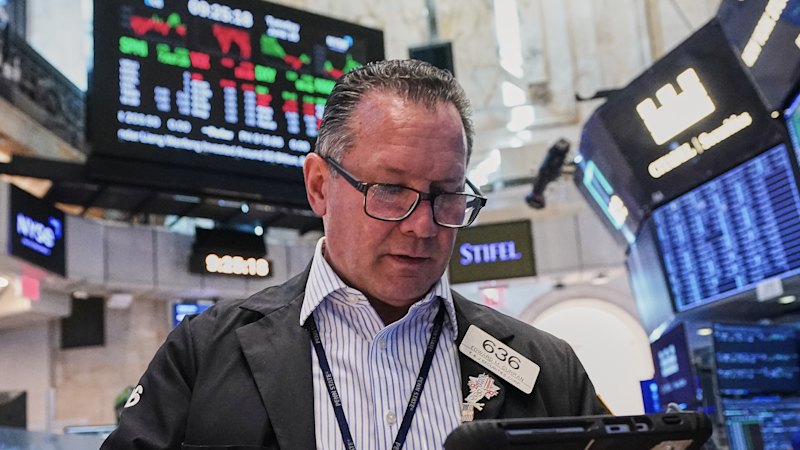
Wall Street has kicked off the week with strong gains.AP Photo/Richard DrewBrent crude fell 7.6 per cent to below $US105 a barrel, its biggest drop in three months, with the US and Iran both signalling a willingness to pursue peace talks as the war in the Middle East enters its ninth month.
Oil stocks slumped on the news, led by a 3.8 per cent slide each in Woodside and Santos shares. Refiner Ampol lost 3.5 per cent, while coal producers Yancoal and Whitehaven – whose products are a fossil fuel alternative when oil prices skyrocket - were down 4.9 per cent and 4.2 per cent, respectively.
Airlines soared on hopes of easing jet fuel bills. Qantas Airways rallied 6.5 per cent and Virgin Australia jumped 8.7 per cent.
The plunge in energy costs reverberated across financial markets a day before Americans cast ballots in the midterm elections. Iran President Masoud Pezeshkian said his government has been granted more authority by the country’s supreme leader to pursue peace talks, as US President Donald Trump hinted at progress in negotiations.
“They want to make a deal, and that could happen,” Trump told reporters in Washington. He added that oil prices had fallen because “it looks like that’s coming together very nicely” and “people found out about it”.
Moments later, he mouthed “No,” when a reporter shouted a question about whether he would resume military strikes on Iran after Tuesday’s midterm elections.
“It’s going to be an extremely interesting week in the markets,” said Matt Maley at Miller Tabak. “We’ll have political issues to decipher as well as geopolitical ones.”
On the local bourse, the mining and banking giants – combined making up more than half of the ASX – paced higher.
BHP, the world’s largest miner, gained 0.4 per cent. Gold miners jumped after bullion prices rebounded overnight as lower oil prices are hoped to ease pressure on the Federal Reserve to raise interest rates – which traditionally is a headwind for the non-yielding metal. Northern Star and Evolution Mining both jumped 3.1 per cent and Newmont rose 2.6 per cent.
Three of the Big Four banks advanced, albeit not by much, with CBA up 1.3 per cent, while National Australia Bank and Westpac both edged up 0.1 per cent and ANZ Bank slipped 0.3 per cent.
The tech sector was also higher, shrugging off losses by tech stocks on Wall Street, with WiseTech Global (up 1.2 per cent) and AI data centre operator NextDC (up 2.3 per cent) leading the gains.
On Wall Street overnight, an early session rally for US stocks petered out as the tech and AI industries remained shaky following their sell-off last week.
The S&P 500 sank 0.5 per cent after erasing a gain that had reached 1.1 per cent early in the day. The Dow Jones Industrial Average rose 0.4 per cent, while the Nasdaq composite fell 1.1 per cent.
The mixed performance for indexes came even though the majority of stocks within the S&P 500 climbed. They benefited from the drop in the oil price, the latest yo-yo move on uncertainty about when the war with Iran will allow the global industry to return to normal.
The price for the most actively traded contract in the Brent market has been veering between roughly $US70 and $US120 per barrel since just before the war with Iran began, and it’s been quick to reverse direction.
So have stocks in the artificial-intelligence industry, which have been shaky for months amid criticism that they surged too high and are in a bubble. Worries are growing that all the hundreds of billions of dollars Big Tech companies are pouring into AI data centres won’t yield enough productivity and profit to make the investments worth it.
The latest profit reports from Alphabet and other Big Tech companies also showed how AI may be dragging on their own businesses. Not only did Google’s parent company burn through more cash during the latest quarter, as measured by something called free cash flow, it also reported slower-than-expected growth in its search business, which raised worries about AI undercutting its cash cow. That caused Alphabet’s stock to drop more than 12 per cent on Thursday for its worst day on record.
On Monday, Alphabet initially rallied 2.6 per cent, but it later erased the gain and then finished with a loss of 0.3 per cent. Nvidia, meanwhile, went from an early gain of 2.6 per cent to a drop of 1.3 per cent following its 4.2 per cent slide on Friday. Such swings dragged the rest of the market with them.
Adding to the weakness in tech was Marvell Technology, which fell 12.7 per cent after saying it would buy Lumentum. Marvell said it will give 4.5 of its shares for each share of Lumentum, which sells lasers and other products that power the networks and infrastructure behind AI and cloud computing. Lumentum’s shares fell 18.6 per cent.
Apple shares fell 2.8 per cent in after-hours, extending their 1.8 per cent drop during the session, after the iPhone maker delivered a mixed outlook in its first quarterly report under chief executive officer John Ternus, with narrower profit margins overshadowing an upbeat sales forecast.
Though Apple predicted revenue growth of up to 10 per cent for the holiday season – beating the 6.1 per cent estimated by Wall Street – the company warned that gross margins would be thinner than projected. It’s also suffering from supply constraints that will make it harder to capitalise on new products like its foldable iPhone.
Outside of AI and tech, the US market did much better, and nearly seven out of every 10 stocks in the S&P 500 index rose.
Expectations are high for all kinds of companies to continue to deliver big gains in profits as the US economy keeps chugging along, even with high inflation and interest rates. That’s what helped send the S&P 500 to its record last month.
A report on Monday said that growth for US manufacturing was better last month than economists expected. Perhaps just as importantly, a measure of inflation in the survey by the Institute for Supply Management showed prices were rising at a slower pace.
In other international markets, indexes rose in Europe. The swings were larger in Asia, where South Korea’s Kospi jumped 2.2 per cent on renewed strength for the tech giants that dominate its market.
In China, indexes rose 1.1 per cent in Shanghai and 0.4 per cent in Hong Kong to recover some of their steep recent losses. The People’s Bank of China said Monday that around 100 billion yuan ($21.4 billion) would be deployed under a new program that could help support the market.
You have reached your maximum number of saved items.
Remove items from your saved list to add more.
You've used all of your gift articles. 3 more will become available on the 1st of every month.

