Anti-Billionaire Abdul El-Sayed Backed by Soros—List of Wealthy Supporters - Newsweek
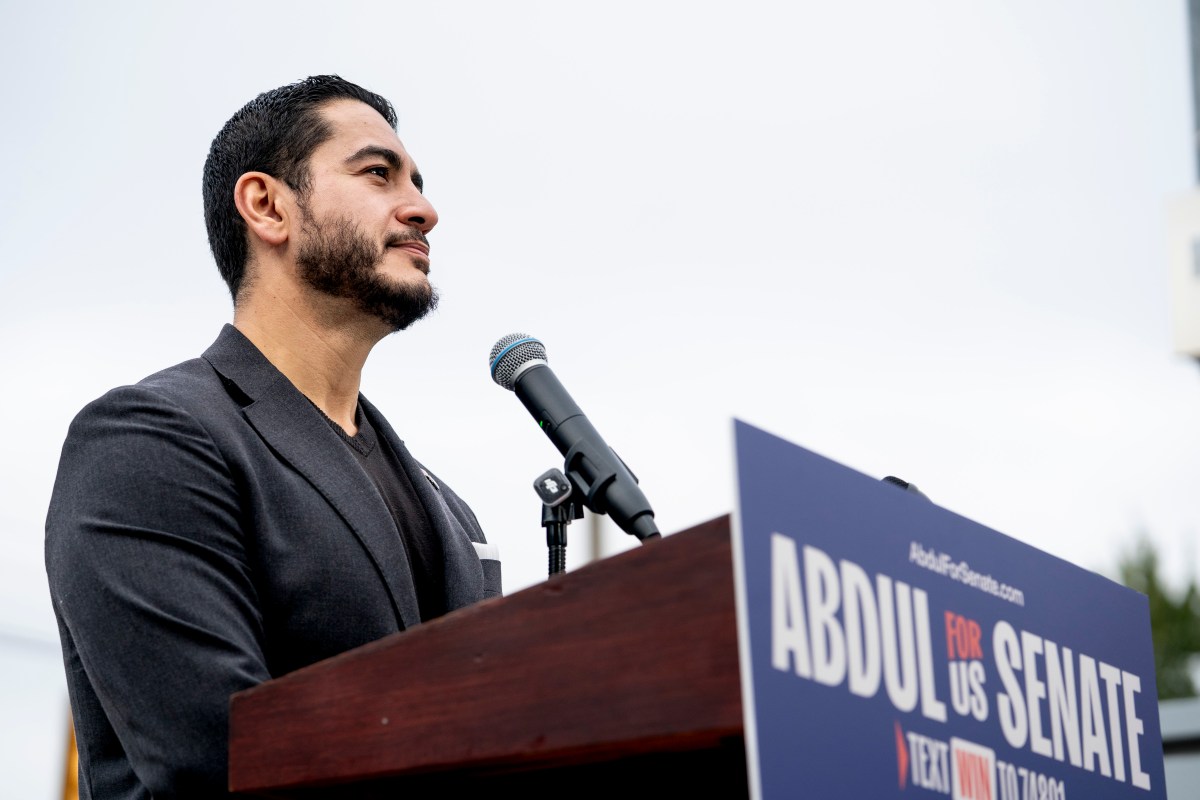
Michigan Senate hopeful Abdul El-Sayed has built his campaign around a promise to get money out of politics, but a recent fundraiser in West Hollywood has put the Democratic nominee’s own donor network under scrutiny.
Jeffrey Soros, a Hollywood producer and nephew of billionaire philanthropist George Soros, hosted El-Sayed on Monday night alongside his wife, Catherine Soros. During the event, Soros said he has known El-Sayed since 2012, when he interviewed him as a finalist for his parents’ fellowship for immigrants and their children.
Footage from the event later emerged, prompting the campaign of Republican rival Mike Rogers to call El-Sayed a “hypocrite” for courting wealthy donors while criticizing billionaires on the campaign trail. El-Sayed’s campaign pushed back by pointing to the money supporting Rogers, arguing that corporate interests are pouring millions of dollars in outside spending into the race on his behalf.
Newsweek reached out to the El-Sayed and Rogers campaigns for comment via email.
El-Sayed holds a narrow lead in most recent polls, with several showing a race that remains within the margin of error. The latest, a Fox News poll released Wednesday, put him ahead 50 percent to 49 percent among likely voters. Among registered voters, he led 51 percent to 48 percent, reversing an August poll that had Rogers ahead by 4 points among that group.
Forty-seven percent of likely voters viewed El-Sayed favorably, compared with 44 percent for Rogers, while 15 percent said they could still change their minds.
A New York Times/Siena poll conducted September 15 to 22 among 605 likely voters showed El-Sayed with a 49 percent to 44 percent lead. A Washington Post/Schar School survey had him ahead 48 percent to 45 percent, while Rasmussen Reports also found him narrowly ahead.
An Emerson College/The Hill poll of 1,000 likely voters, conducted September 12 to 14, similarly showed El-Sayed with a slight lead, 48 percent to 46 percent.
Two polls gave Rogers the edge. A survey commissioned by the Republican-aligned Common Sense for America PAC put Rogers at 44.4 percent to El-Sayed's 43.1 percent. A WDIV/Detroit News poll conducted August 31 to September 3 had Rogers at 45.8 percent and El-Sayed at 44.4 percent. In both polls, the difference was within the margin of error.
Sabato's Crystal Ball moved the race from Toss-up to Leans Democratic last week, while the Cook Political Report continues to rate it a Toss-up.
Since the primary, campaign spending has become one of the Republicans' main lines of attack against El-Sayed.
In mid-September, after El-Sayed met with Senate Minority Leader Chuck Schumer of New York in Washington, the Schumer-aligned Senate Majority PAC announced another $10 million in spending in Michigan, bringing its total commitment to $30 million, according to Axios.
Alyssa Brouillet, communications director for the Rogers campaign, told Fox News Digital that raising “dark Soros money in California” after asking Schumer for help was “the least surprising thing he's done all cycle.”
Rogers also skipped a September 15 televised forum on Fox affiliate WJBK in Detroit, accusing moderator Roop Raj of favoring El-Sayed. El-Sayed appeared for the event and spoke for about an hour beside an empty podium.
“If I were him, I wouldn't debate me either,” El-Sayed told reporters afterward.
Rogers told CBS News Detroit that his campaign had never agreed to participate in the forum.
On Sunday, the Detroit Free Press, Michigan's largest newspaper, endorsed El-Sayed. The editorial board noted that he has never held elected office and described his public health career as impressive but relatively short before criticizing Rogers over healthcare, tariffs and reproductive rights. The board called Rogers “the election denier who's willing to deprive Michiganders of essential rights.”
The two candidates are scheduled to meet October 8 for a debate hosted by WOOD-TV in Grand Rapids. Early voting in Michigan begins October 24, ahead of the November 3 election.
In late August, El-Sayed apologized to the Michigan Democratic Jewish Caucus over remarks that had upset Jewish Democrats.
El-Sayed's connection to the family goes back to 2012, when he won a Paul & Daisy Soros Fellowship for New Americans, a graduate program for immigrants and their children founded by George Soros' late older brother, Paul, and his wife. The award helped cover his medical degree at Columbia University, finished in 2014.
The son of Egyptian immigrants, El-Sayed is still featured on the fellowship's website.
Jeffrey Soros, the founders' son, sat in on his finalist interview: "I've had the pleasure of knowing Abdul since 2012," he told guests on Monday.
The invitation for that event allowed contributions of up to $57,800 per person to the Abdul for Michigan Victory Fund, a joint fundraising committee. Co-hosts included former Obama aides and Pod Save America hosts Jon Favreau, Tommy Vietor and Ben Rhodes.
Democracy PAC, the Soros family's super PAC, had given $9 million this cycle to Senate Majority PAC, the group spending $30 million to elect El-Sayed, according to campaign finance records through June 30 reviewed by Newsweek. Nothing in the filings shows that the money was earmarked specifically for Michigan.
Democracy PAC and Democracy PAC II have distributed more than $40 million to Democratic-aligned groups this cycle, including House Majority PAC and J Street Action Fund. George Soros handed control of much of his political operation to son Alex Soros in 2023.
El-Sayed's campaign committees raised about $14.5 million from January 2025 through July 15, the latest two-year reporting period, according to Federal Election Commission filings. Rogers' committees reported $10.9 million over the same stretch, though about $3.2 million of that came as transfers from other authorized committees, FEC data shows.
El-Sayed reported $14.4 million in individual contributions, more than double Rogers' $6.8 million. PAC money tilts the other way: Rogers took in $787,227 from other political committees and $62,000 from party committees, against $71,845 in committee money for El-Sayed.
By July 15, El-Sayed had burned through nearly $12 million, much of it in a bruising primary, and had $2.6 million left in the bank. Rogers, unopposed for the Republican nomination, had spent $6.7 million and held $4.5 million.
About $4.1 million of El-Sayed's individual money arrived in non-itemized gifts from donors giving $200 or less over the cycle, with the other $10.3 million itemized. Roughly 450 people had given him the $7,000 legal maximum, about three times the 150 who had maxed out to Rogers.
Senate Majority PAC's $30 million commitment draws on some of the Democratic Party's biggest donors.
On the Republican side, Planet Detroit reported that Rogers' campaign received $34,500 from seven Blackstone employees and that he holds up to $250,000 in a Blackstone real estate trust heavily invested in data centers.
Michigan gives Republicans one of their few real shots at flipping a Democratic seat. With Senator Gary Peters retiring, it is the only Democratic-held seat that the Cook Political Report rates a Toss-up.
Republicans hold a 53-47 Senate majority. Democrats need a net gain of four seats to retake control, since Vice President JD Vance breaks ties.
President Donald Trump carried Michigan in 2016 and 2024. Voters there have not sent a Republican to the Senate since 1994, and Rogers, a former U.S. representative, came up fewer than 20,000 votes short against Democrat Elissa Slotkin two years ago.
For Democrats, El-Sayed's run doubles as a test of the progressive wing. Endorsed by independent Vermont Senator Bernie Sanders, who caucuses with the Democrats, he beat Representative Haley Stevens in the August primary despite heavy outside spending against him. The party has not fully closed ranks, though, as 11 percent of likely voters who backed Stevens say they plan to vote for Rogers, the Fox News poll found.
If elected, El-Sayed will be the first Muslim in the U.S. Senate.
Contact Newsweek editors on this story: Jenna deJong and Dave Siminoff.