Alberta bill to limit institutional speech, comments from post-secondary schools - Global News
Alberta is proposing a new law that would restrict post-secondary schools from being able to weigh in on social and political issues.
Myles McDougall, Alberta’s Advanced Education Minister, tabled the Advanced Education Statues Amendment Act Tuesday afternoon.
If passed, it will require post-secondary schools to develop and implement institutional neutrality and freedom of expression policies, which McDougall could review.
The policies would bar post-secondary institutions, like universities and colleges, from making official statements on global political, social and ideological issues outside of their “academic mission.”
Beyond that, the bill has wide-reaching policy changes that would also authorize McDougall to set maximum tuition amounts for programs or groups of programs and enable the government to set minimum requirements for student codes of conduct.
As far as making official university statements, McDougall said there are some instances, like the loss of life, where the university could make an expression of sorrow or support but would not be able to explore any related politics.
“Underlying some tragedies there can be some political issues, and what we’re saying is that’s not the role for the institution to get into that area,” McDougall told a news conference before tabling the bill.
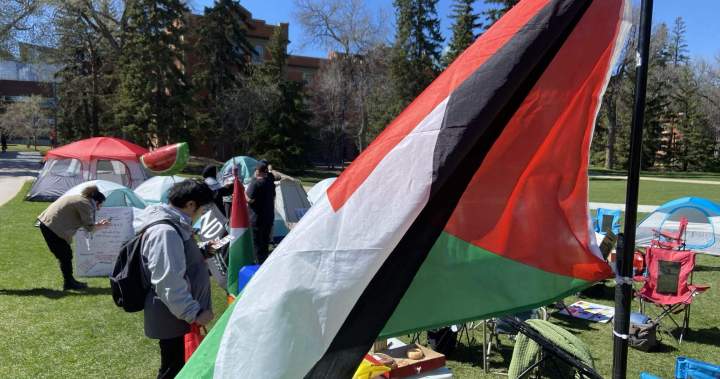
The Israeli-Palestine conflict is “obviously political,” he said, and institutions could not show support for either side, though those rules wouldn’t apply to university officials, staff or students. Private institutions and First Nations would also not be bound by the new rules.
In a statement, Premier Danielle Smith said “our universities and colleges should teach students how to think, not what to think. Alberta will protect that freedom and keep a great education within reach for everyone.”
British Columbia has seen a court challenge on that front.
Last year, several professors and a graduate student from the University of British Columbia filed a petition against the school over what they deemed “political activity.”
They said the activity violates legislation that the school remain non-political, citing issues with the university’s diversity, equity and inclusion policy, its public stance on the Israeli-Palestinian conflict and its Indigenous land acknowledgement, which declared the university was on “unceded Indigenous” land.
McDougall said there will have to be consequences if schools don’t follow the rules, but said those details are not prepared yet and he doesn’t expect it will be an issue.
David Eggen, the Opposition NDP’s advanced education critic, told reporters that much of the government’s bill was a waste of time.
He said the government’s focus on “culture war garbage” was merely a distraction from real issues affecting post-secondary schools and students, like stable funding and affordability.
“The government has not had a coherent policy for advanced education for seven years,” Eggen said.
“We can do better. We must do better.”
All the tuition changes in the bill apply to domestic students.
The bill would enable McDougall to replace annual tuition growth caps with maximum amounts.
The province did not say which groups or programs would be affected and did not respond to an emailed question about whether it aims to cut tuition costs or increase them.
McDougall said a combination of factors will determine the change in tuition, including the cost to offer the program.
Students already in their programs, though, will have tuition capped at two per cent next year.
Last year, an expert-panel estimated that two-thirds of Alberta’s tuition fee revenue come from domestic students while most other provinces rely more heavily on international students. Saskatchewan was the only province that relied slightly more heavily on domestic students for tuition dollars.
Statistics Canada data shows Alberta’s domestic tuition fees across all programs rose by 35 per cent from 2020 to 2027, the most of any province in Canada.
However, Alberta’s average domestic tuition cost of $8,260 is not the highest in Canada. In New Brunswick, it’s $10,373.