AI's coming roadblock in regulation: Antitrust hawks

The push to regulate artificial intelligence faces a big speed bump in Washington: Antitrust hawks.
AI companies have asked for narrow antitrust exemptions to collaborate on safety issues as they push Washington to regulate them amid growing fears that the technology could grow out of control. But some lawmakers on Capitol Hill who would write the laws regulating the industry are recoiling at the suggestion of an antitrust carveout.
"No," Sen. Elizabeth Warren, D-Mass., told CNBC at the Capitol when asked about a potential waiver. "Antitrust law already has an exception for companies working together on safety issues; there's no need for any additional antitrust waivers."
"I understand that big companies love antitrust waivers, but no," she said.
Warren was one of a number of antitrust exemption skeptics on Capitol Hill who CNBC spoke with to gauge the appetite for granting the request floated by Anthropic CEO Dario Amodei with support from other AI executives.
In a blog post earlier this month, Amodei raised the possibility of an antitrust waiver. The essay, titled "We Must Pace the Frontier," came after one of Anthropic's researchers resigned and said publicly that AI "could kill us all by the end of the decade."
"AI companies can and should voluntarily work together to set standards," Amodei wrote in the essay. "For antitrust reasons, it's helpful for the US government to mediate or at least enable these discussions — they don't need to participate, but do need to issue a narrow waiver for certain kinds of safety conversations."
Other AI executives quickly endorsed Amodei's call to action, setting off a mad dash in Washington to come up with rules for the technology.
But the short amount of time left this year for Congress to legislate and the bitterly divided nature of the government's legislative branch mean that any brewing dissent presents a risk to quickly passing legislation on a pivotal topic like AI.
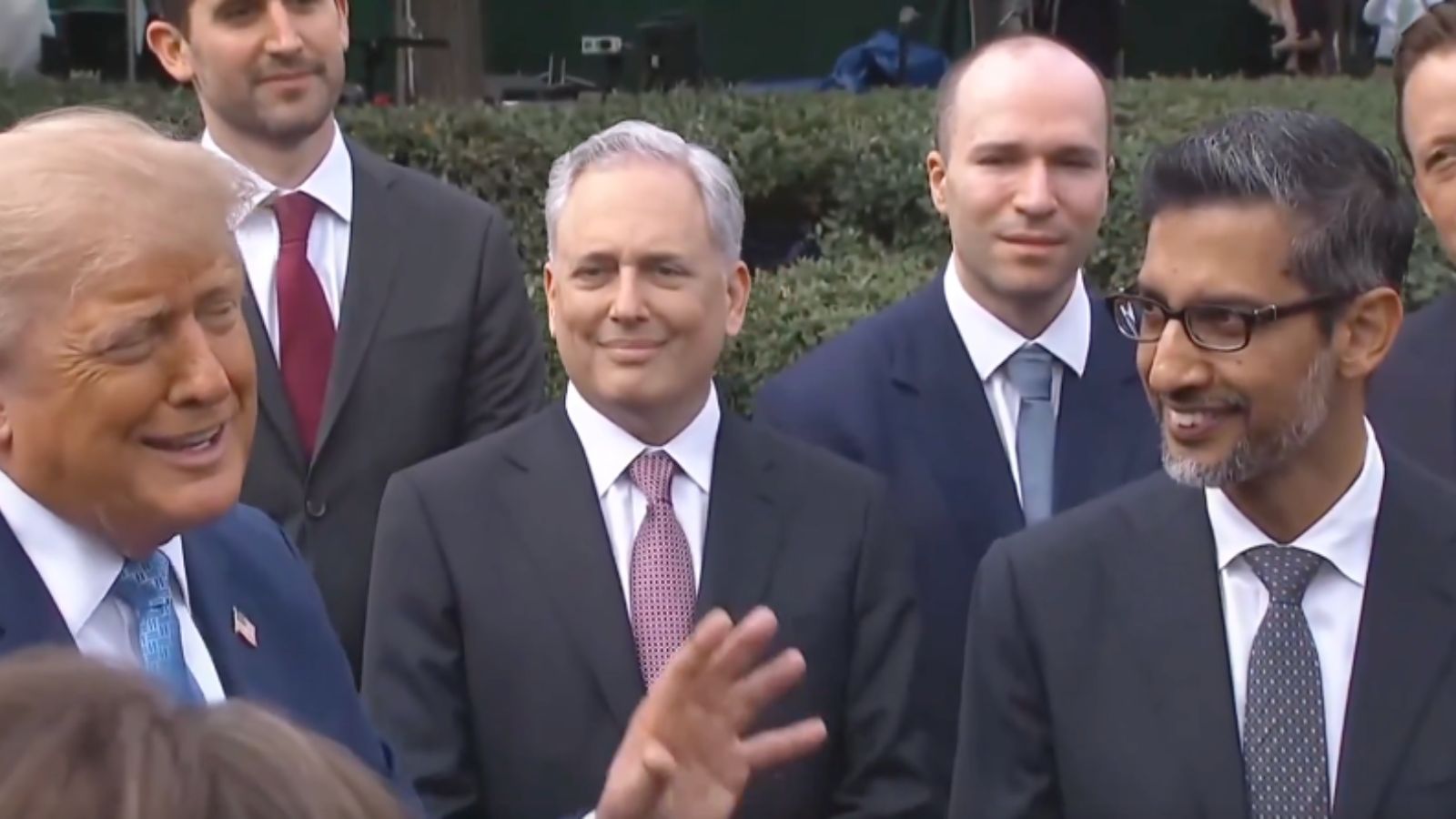
Antitrust enforcers are also skeptical of any carveouts for AI, whose executives met Tuesday at the White House with President Donald Trump.
In addition to Amodei Google's Sundar Pichai, Tesla and SpaceX chief Elon Musk, Meta's Mark Zuckerberg, OpenAI President Greg Brockman and Jensen Huang of Nvidia appeared at the White House as Trump declared that artificial intelligence should be called "super intelligence" instead.
Jonathan Kanter, who ran the Justice Department's antitrust division under former President Joe Biden, told CNBC an exemption to existing antitrust laws is not needed for the companies to collaborate on safety.
"They can share information about malicious threats and other information without an antitrust exemption," Kanter said. "The antitrust laws don't prevent companies from coming together to talk about how to develop standards to make products more safe ... what the antitrust laws might prevent is companies coming together and saying they should stop innovating and stop competing."
Amodei described such a slowdown in his essay about pacing as collective "limits on the rate of unchecked AI progress" and noted they could be legally challenging.
"They don't need to make those decisions jointly," Kanter said.
Kanter said Congress should separately consider imposing "basic rules of the road to ensure that the public is protected from harmful products and services in this new and emerging area."
He also warned safety could be used as a pretext for the companies to coordinate on other types of anticompetitive behavior.
"There's a real risk that you can get the antitrust exemption wrong," he said. "That being said, I don't think you need one.
Kanter and Warren are not alone in saying they don't think antitrust waivers are necessary for the companies to coordinate on safety.
"They don't need a waiver to prevent catastrophic consequences as long as they're cooperating with some kind of governmental rubric or oversight," Sen. Richard Blumenthal, D-Conn., told CNBC.
And Sen. Ruben Gallego, D-Ariz. warned about the possibility that Congress could rush into delivering the AI industry everything it wants.
"I'd have to see exactly how far that goes, it doesn't remove them from liability issues, first of all," Gallego said of potential legislation. "I'm not going to give them a free carte blanche on everything."
Sen. John Hoeven, R-N.D., said Congress is still trying to figure out a coordinated way forward on addressing AI. He warned that prior experience regulating other recent technological breakthroughs like the internet looms large over lawmakers.
"I think there's unhappiness with these antitrust carveouts that the internet guys got, so we're thinking about, okay, how do we avoid that problem with AI?" Hoeven told CNBC. "To just give them some carte blanche antitrust thing, we've seen that doesn't work."
In addition to the antitrust concern, some lawmakers are suspicious of calls for a coordinated slowdown of AI, warning it could result in regulatory capture — where a regulator intended to serve the public's needs instead bends to industry. Some analysts have suggested it could be a ruse to curb the companies' growing debt portfolios ahead of initial public offerings and stifle competition, though there is not concrete evidence of such coordination.
"A little bit," Sen. Kevin Cramer, R-N.D., said Tuesday when asked about whether he's concerned about the potential for regulatory capture on CNBC's "Squawk Box." "Anything that blocks entrance to an industry by somebody who's big in it, again, I'm always a little bit suspicious of."
Industry's call for a narrow antitrust exemption does have some supporters.
Reps. George Whitesides, D-Calif. and Bob Latta, R-Ohio, and Sens. Adam Schiff, D-Calif., and Jim Banks, R-Ind., carry a bill that would create such a carveout. It would allow AI companies to share information relating to AI security threats to prevent, investigate or mitigate the risk. The bill would also allow them to coordinate to reduce AI security issues by delaying or limiting the deployment of high-risk models.
"It needs to be harbored very narrowly to ensure the focus is on exactly what needs to be done around testing, evaluation and training that makes these models safer," Rep. Sam Liccardo, D-Calif., who pushed for Whitesides' bill, told CNBC. "Frankly, there's not a lot of incentive for these companies to want to collaborate on a whole lot of things; this is an intensely competitive industry."
_2026_09_30_13_28_27.jpg)