Airlines blame airport congestion, weather for flight delays - Premium Times Nigeria
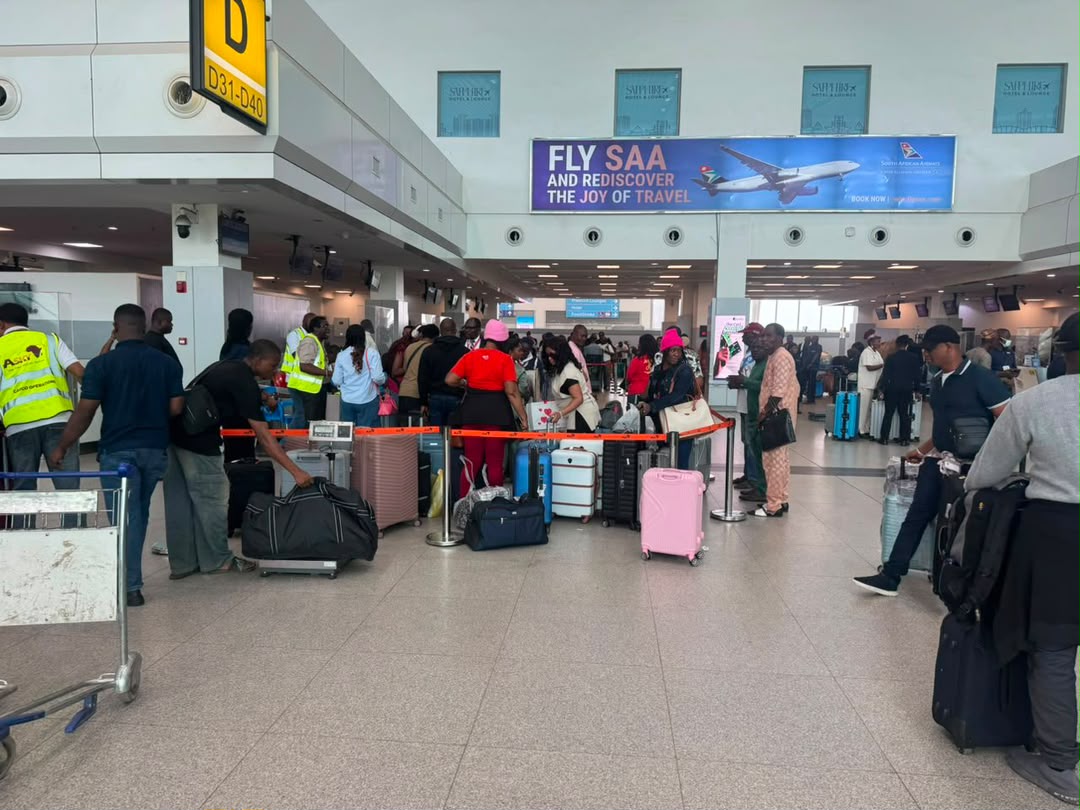
Nigerian airlines have attributed a significant share of flight delays and cancellations to airport congestion, inadequate infrastructure and adverse weather, saying some disruptions occur outside their control.
The operators, however, acknowledged that airlines are responsible for delays within their control and said passengers should also understand their rights when disruptions occur.
They spoke on Tuesday during the Aviation Day of the 23rd Akwaaba African Travel Market in Lagos, themed “Delayed and Cancelled Flights: The Rules and the Rights of Passengers — The Airline Perspective.”
The discussion comes amid growing concerns over flight disruptions in Nigeria.
PREMIUM TIMES previously reported that the Nigerian Civil Aviation Authority (NCAA) recorded 7,961 domestic flights in August, of which 4,765 were delayed, and 36 were cancelled.
More than 600 of the delays lasted at least two hours, with 407 lasting between two and three hours and 235 lasting more than three hours.
Air Peace recorded 1,330 delays from 1,864 flights, while United Nigeria Airlines recorded 943 delays from 1,231 flights.
The figures have renewed scrutiny of how airlines plan their schedules and handle passengers when flights are disrupted.
Speaking on the issue, the Chief Commercial Officer of United Nigeria Airlines, Adedayo Olawuyi, said it would be misleading to attribute all delays to airlines without considering conditions at airports and other factors affecting flight operations.
Mr Olawuyi compared airport congestion to having several vehicles competing for a single parking space.
He said an aircraft could be ready to depart at its scheduled time but remain on the ground because other aircraft were occupying the ramp or waiting to use the runway.
“Sometimes that’s what we face because of congestion at the airport,” he said.
According to him, an aircraft scheduled to push back at 6:59 a.m. could end up taking off more than 30 minutes later due to congestion, even though the airline had done what was required of it.
He said airlines also faced technical problems that required aircraft to be taken out of service until the faults were resolved.
“We operate machines. Have you ever woken up, and your car did not start? Sometimes we have technical challenges,” he added.
Mr Olawuyi said safety considerations meant airlines could not release an aircraft for service until necessary checks and repairs had been completed.
Weather, he added, could further compound delays.
He cited a recent United Nigeria flight from Lagos to Kano that was delayed due to bad weather in Kano.
The flight eventually departed Lagos at about 10:30 p.m., but when it approached Kano, a thunderstorm affected the runway lighting, preventing the aircraft from landing.
The aircraft returned to Lagos and landed at about 1 a.m., he said.
“That’s not the fault of the airline,” he noted.
Mr Olawuyi also said many Nigerian airports had limited night operating capabilities, meaning that delays earlier in the day could eventually result in cancellations when operations extended into the night.
Reacting to the NCAA data showing that about 60 per cent of domestic flights were delayed in August, Mr Olawuyi said the figures should distinguish between delays within an airline’s control and those caused by external factors.
“I will use an analogy. You go to school, and 60 per cent of the students fail. Is that the fault of the school?” he asked.
He said the data would provide a clearer picture if controllable and uncontrollable delays were separated.
“When you remove the controllable delays, and you have a high number of 60 per cent, then you can say the problem is the airlines.”
Mr Olawuyi argued that responsibility for flight disruptions should not be placed solely on airlines, saying airports, regulators and other operators within the aviation system also contribute to the conditions under which flights are operated.
His comments come shortly after the NCAA raised concerns about airlines’ operational capacity amid widespread delays.
At meetings with airlines in September, the NCAA Director-General of Civil Aviation, Capt. Chris Najomo questioned whether some carriers were operating schedules beyond their available aircraft and crew.
The regulator has also stressed that while delays and cancellations may occur for reasons beyond an airline’s control, carriers remain responsible for complying with passenger protection requirements during such disruptions.
Mr Olawuyi also spoke about airlines’ obligations to passengers during disruptions.
He said passengers should understand the protections available to them under the NCAA’s passenger protection regulations, while airlines also expect travellers to cooperate during disruptions.
“Passengers should know that their rights protect them,” he said.
He explained that passengers are entitled to refreshments when a domestic flight is delayed for the applicable period and that airlines have obligations to assist passengers during prolonged disruptions.
He also urged passengers to check airline messages for updates, arrive on time and use online check-in where available.
“When there are challenges, we expect you to remain calm,” he said.
Under NCAA Part 19, airlines are required to provide specific assistance during qualifying delays and cancellations, including refreshments and communication after two hours of a domestic delay, while longer disruptions may trigger reimbursement, re-routing, accommodation or compensation depending on the circumstances.
The regulations also distinguish between disruptions caused by circumstances within an airline’s control and extraordinary circumstances beyond its control.
This distinction has become increasingly important as airlines defend their performance against the rising number of delays recorded by the NCAA.
The Chief Commercial Officer of ValueJet, Trevor Henry, also attributed many delays to airport congestion and operational bottlenecks.
He cited presidential movements, weather, check-in congestion, security checks, and crowded boarding gates as factors that can slow operations.
According to him, congestion can continue even after passengers have boarded and the aircraft is ready to depart.
“When the aircraft taxis to the runway, especially in the morning, there can also be congestion from the taxiway to the runway before takeoff,” he said.
The Chief Operating Officer of the Murtala Muhammed Airport 2 (MMA2), Remi Jibodu, proposed better coordination of flight schedules to reduce congestion at peak periods.
He said thousands of passengers arriving at the airport around the same time could create avoidable pressure on airport facilities.
Mr Jibodu said it was not unusual for more than 10 airlines to schedule flights around 7 a.m., creating congestion at check-in points, boarding areas, taxiways and runways.
“What we can do then is to have a coordinated system,” he said.
He proposed that airlines and airport operators consider staggering departure times rather than having several carriers attempt to operate at the same peak period.
“The truth is that at this point, we have to look at the slot system to see how we can coordinate it. It may not be a full slot system, but we must be able to give a little bit of concession to that,” Mr Jibodu said.