After 2 years in office, how has Claudia Sheinbaum changed Mexico?
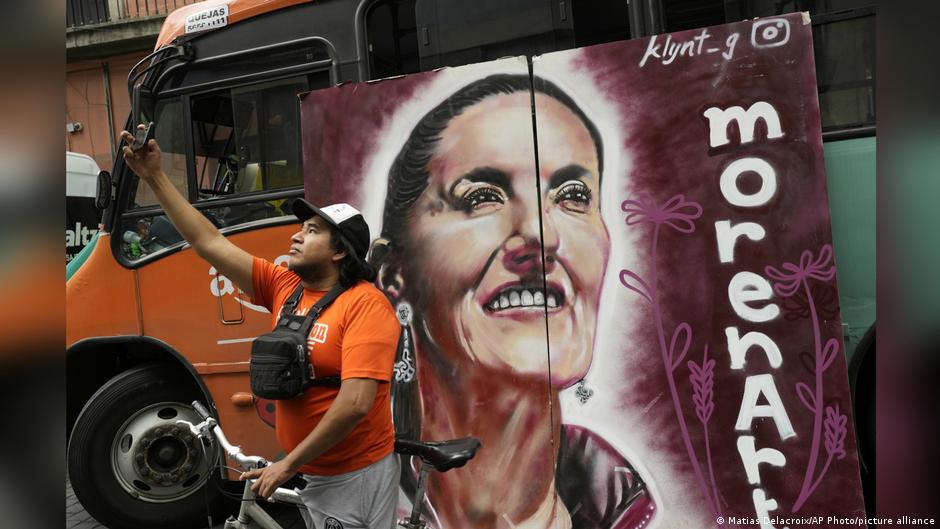
Claudia Sheinbaum was elected as Mexico's first female president in June 2024Image: Matias Delacroix/AP Photo/picture allianceAdvertisementSince Claudia Sheinbaum first took office in 2024 as Mexico's first female president, she has largely adhered to the political agenda of her mentor and predecessor, Andres Manuel Lopez Obrador.
But she has also had to contend with several problems that go far beyond Mexico's borders: violence inflicted by drug cartels, tens of thousands of missing persons and the growing political pressure from US President Donald Trump.
Sheinbaum has been able to report some progress when it comes to the security situation in Mexico. In her second government report, presented in September, she touted a 51% drop in the daily homicide rate since 2024.
To what extent this progress can be attributed to Sheinbaum's administration is, however, a matter of debate. While the Mexican Institute of Human Rights and Democracy has also noted progress in the effort to reduce homicides, the Mexico Evalua think tank has said there isn't enough statistical evidence to attribute the decline directly to measures taken by Sheinbaum.
And other indicators highlight a problematic trend. Mexico Evalua, referring to the government's own figures, pointed out that the number of recorded cases of kidnapping and enforced disappearances has surged by 127% over the last decade, "crimes against life" by 197% and femicide by 53%.
As of June 2026, the national register recorded a total of 135,271 missing persons. At the start of Sheinbaum's time in office in October 2024, that figure stood at around 115,000, according to an analysis by Red Lupa, a citizen-led network dedicated to monitoring disappearances.
"There is a lack of political will [to address the issue]," said Edgar Cortez, a project coordinator at the Mexican Institute of Human Rights and Democracy in Mexico City. On the one hand, he said, the government sees little political benefit, while at the same time it's lacking the technical expertise to coordinate the varied measures implemented at the state and federal levels.
Displacement — another consequence of violence — is also disrupting the lives of millions across the country. According to the National Institute of Statistics and Geography, violence or crime forced at least one member in 510,000 households — some 1.6 million people — to change their place of residence between October 2020 and October 2025.
Eduardo Bohorquez, director of civil society organization Transparencia Mexicana, told DW he has noted a shift in the government's strategy when it comes to fighting corruption. Two years on, he said the government is now focusing on the links between federal employees and organized crime.
As example he gave Operacion Enjambre, during which more than 100 public officials of varying political affiliation were arrested — including mayors, former mayors and police commanders, according to Mexico's security chief Omar Garcia Harfuch.
Critics, however, have accused the government of taking a selective approach. To date, no incumbent or former governor of Sheinbaum's ruling Morena party has been either prosecuted or detained for corruption or alleged links to organized crime.
Shienbaum has announced a package of reforms to tackle corruption, and Bohorquez said that will show whether or not her administration will actually chart a different course than that of her predecessor.
Domestic and foreign policy have been closely linked during Sheinbaum's two years in office. Most of that time has been shaped by Donald Trump's return to the White House in January 2025, and his administration's increasing pressure on drug cartels, migration and trade.
Trump has accused Mexico of not doing enough to tackle the cartels, with Washington classifying several Mexican criminal organizations as terrorist groups. The US president has repeatedly threatened to take unilateral action against the cartels. Sheinbaum, however, has opposed any US military actions on Mexican territory, calling instead for "cooperation without subordination."
At the same time, Mexico and the US have been cooperating closely — especially when it comes to migration. Between 2024 and 2025, the number of migrant contacts registered by US authorities along the US-Mexico border dropped by more than 84%, from 1.5 million to around 238,000.
Economic cooperation is also key to the cross-border relationship. Mexico and the US are currently negotiating several trade issues, including the future of the US-Mexico-Canada Agreement, known as USMCA. For its part, Mexico is hoping to reduce Trump's tariffs on steel, aluminum and automobiles.
After talks with Trump in September, Sheinbaum said both sides were working toward a trade deal. It remains a tricky balancing act for the Mexican president — developing the closest possible trading relationship with her country's most important economic partner, while at the same time not giving the impression that Mexico is giving up its political sovereignty under pressure from Washington.
The outlook is brighter when it comes to economic and social rights, with Cortez of the Mexican Institute of Human Rights and Democracy singling out the increase in minimum wage and government benefits for older people and those living with disabilities.
When it comes to other human rights concerns, however, he hasn't seen "any progress or setbacks." Alongside the staggering number of missing persons, Cortez also pointed out attacks on human rights defenders and journalists, along with a failure to sufficiently consult with Indigenous groups and rural communities when it came to major construction projects.
Sheinbaum has announced a plan to introduce a nationwide law against femicide that would align the various regulations on the local and state level, said Cortez. "That could end up being a positive, but the problem will be to put it into practice," he added.
The government's record on transparency remains problematic, according to observers, with Sheinbaum doing away with the National Institute for Transparency, Access to Information and Protection of Personal Data, or INAI. The responsibilities of the independent agency, which had been in place for two decades, have since been divided among several state entities.
"Instead of making things easier, everything has become fragmented," said Bohorquez of Transparencia Mexicana. Anyone looking for information from Congress, the judiciary, the military or local authorities now needs to go directly to the source.
Bohorquez also gave a mixed reaction to Sheinbaum's daily press conference, saying that while it was "a very effective political communication tool it didn't provide accountability."
For Cortez, that reflects a fundamental question of Sheinbaum's political priorities. New social programs bring "instant political benefits," he said, while advancing on civil and political rights required long-term effort and didn't allow the government to "immediately capitalize on political gains."
This article was originally written in German.