Adam Radwanski: Corporate Canada’s love-in with Mark Carney is like nothing we’ve seen before - Toronto Star
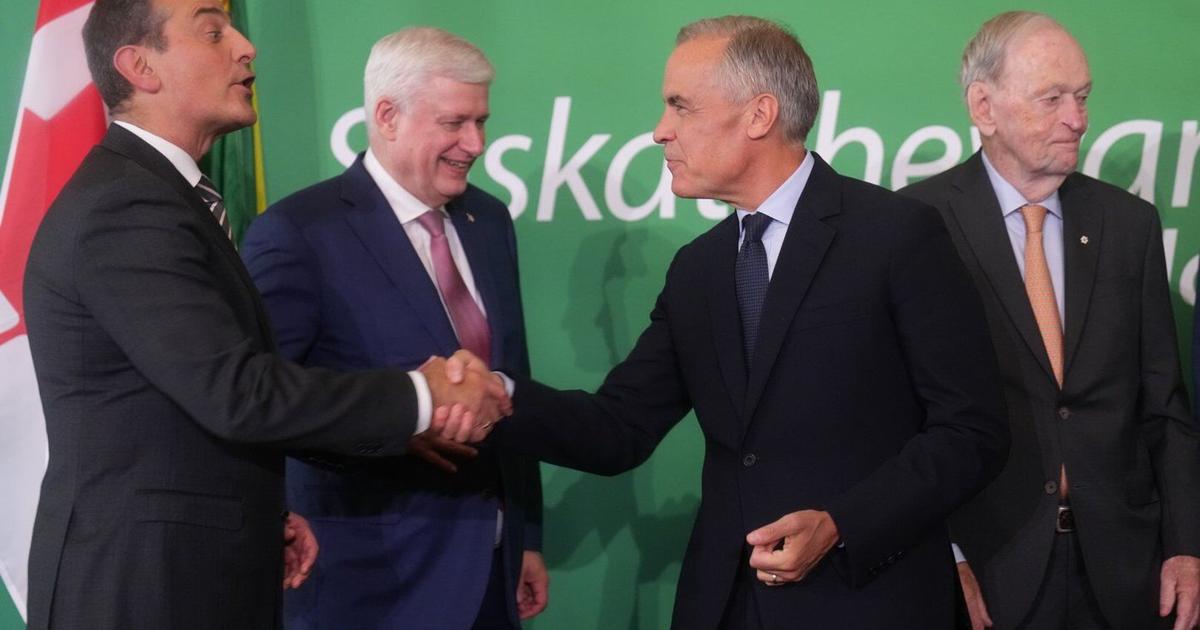
Prime Minister Mark Carney’s cozy relationship with corporate Canada may drive investment, but faces potential backlash if political moods shift, writes Adam Radwanski.
Bell Canada CEO Mirko Bibic, left, shakes hands with Prime Minister Mark Carney as former prime ministers Stephen Harper, second from left, and Jean Chrétien look on at Canada’s national investment summit, in Toronto, on Monday, Sept. 14, 2026.
Adam Radwanski is a business columnist for the Star, focused on the intersection of the economy, politics and public policy. Reach him via email: aradwanski@thestar.ca
At what point does a prime minister’s coziness with corporate Canada become politically problematic?
Mark Carney certainly isn’t at that point, yet. Not when he’s just reached a new high in aligning with the titans of Bay Street, the energy patch and Quebec Inc., for the benefit of a global audience Canadians are currently desperate to court.
In fact, the most impressive thing about his exclusive sales pitch this past week to foreign investors wasn’t that he leveraged his rolodex to attract a slightly sinister who’s who of global financial elites — from Saudi sovereign wealth fund CEOs to U.S. private-equity titans — to a two-day summit at a Toronto hotel.
It was that he managed to get Canada’s executive class — people who are historically cantankerous toward politicians allegedly making this country an uncompetitive place to do business — to sing to our visitors from the same hymnbook.
There was little of the usual complaining about overregulation, over-taxation, or anything else holding them back from domestic investments and causing them to put money elsewhere.
Instead, some of them arrived bearing gifts of patriotic financing: hundreds of billions of dollars in purportedly new pledges from our major banks to invest more in critical Canadian sectors, hundreds of billions more from big pension funds and other institutional investors, and a new Bell Canada commitment to quadruple a planned data centre in Saskatchewan.
The rest brought their pom-poms. Rich Kruger, the Suncor CEO not known for being onside with Ottawa even by oil-industry standards, pronounced himself “as encouraged or optimistic today as I’ve ever been for what our future holds.”
TC Energy’s Francois Poirier lauded Carney for “listening to the private sector to a degree that we’ve not seen in quite a long time.” RBC’s Dave McKay enthused about the feds, provinces and business leaders being on the same page
At a scrum with four heads of manufacturing heavyweights — Bombardier’s Éric Martel, Telesat’s Daniel Goldberg, Linamar’s Linda Hasenfratz and CAE’s Matthew Bromberg — I asked about government procurement policy. It’s typically a gripe in their worlds, because of bureaucratic impediments to supporting Canadian companies, but all I got were positive responses about how much it’s improving.
For this disorienting shift in collective tone, we don’t solely have Carney to thank. The mounting volatility of other markets, particularly the behemoth to our south, has a way of making Canada’s faults look more manageable and its stability more enticing.
But it’s been a very long time since big business in this country has had a prime minister catering to its policy demands the way this one is — something he reminded them of by using his keynote address to announce a massive expansion to capital-investment write-offs, touted as getting the marginal corporate tax rate down to the lowest of any G7 country.
More than that, he is — to a greater extent than any other modern prime minister — one of them.
It’s not just that he has a background in high levels of investment banking, as does much of his inner circle, and looks the part. He speaks their language, gladly takes their calls, and plainly prefers interacting with them to members of Canada’s political class.
That strikes such a stark contrast to both his predecessor and the leader of the opposition, each perceived on Bay Street as unfriendly and unserious, that his success is in their interests.
What makes this moment even more unique is that most Canadians seemingly see it as being in their interests as well.
Usually, politicians are wary of perceived tightness with the richest people in the country, for fear of being seen as indifferent to the needs and worries of everyone else. We were living in such times until a couple of years ago, before Donald Trump retook office.
Now, with economic growth and resilience in the face of U.S. aggression being prized above all else, it’s seen as a virtue to have mutual respect and admiration with the people who control where dollars flow.
The thing about political moods, though, is that they can change quickly — and so can attitudes toward people who embody them.
It doesn’t require a vivid imagination to foresee how much more poorly an event like this week’s, which may or may not become an annual thing, could play in future.
If Trump is no longer as top of mind, if the gap between rich and poor continues to grow, if the cost of basic needs keeps rising, if artificial intelligence embraced by business wreaks havoc on workplaces and civil society, if climate change goes back up the list of concerns, if privatization (like the airport scheme Carney unveiled this week) is seen to make public services worse...any of that and more could significantly reduce the charm of the prime minister and business elites feting each other at cordoned-off luxury hotels.
And as much as Carney needs to be mindful of that, so do his friends in high places — not because it makes the current love-in a mistake, from their perspective, but because it underscores the need to quickly make good on it.
As the tax regime is made friendlier than ever before, regulations are pared back and bridges are built to global capital, the excuses not to invest at home (or in many cases to demand new subsidies to do so) are running pretty thin.
Capital for the 167 projects in the prospectus that Ottawa cobbled together ostensibly for the foreign investors — but which, based on conversations with project proponents this week, was aimed as much at Canadian backers — will be a pretty good litmus test.
The same goes for willingness to finance Canadian tech companies that have long struggled to grow within Canada, and wind up either running into a wall or getting swallowed up by the U.S.
They could also show good faith toward the public and the government that answers to it, with sensitivity toward workers (by carefully managing, rather than racing toward, disruptions from technological shifts) and consumers (by curbing monopolistic practices driving up the cost of living).
And if the pillars of Canadian business can remain the global ambassadors that they were this week, singing praises rather than going back to bemoaning their domestic fortunes, so much the better.
All of that, even, might not avoid the eventual backlash, when the political pendulum swings again. But at least it would give us a lot to show for this interregnum of political and corporate symbiosis.
Opinion articles are based on the author’s interpretations and judgments of facts, data and events. More details
Adam Radwanski is a business columnist for the Star, focused on the intersection of the economy, politics and public policy. Reach him via email: aradwanski@thestar.ca