Adam Hamilton’s Chances of Beating Roger Marshall in Kansas Senate Race - Newsweek
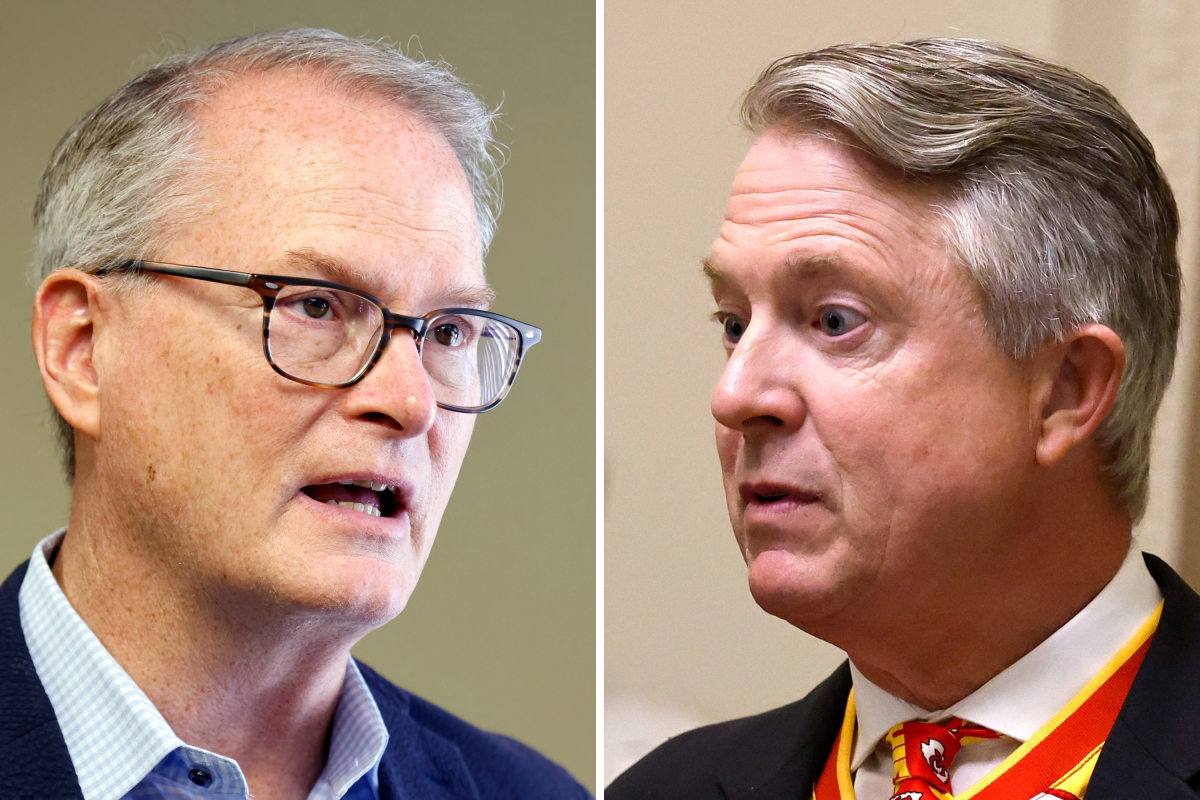
Democrat Adam Hamilton and incumbent Republican Senator Roger Marshall are squaring off in an increasingly competitive battle over Kansas, long considered a GOP stronghold, with a new poll showing the challenger narrowly ahead.
Marshall is seeking a second term, while Hamilton, the founder of the country's largest United Methodist Church, is trying to become the first Democrat elected to the Senate from Kansas when George McGill was reelected in 1932.
A Wedgewood Polls survey released this week found Hamilton with support from 50 percent of likely voters, compared with 48 percent for Marshall, while Libertarian David Graham received 2 percent. Hamilton’s 2-point advantage falls within the poll’s margin of error of plus or minus 4.4 percentage points, meaning the survey does not establish a clear leader in the race.
The survey was conducted among 500 likely voters using an online panel between September 22-24. Wedgewood said it independently designed and funded the survey and that no candidate, campaign, political party or outside organization sponsored it.
The Senate battle comes as Marshall has also voiced concerns about the way U.S. Immigration and Customs Enforcement (ICE) has carried out operations in southwest Kansas. On September 23, amid increased ICE activity around Dodge City, Garden City and Liberal, Marshall called for federal immigration agents to work more closely with local authorities to conduct enforcement operations.
Republicans have generally been strong supporters of the Trump administration's immigration enforcement agenda, including expanded deportation efforts and increased ICE operations. It comes after a slate of shootings involving federal immigration agents under the government's mass deportation policy.
Meanwhile, the White House dispatched Vice President JD Vance to campaign with Marshall earlier this month as Republicans scramble to shore up support in unexpectedly competitive Kansas.
The Sunflower State remains a strongly Republican one. President Donald Trump won Kansas by 16.1 points in 2024, up from 14.7 points in 2020. The state's electorate is also heavily white and non-college-educated, groups that have generally leaned Republican in recent elections.
Newsweek has contacted the campaigns of Hamilton and Marshall for comment on the latest polling.
The Wedgewood Polls survey was conducted less than a week after an Emerson College Polling/Nexstar Media poll also showed Hamilton with a narrow advantage.
That survey, conducted between September 15-16 among 750 likely Kansas voters, put Hamilton at 45 percent and Marshall at 43 percent. Graham received 4 percent, while 8 percent of voters were undecided. Hamilton's 2-point advantage was again within the survey's 3.6-point credibility interval.
The Emerson survey also provided an indication of how Hamilton could make the race competitive. Among independent voters in that poll, Hamilton led Marshall 42 percent to 27 percent.
The Wedgewood survey also found Hamilton received 54 percent support among women compared with Marshall's 45 percent, while Marshall led among men, 51 percent to 46 percent. Hamilton performed particularly strongly among voters ages 18 to 29, receiving 59 percent to Marshall's 40 percent. Among voters ages 45 to 64, Marshall led 52 percent to 46 percent.
Education also produced a substantial divide. Hamilton led 59 percent to 40 percent among voters with at least a bachelor's degree, while Marshall led 53 percent to 44 percent among those without a four-year degree.
Meanwhile, a co/efficient poll, conducted September 8-10 among 915 likely voters, had Marshall leading Hamilton 49 percent to 44 percent, with 5 percent undecided. The poll had a margin of error of plus or minus 3.22 percentage points.
A Global Strategy Group poll conducted August 12-16 among 800 likely voters found Hamilton narrowly ahead, 44 percent to 43 percent. The one-point difference was within the poll's margin of error of plus or minus 3.5 percentage points.
Another August poll showed Marshall with a narrow lead. A Public Policy Polling survey conducted August 7-8 had Marshall ahead 46 percent to 45 percent. The available results do not report a margin of error.
The state’s political history is more complicated once voters get beyond the Senate.
Governor Laura Kelly, a Democrat, has won two terms, and a 2022 ballot measure that would have removed abortion protections from the state constitution was rejected by 59 percent of voters.
Marshall, who won in 2020 by 11.4 percentage points, is leaning into the Republican coalition that has carried the state for decades, focusing on rural voters and warning that a Hamilton victory could help Democrats take control of the Senate.
Hamilton, meanwhile, is presenting himself as a centrist. He points to his own congregation, which he says is split roughly evenly among Democrats, Republicans and independents, as an example of the voters he hopes to bring into his campaign.
The nonpartisan Cook Political Report recently shifted its assessment of the Kansas race from "Likely Republican" to "Lean Republican."
The general election is scheduled for Tuesday, November 3.
Newsweek’s reporters and editors used Martyn, our AI assistant, to produce this story. Learn more about Martyn here.
Contact Newsweek editors for this story: John Fitzpatrick and Anthony Murray.