
Acclaimed artist Kent Monkman on creating a ‘beaver condo’ for Biidaasige Park - Toronto Star
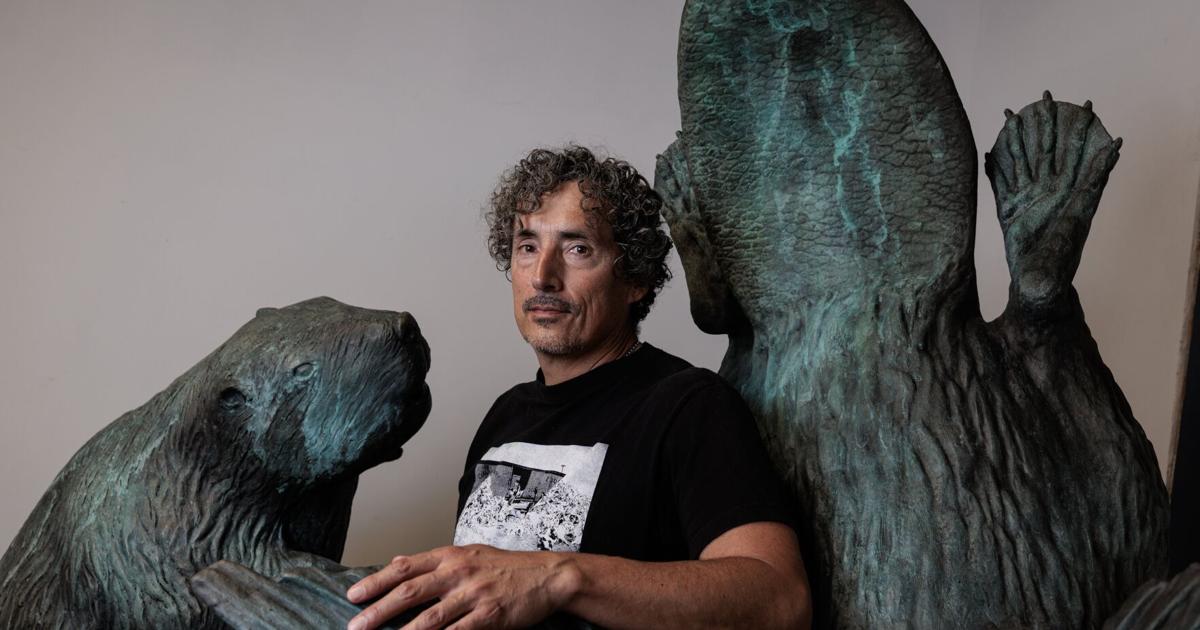
'The Colony,' the prolific Cree artist’s first outdoor installation, will be unveiled at the Lassonde Art Trail on Sept. 29.
It’s three weeks before the launch of his first public artwork and Kent Monkman has lost count of his beavers.
On Sept. 30 the prolific Cree artist’s sculpture, called “The Colony,” will be unveiled in Biidaasige Park’s Lassonde Art Trail, near the mouth of the Don River.
Continuing the artist’s practice of centring Indigenous world views while referencing Western European and American art history, “The Colony” consists of giant beavers in various states of Indigenous joy — singing, dancing, feasting — evoking the style of the baroque sculptures found in the Gardens of Versailles.
“I think that was beaver number 28,” Monkman said, as he walked through the MST Bronze Limited foundry in Etobicoke, where the sculpture’s components are being constructed. “There are so many of them, we still don’t know exactly how many there are.”
Some of the beavers are solo — one stands on a giant shell, in homage to Botticelli’s “The Birth of Venus” — while most appear in vignettes inside the massive 15-foot-high sculpture that he’s been calling “the beaver condo.”
Kent Monkman stands in front of his 12-foot “beaver condo.”
The shape of this beaver lodge he sculpted with the help of the foundry’s team was inspired by Veremondo Rossi’s 1763 engraving “La Caccia Dei Castori (The Hunt for Beavers),” which depicts hunters training their weapons on the animals’ home.
Beavers have been a constant theme in Monkman’s work. His 2011 painting, “Les castors du roi (The King’s Beavers),” commissioned by the Montreal Museum of Fine Arts, foregrounds French, English and Indigenous people brutally attacking the animals, while in the background, a domed hut occupied by many beavers, sits in the water.
“(That) painting was based on compositional conventions that were used by some of those painters that Louis XV had commissioned, hunting animals in foreign lands,” he said. “So this is the painting of North America that he never commissioned, which was about the fur trade, and so I snuck that lodge in there.”
Monkman found the beaver lodge in the Rossi etching to be hilarious as it was created by a European artist who’d clearly never seen real beavers.
That image stayed with him, and once the Lassonde Art Trail Foundation approached Monkman in 2023 to create a piece meant to sit on the waterfront, he immediately thought of giant beavers.
“I was thinking about the site, the landscape, the redirecting of the river,” he said. “Beavers play such a huge part in redirecting water in nature, so I imagine this beaver condo would be this reference to how important that species is to the land.” Besides, with the skyline full of highrise condos, a beaver condo made perfect sense.
The piece has been several years in the making — from drawing, to collaborating with the foundry’s digital artists, to translating those drawings into 3D digital models. A massive robot arm prints the pattern from the 3D files into giant blocks of foam, which are then covered with wax. A cupric coating is then applied to give the sculptures an aged, bronzed look, like copper roofs.
Monkman applies wax to a beaver sculpture at an Etobicoke foundry.
The family-run MST Bronze foundry is fully immersed in Monkman’s vision. One space holds the robot arm, the lodge and several individual beavers, while at a second location, metalwork and finishing take place.
Christina Trutiak, applying the patina for “The Colony,” said it’s the biggest piece the foundry has worked on.
“It’s monumental in size, and conceptually I think it’s brilliant,” she said. “The patina adds a very interesting finish, aged to the point where it looks like it hasn’t ever been maintained, (alluding to) how Indigenous people have been on this land since the start.”
“The Colony” is Monkman’s first sculpture, an evolution of his artistic practice that has been focused on paintings. But it’s not a complete departure, as it contains many references to art history that have been foundational to his three decades of his practice.
“I’m really an art history nerd, and look for inspiration and pull these references out, (like) Botticelli’s “Venus” and Bacchanalia scenes,” he said.
Additionally, “The Colony” features a small detail that encapsulates Monkman’s art — one beaver in the lodge reads “The Memoirs of Miss Chief Eagle Testickle,” written by the artist with his long-time collaborator Gisèle Gordon. The two-volume work tells the story of Miss Chief, Monkman’s gender-fluid, time-traveling alter ego, and her journey through history, illustrated with the artist’s paintings.
“Kent, in his decades of work in inserting Indigenous realities and truths, is taking that same reclaiming of narrative and putting it out in a very public-facing way,” said Gordon, who is unaffiliated with the sculpture.
“People will see a sculpture that, on the surface, is very playful, (but) like all of his work, is extremely seductive and draws everybody in. Then, if they go a bit deeper, they can see all kinds of references that open up into other stories and realities.”
The dancing beavers are meant to evoke the style of the baroque sculptures found in the Gardens of Versailles.
Centring the sculpture on beavers has many layers of meaning for Monkman. It’s an ode to the mistahi-amiskwak, the giant beavers found in Cree stories that are often credited with creating massive floods. The beaver was also a key figure in the fur trade, in which First Nations people would sell pelts to the French, Dutch, English and American settlers and explorers.
“I wanted it to feel very opulent. I wanted it to feel like a populated little village of beavers,” Monkman said, after checking on beaver number 28, while chunks of brown wax were being heated in a nearby crockpot.
Monkman’s most recent solo exhibition, “History Is Painted by the Victors,” a collection of more than 40 paintings, has toured the U.S., Australia, and, in Canada, Montreal, while his last large-scale exhibition in Toronto was the “Being Legendary” installation at the Royal Ontario Museum in 2022.
Having his first public permanent exhibition in this city, therefore, is very meaningful to the artist, who has lived in Toronto for more than three decades. A member of Fisher River Cree Nation, Monkman started his art career in this city, and has a deep connection to these lands.
“Embedding First Nations perspective on this land that is now populated with condos and people from all over the world — it’s a very important sort of landmark to remind people there were other cultures here a long time ago, long enough that you know we have stories about the giant beavers and the giant buffalo,” he said. “(‘The Colony’) looks back, but it also looks forward.”
As he travels between the foundry’s two locations, checking on the final work, Monkman reflects on what his first foray into sculpture means to him.
“To have a permanent outdoor piece has always been an attractive idea,” he said. “Even if you put your work in a museum, get your work on a wall, it might not be there long. They’ll change the exhibition.
“But this piece will be there for a very long time.”
This article was updated from a previous version to note that Kent Monkman’s “The Colony” sculpture in Biidaasige Park will now be unveiled on Sept. 30, not Sept. 29, as originally planned.
Error! Sorry, there was an error processing your request.
There was a problem with the recaptcha. Please try again.
You may unsubscribe at any time. By signing up, you agree to our terms of use and privacy policy. This site is protected by reCAPTCHA and the Google privacy policy and terms of service apply.
Kelly Boutsalis is a Mohawk journalist from the Six Nations of the Grand River reserve. Now living in Toronto, she devotes the bulk of her work to highlighting Indigenous stories.

