Abdul El-Sayed Scores Double Polling Boost Weeks Before Midterms
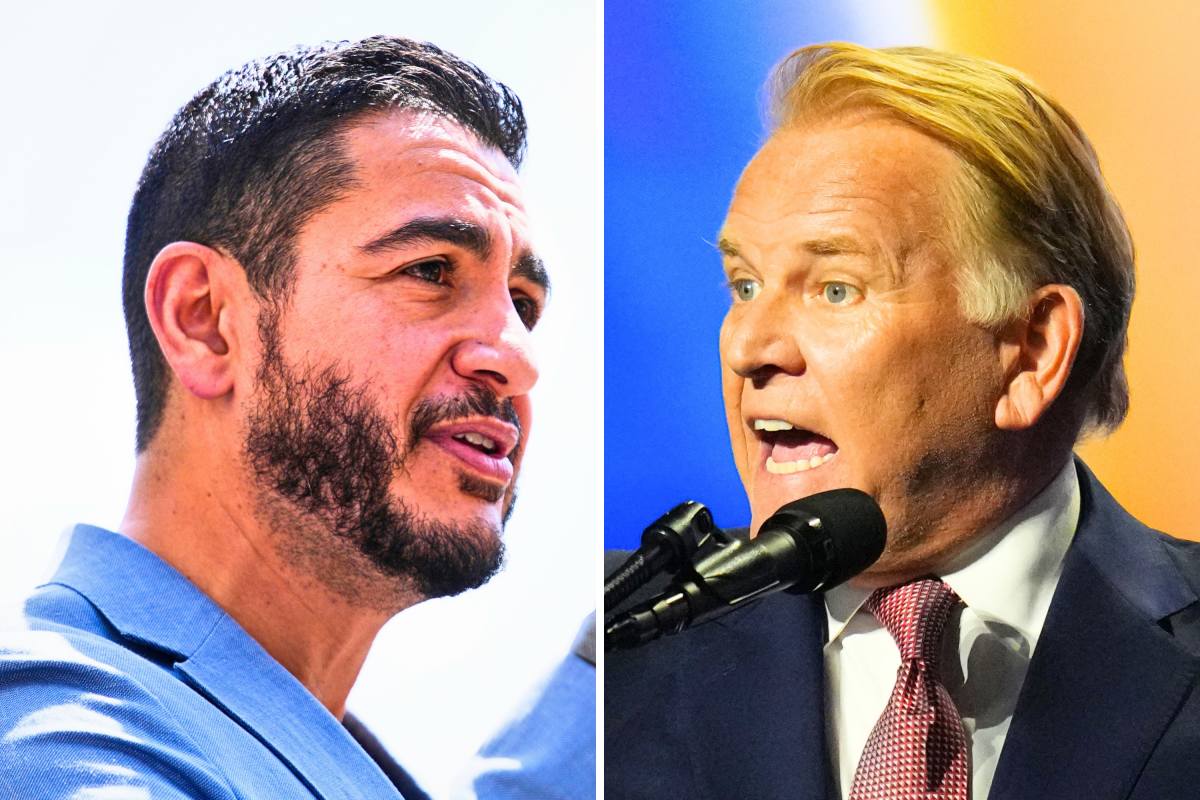
Democrat Abdul El-Sayed leads Republican Mike Rogers in two September surveys of Michigan’s U.S. Senate race as the midterm campaign enters its closing stretch and voters focus on household costs.
A Fox News poll found a near-even race, with a very slight advantage for the El-Sayed, while Big Data Poll measured a wider Democratic edge using another sample and approach.
The findings give El-Sayed fresh momentum and suggest he currently holds the better position, though neither survey shows a clear lead beyond polling uncertainty.
For Michiganders, the race offers a sharp ideological contrast—this is not merely a choice between a Democrat and a Republican, but between two competing explanations of why life feels harder.
El-Sayed, who holds a medical degree but does not appear to have practiced as a licensed physician, is running as an economic populist from the Democratic left, campaigning for Medicare for All, stronger unions, tougher antitrust enforcement and an end to corporate political influence.
He has cast the election as a struggle between ordinary voters and wealthy interests, arguing that candidates can win without corporate PAC money and that politics should “inspire people about what we can do.”
A longtime Republican establishment figure who has aligned himself closely with President Donald Trump, Rogers is presenting a conservative message centered on domestic manufacturing, public safety, lower costs and the “American Dream.”
At a September campaign event, Rogers framed the choice starkly: “Do you want to give your family divisiveness and anger, or do you want to give them the promise of America?”
Newsweek contacted both campaigns via email for comment on Thursday morning.
The Fox News Poll: Michigan Voters Split Between El-Sayed and Rogers, released September 30, put Abdul El-Sayed at 50 percent and Mike Rogers at 49 percent among 1,028 likely voters.
That one-point difference falls within the margin of error of plus or minus 3 percentage points. Beacon Research and Shaw & Company Research conducted the survey from September 24 to 28.
The registered-voter margin was plus or minus 2.5 points.
That poll also found Abdul El-Sayed ahead 51 percent to 48 percent, reversing an August result that placed Mike Rogers 4 points in front.
Candidate images were similarly close.
Forty-seven percent viewed El-Sayed favorably and 44 percent said the same of Rogers, while 39 percent were extremely concerned that the Republican was too close to President Donald Trump and 36 percent worried the Democrat was too liberal.
Each nominee retained overwhelming partisan support, leaving smaller groups to shape the margin. El-Sayed performed best with women, Black voters, college graduates, adults under 45 and union households; Rogers drew strength from men, rural residents, white evangelical Christians, married voters and white voters without degrees.
Economic strain offered the Democrat his clearest opening.
Four in 10 respondents said they were falling behind financially, and those voters favored him by 25 points.
Among the 70 percent calling living costs extremely important, his advantage stood at 13 points.
Rogers had firmer ground elsewhere, leading by 26 points among people prioritizing immigration.
A separate Wolverine State survey conducted by Big Data Poll produced a broader spread.
El-Sayed received 45.9 percent against Rogers’ 40.5 percent on the initial likely-voter ballot; after undecided respondents were pressed to lean, the figures became 46.7 percent and 42.1 percent.
The Public Polling Project interviewed 725 registered voters, including 678 classified as likely to participate, from September 22 to 24.
The stated margin of sampling error was plus or minus 4 points for each electorate at the 95 percent confidence level.
El-Sayed’s most notable advantage in that survey involved intensity.
Among extremely enthusiastic likely voters, 55.3 percent backed him after leaners were included, compared with 39.5 percent for Rogers.
Rich Baris, director of Big Data Poll, said some undecided Democrats were initially choosing another option but recalled that similarly hesitant voters in Virginia in 2025 ultimately supported their party’s candidate. The 2025 Virginia governor's race saw Democrat Abigail Spanberger defeat Republican Winsome Earle-Sears.
“The undecided voters in the race for U.S. Senate in Michigan remind me somewhat of the Virginia election in 2025,” Baris said in a statement released by the pollster.
“A not-so insignificant share of undecided Democrats are choosing someone else when leaned over a controversial nominee, though both candidates appear to have equal support among the rest of their base. In the end, they voted for the Democratic candidate.”
Newsweek’s reporters and editors used Martyn, our AI assistant, to produce this story. Learn more about Martyn here.