A Russian is dead from suspected plague after a lab accident. Should we be worried?
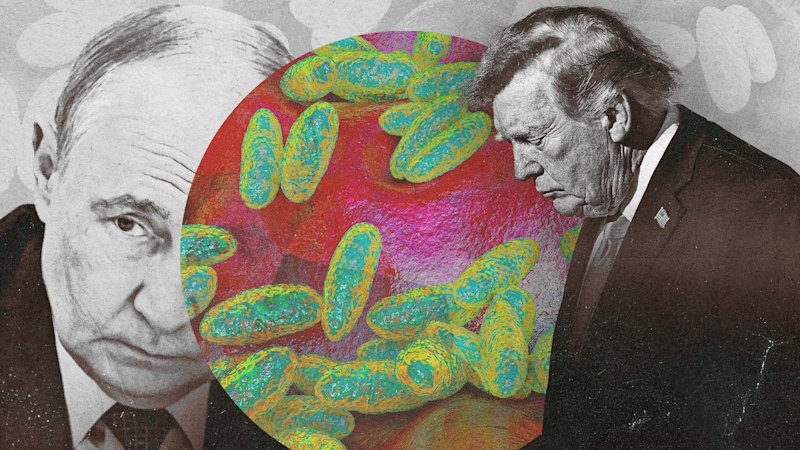
Donald Trump is worried about the plague.
“It’s a rough disease. You know, that’s a disease we used to be able to control, but somehow those microbes have gotten stronger and smarter. They’re like an army,” the US president said outside the White House after reporters asked him about rumours of a woman dying of pneumonic plague in Siberia last week.
“Even with great advancement, the germs have really become relatively stronger than they were, and things that used to work on pneumonia don’t work as well any more.”
Vladimir Putin’s Russia and Donald Trump’s United States are watching the scenario in Siberia, where a lab worker is feared to have died of plague.Illustration: Aresna VillanuevaWhile he had yet to speak with Russian President Vladimir Putin about the situation when he made his comments on Monday (US time), Trump said he was monitoring the situation with concern, and that the US was willing to help.
US Secretary of State Marco Rubio echoed this, noting Russian officials had shared some information about an infected lab technician and concerns more Russians could be affected.
Rubio, however, said he did not think there was cause for alarm, although he was aware that despite the limited travel between the US and Russia, “if something like that gets out, it could quickly spread”.
The Kremlin, meanwhile, is urging people to ignore speculation. Yet concrete information is difficult to find. Regional authorities in Russia and state-aligned media are editing and deleting conflicting reports, all of which pale against the bleak picture portrayed in local independent media.
Should we be worried about the suspected case of pneumonic plague in Siberia? Here’s what we know.
The official line is from Rospotrebnadzor, Russia’s federal public health agency and consumer safety watchdog.
It confirmed on Sunday (Monday AEDT) that a 28-year-old woman who worked in a laboratory at the Irkutsk Antiplague Research Institute of Siberia and Far East died after contracting “pneumonia of unknown etiology”.
According to The New York Times, the agency said that after “extensive” testing, “no microorganisms linked to her professional activity were identified in the patient’s samples”.
Rospotrebnadzor said a commission had checked the anti-plague institute’s compliance with biological safety requirements and “no emergency situations involving pathogenic microorganisms were identified”.
While two people among the woman’s contacts had tested positive for COVID-19, and two others had tested positive to rhinoviruses that cause a common cold, no other cases of infectious diseases were noted in the contacts traced and tested. Rospotrebnadzor said the Irkutsk region’s “sanitary and epidemiological situation” was stable.
Anna Popova, the head of Rospotrebnadzor, flew to Irkutsk – the region’s capital city, about 4200 kilometres east of Moscow – at the weekend to meet with the region’s governor, Igor Kobzev, and other officials. The woman died on Thursday (Friday AEDT), according to The Moscow Times.
Kobzev said in a statement shared to Telegram that the “extraordinary meeting” he had on Friday with Popova was about “a suspected case of a particularly dangerous infection in a resident”. All the dead woman’s identified contacts were put under medical observation.
Maksim Modin, the mayor of Shelekhov – the town where the anti-plague institute is located, about 20 kilometres from the city of Irkutsk – confirmed on Friday that the local hospital’s in-patient department was closed for quarantine. He wrote on Telegram that the hospital’s laboratory had suspended operations. Modin also urged residents not to spread rumours.
That same day, Aleksei Tsydenov, the governor of Buryatia – a region that neighbours the Irkutsk region – shared his own statement to Telegram. In it, he said the dead woman had not visited Buryatia. But the language he initially used was changed. And this is where people stood to attention.
Tsydenov, per The New York Times, first referred to the woman as someone “who died of plague in the Irkutsk region” before updating his statement to read “possibly died of plague”.
By Saturday, authorities in the town of Baikalsk – about three hours’ south of Irkutsk by car – advised against travelling to Shelekhov. The statement, citing “unofficial information” about “a case of plague”, has since been deleted from Telegram.
Artyom Fominykh, the director of the Irkutsk Aluminium Plant in Shelekhov, wrote on Telegram on Saturday that the plant’s staff would be required to wear masks, though he called it a preventative measure and urged calm.
“Better be safe than sorry,” Fominykh said.
On Sunday (Monday AEDT), independent local news outlet Lyudi Baikala reported that a maternity ward and other clinics were closed in Irkutsk, in addition to the hospital in Shelekhov where the woman died. Some reports claimed 200 potential contacts had been identified, and those people were in quarantine.
Local reporter Pavel Stepanov identified the dead woman as a 28-year-old lab technician who broke a test tube containing pneumonic plague bacterium.
Stepanov defended his reporting in a follow-up post shared to Telegram, which also questioned why authorities and state-aligned news outlets had wiped statements and stories on the situation.
REN TV, a free-to-air news network majority owned by pro-Kremlin private holding company National Media Group, reportedly deleted at least three posts about the situation, including one that reported the dead woman researched plague and named her. According to Reuters, local media identified the woman as Darya Shipilova.
According to the Associated Press, Kremlin spokesman Dmitry Peskov said on Monday (Tuesday AEDT) the public and media should follow Rospotrebnadzor’s official statements instead of “rumours or speculation”.
Though at least 50 million deaths in Europe were caused by plague during the 14th century’s Black Death, all main clinical forms of plague – bubonic, pneumonic and septicemic – are now treatable with antibiotics if detected early.
Caused by the bacteria Yersinia pestis, plague is mostly found in small mammals and their fleas in all continents except Oceania and Antarctica. Humans can be infected from bites from infected animals, unprotected contact with contaminated materials or infectious bodily fluids.
Plague is endemic to Siberia, which was the site of the first known prehistoric human outbreak, but it’s rare for Russians to fall ill with it.
Since the 1990s, most human cases of plague have been reported in Africa, particularly in the Democratic Republic of the Congo and Madagascar, though there were epidemics in Asia and South America in the first half of the 20th century.
The World Health Organisation says bubonic – characterised by its dramatic “buboes” boils – is the most common form of plague globally, with a case-fatality ratio of 30 to 100 per cent if untreated. It can develop into pneumonic or septicemic plague. Human-to-human transmission, however, is rare.
Pneumonic is the most virulent form of plague. The WHO notes pneumonic plague is “especially contagious and can trigger severe epidemics through person-to-person transmission via respiratory particles”.
Symptoms of pneumonic plague include those associated with pneumonia – fever, headache, weakness, shortness of breath, coughing, chest pain, bloody or watery mucous – and can develop rapidly after infection, sometimes within 24 hours.
Lab workers at the Irkutsk Antiplague Research Institute of Siberia and the Far East. This undated photo was released in 2019.Irkutsk Antiplague Research Institute of Siberia and Far EastRecovery rates are high when the strain is detected and treated within 24 hours of symptoms starting. But the lung-based plague is fatal without early diagnosis and treatment.
Septicemic plague is when the bacteria multiply rapidly in the bloodstream, and can lead to organ failure and tissue death of the extremities. Symptoms can include a bluish discolouration of the skin. It is fatal if left untreated.
Founded in 1934 by epidemiologist Aleksey Mikhailovich Skorodumov on the order of the Soviet Union’s Labour and Defence Council, the institute initially acted as a regional plague control body.
It has since expanded its scope to other dangerous diseases, focusing on research, prevention, diagnostics and outbreak response for cholera, brucellosis, tularemia, anthrax and arbovirus infections.
The institute operates under Rospotrebnadzor. According to its website, 95 employees work there.
In its 2025 Arms Control Treaty Compliance Report, the United States accused Russia of continuing to develop biological weapons in violation of the 1975 Biological Weapons Convention. The Kremlin denies this.
Although the US alleges these programs occur in laboratories in Russia, this specific Irkutsk facility was not mentioned in the report.
Social media is ablaze with conspiracy theories, helped in large part by the recent release of Biological War: A Scenario. Written by investigative reporter Annie Jacobsen, the book starts with a plague outbreak in Siberia that unfolds into a catastrophic global event in a matter of days.
“It is fiction, but it is frightening precisely because it is all too plausible,” former British Army officer Hamish de Bretton-Gordon wrote about Jacobsen’s book in the London Telegraph, citing the institutional knowledge from the offensive biological weapons program that endured after the Soviet Union’s collapse, and transparency concerns from China’s response to COVID-19.
The WHO, however, has said “the public health risk to the general population appears to be low” based on the information available. The organisation will conduct new risk assessments once it receives further information.
Putin and Irkutsk Governor Igor Kobzev in 2025.APRussian authorities are meant to report to WHO that the woman’s death was caused by pneumonic plague if they confirm that is what happened, though this could take days as they await test results.
Former and current officials in the US are emphasising the need for Russian leaders to share as much information as possible.
“What we need right now is really transparency from the Russian authorities, and I’m worried about whether we’re going to get that or not,” Ashish Jha, the White House COVID-19 response co-ordinator in 2022-23, told The Washington Post.
Rospotrebnadzor had the situation “under control”, Modin, the Shelekhov mayor, wrote in a Telegram statement issued on Monday (Tuesday AEDT), the same day Trump and Rubio confirmed they were watching the situation. Modin also said a “set of anti-epidemic measures is being carried out”.
All public events in Irkutsk have been cancelled. Law enforcement officials have opened a criminal investigation into possible safety violations surrounding the woman’s death, according to Russian media.
Get a note directly from our foreign correspondents on what’s making headlines around the world. Sign up for our weekly What in the World newsletter.
You have reached your maximum number of saved items.
Remove items from your saved list to add more.