A Camino that leads home: Alvin and Jean walk for Masithandane - IOL
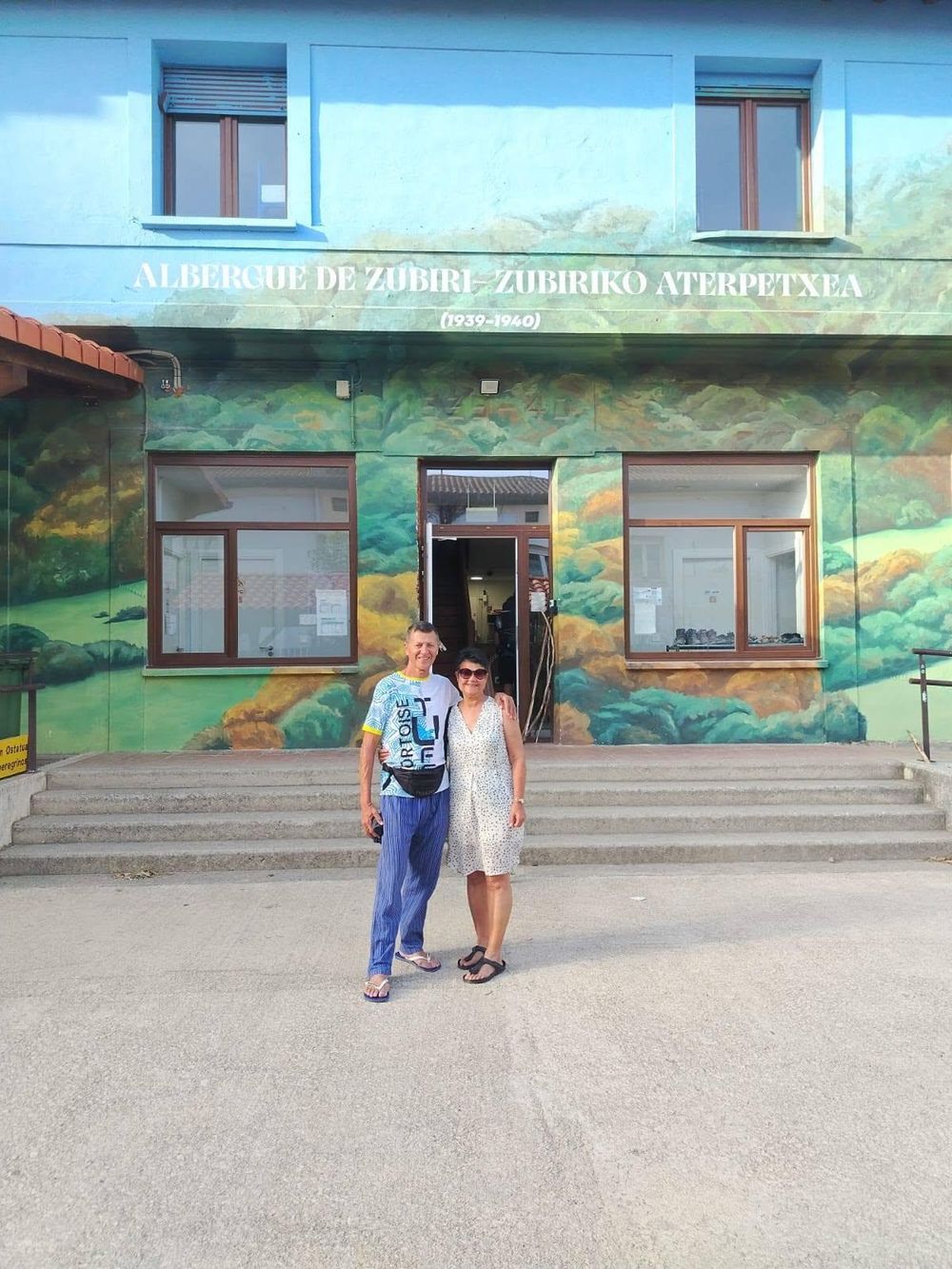
Alvin and Jean Witten on the Camino Francés.
Alvin and Jean Witten began the Camino Francés, the most popular and famous route of the Camino de Santiago network, on September 3 at Saint Jean Pied de Port in France.
This account is based on a series of diary updates Alvin has shared from the trail.
In a conversation during the pilgrimage with IOL, Alvin said the Camino had been on their wish list for years. People walk for religious or spiritual reasons, to find themselves, or for the adventure, he said.
“We wanted to give this walk a deeper purpose.”
The Camino Francés is a historical route converging on Santiago and the shrine associated with St. James.
For Alvin and Jean, faith and the pleasure of walking together sit beside an appeal for a community far from Spain.
Jean knows some of that work firsthand.
“I belong to a group called Happy Hands, and we knit squares, and we crochet blankets,” she told IOL.
The group has supplied blankets to Masithandane, an organisation whose community care serves children, adolescents, adults, and older people in the Sedgefield area, providing health and nutritional support.
The Camino appeal names the organisation as its general beneficiary, allowing funds to be directed where the community needs them most.
For Alvin, the needs of children bring back his own childhood. One of 12 children, he grew up knowing that his self-employed father did not always have work.
He remembers arriving at school hungry and waiting for the first break, when a feeding scheme provided “a jam sandwich and some milk”. In winter, there might be soup and bread.
“We knew poverty. We knew pride. And we learnt how to make do with very little,” he told IOL.
His parents told him, “Don’t worry, my child. The Lord will provide.” Seeing children face hardship now draws the connection to his own walk: “And the difficult thing is that this isn’t history. It is happening today.”
Setting out on Day 1 of the pilgrimage.
Before dawn on Day 1, September 3, Alvin lay awake in an upper bunk in Saint Jean Pied de Port, hearing snores and a distant rooster.
Jean wanted to set out early, before the heat. The roughly 25km stage to Roncesvalles rose through the Pyrenees under a clear sky.
By the time they reached their first stop, they were tired and, Alvin wrote in a diary update, felt “an overwhelming sense of achievement”.
The following morning, they left before sunrise for Zubiri.
“Yesterday, the mountain challenged body, soul and mind,” Alvin wrote. The new day had its own demands, but also a breakfast of bread, goat’s cheese, and basil that he remembered long afterwards.
They had chosen not to book every bed ahead, “because we don’t want to be controlled by a destination,” Alvin explained to IOL. That evening they found places beside a church and shared supper with pilgrims met on the road.
Jean settling into a shared hostel bunk bed.
Age brought a lighter hostel moment. At one stop, staff asked Alvin to take an upper bunk so lower ones could be saved for older arrivals.
He and Jean asked for lower beds beside each other. The staff later saw on his papers that he was 69 years old, and apologised.
By their fourth day on the road, cloud cover softened the sun over 19km of harvested fields to Puente la Reina. At Alto del Perdón, the couple stood beside the metal figures of pilgrims depicting travellers from different historical periods.
“Now we were standing in the picture,” Alvin wrote.
A pre-dawn start on the trail, passing through Ayegui along the route.
Two mornings later, outside Ayegui, they missed the markers and strayed onto a forest path in the dark. Alvin used the torchlight of other lost walkers to guide their group of five back to the route.
Later, they met Eve and Lars Gunnar, a Swedish couple aged 77, walking their third Camino and approaching 50 years of marriage.
Eve and Lars-Gunnar from Sweden are walking their third Camino.
Cooler clouds on Day 8 persuaded Jean and Alvin to go beyond their intended stop at Navarrete and on to Nájera, about 30km in all. Looking back, Alvin saw Jean pushing on her knees with her hands to keep climbing, continuing without complaint
Jean and Alvin on Day 9 of their walk.
They passed another planned stop on Day 9, going beyond Santo Domingo de la Calzada to Grañón. There, 64 pilgrims pooled their efforts to prepare supper, eat, and wash up.
“Sixty-four strangers had somehow become one little community, each doing their bit,” Alvin noted.
Day 10 was shorter, about 16km to Belorado. When they approached what looked like a café, they discovered a former pilgrim who offered breakfast for a donation, noting he had walked the route six times himself.
Alvin left with a question: “How often am I actually doing something for my neighbour?”
Jean pushing through foot pain on the road to Atapuerca.
On Day 11, Jean’s left arch began to hurt past San Juan de Ortega. Having cooked curry for a group the previous evening, she now had to push through the pain as beds at several stops proved unavailable.
The Camino brings people from all walks of life together.
Arriving at the Cathedral of Burgos.
Day 12 offered a first view towards Burgos. Reaching its cathedral did not end the walking; without GPS, they followed markers through traffic, facing a flat final 8km to Tardajos.
“I have walked up steep hills that seemed easier than this,” Alvin wrote.
The flat expanse of the Meseta begins.
The flattened landscape of the Meseta.
Day 13 brought a deliberate easing: 20km from Tardajos to Hontanas. The broad farm country of the Meseta opened around them.
“As the landscape flattens and the distractions disappear, there is nowhere much to hide from your own thoughts,” Alvin reflected in his diary. He and Jean agreed they were “not going to race the Meseta”.
“The Meseta is teaching me that there is beauty in the ordinary,” he wrote.
After struggling to find soap or toothpaste at an earlier stop, a roadside food truck provided a much-needed morale boost.
Jean put plasters on before blisters could form and asked Alvin to rub the shoulders marked by her pack. Such small care helped them prepare for the next morning.
A welcome roadside food truck provides a morale boost.
The Wittens described their shared destination as a unifying force among people of different faiths and cultures: “We’re all walking towards Santiago.”
Day 18 was a 31km stretch to Reliegos. When pressure grew on Alvin’s left foot, he changed into the inexpensive shoes packed for evenings and walked the remaining 12km in them. “I’d choose adventure over comfort any day,” he wrote.
Jean spoke of what the walk was teaching her. “You can be happy with little, really,” she said.
Navigating the paved streets beyond León.
Leaving León meant navigating about 9km of paved streets. Beyond the city, the path towards Villadangos del Páramo ran beside a motorway.
Two days later, they walked 28km to Astorga.
At a table along the way, strangers offered fruit and cold water without setting a price. “Our gift lies in giving,” Alvin recalled being told.
By Astorga, Alvin’s watch put their recorded walking distance beyond 500km.
Along the way, distinctive doors cut into hillsides caught Alvin's attention. He later learnt from local signage that they led to underground wine cellars, where the earth historically helped maintain a steady temperature for stored wine.
They looked to him like Hobbit houses.
A scenic view along the Camino route.
Alvin Witten turned 69 on a mountain. Ahead lay the climb to Foncebadón, one of the highest stages of the Camino Francés.
“Blessings, Bishop!” Before retirement, Alvin had served as a bishop in his church ministry. “Coincidence? I prefer to see God’s hand of grace in it,” he wrote.
The birthday ended with a quiet thank you to the people supporting their fundraiser for Masithandane in Sedgefield.
Alvin celebrates his 69th birthday on the trail.
The next morning, before sunrise, they left Foncebadón in darkness for Cruz de Ferro, the highest point of their Camino at about 1,504 metres above sea level.
The descent towards Molinaseca was another test. “It was more like mountain climbing in reverse!” Alvin wrote.
Leaving Foncebadón in darkness before sunrise.
According to Camino lore, it is a tradition for pilgrims to carry a stone from home to leave at the iron cross. Here, Alvin and Jean left stones of their own, reaching Molinaseca after 23 days.
Reaching Cruz de Ferro, the highest point on the Camino Francés.
As they left for Villafranca del Bierzo, roosters were crowing and the roads were quiet.
“Just Jean and me, our backpacks, the Camino beneath our feet and the complete freedom of having nowhere else we needed to be,” he wrote.
The route passed through Ponferrada, where the Castillo de los Templarios rose above the town. Alvin noted that the Camino reminded him he was not simply walking through Spain, but “walking through history”.
Facing an unexpected uphill climb toward Villafranca del Bierzo.
They had planned to stop at Cacabelos but reached the town before the albergue opened, deciding to walk another 8km to Villafranca del Bierzo.
“Murphy’s Law had obviously decided to join us,” Alvin wrote when the road turned upwards almost immediately. “Some days are easy. Some are hard. But every day gives you something.”
The day became a parade of small encounters. There were cows with bells, a farmer tending sheep, and villages that looked as though they had been forgotten by time.
On September 28, the next stage began with another climb to La Faba. Alvin said it felt “as though we were walking on the roof of the world”.
The final two kilometres were steep and exhausting, taking “every ounce of energy we had left”.
The steep, mountainous terrain near La Faba.
They crossed from León into Galicia, descending towards Triacastela where they spent the night.
León into Galicia with Thomas and Boas, two young Dutch pilgrims.
The couple crossed from León into Galicia with Thomas and Boas, two young Dutch pilgrims they had met days earlier. Their paths had continued to meet along the route.
Finding encouraging messages during a difficult stretch of the walk.
The walk to Sarria on September 29 began with a steep, rocky climb before dawn. Dust blew into their eyes. Both were finding the day difficult, but neither had said so.
“Neither of us was struggling alone. We simply hadn’t said it,” Alvin wrote. When they talked, they were able to encourage each other.
When they talked, they could encourage each other. “We don’t always need someone to fix our problems. Sometimes we simply need someone beside us who understands.”
After about 10km, a couple originally from Australia welcomed passing pilgrims into their home for food, fruit and drinks.
Alvin and Jean rested with other walkers, left a donation, and returned to the windy path.
Supper in Sarria required some help too.
Enjoying supper with fellow pilgrims in Sarria.
Sharing the path with new arrivals joining the route.
On Day 28, September 30, many more pilgrims joined the route from Sarria. Alvin found the new arrivals friendly, even if “fresh legs tend to move considerably faster than 28-day-old ones”
On October 1, in the forest, dew revealed spiderwebs stretched between the grasses.
“Tiny droplets cling to every thread, transforming an ordinary web into a necklace of diamonds,” he wrote.
The couple reached Palas de Rei after 29 walking days. Santiago de Compostela was still ahead.
As of publication on October 3, 2026, the couple has been walking for a month. While their ultimate destination of Santiago remains ahead of them, their journey so far covers 30 days of endurance, community, and reflection.
If you would like to support their cause and help the community, you can through their Donations for Masithandane campaign page.