7 rape accused, a silent Ivy League: How 5 student journalists broke Cornell's silence
This week, women students are marching through Delhi with one demand -- let us walk home safely.
Nearly 12,000 km away, at one of America's most elite universities, four student editors at an Ivy League student newspaper asked the same thing, just differently -- Who speaks up when the institution won't?
Their answer was a headline: "Cornell Won't, We Will."advertisement❮❯ Read Full StorySEVEN NAMES, NO BLURMatthew Ingalls, Jonathan Newell. Winston Lee, Gillio Lopes, Diego Sarabia, Scott Norris, Scott Kretzschmar.
These are the seven men named as accused in a drug-facilitated gang rape at Cornell's Chi Phi fraternity house in October 2024.
The woman, identified in the suit as Jane Doe, says she was 20 and a full-time student when the alleged gang rape took place on the night of October 19, 2024, into the early hours of the next day.
She claims she was pressured into taking ketamine for the first time, along with marijuana and high-proof alcohol. At 1:42 am, the lawsuit says, a Snapchat message went to a group called ‘Chi Phi Actives’, telling members there was "free pu**y" upstairs. There were 57 members in that group chat. The lawsuit says the assaults lasted hours, ending around 5:45 that morning.
Fifty-seven men got that message. That is why the internet now calls it the "Cornell 57," not just the "Cornell 7."
The seven accused are not convicted, but the case is back in the spotlight because New York prosecutors have reopened the criminal investigation after the September 14 civil lawsuit, and a grand jury is expected to hear it.
On September 21, The Cornell Daily Sun began its editorial with those seven names. They didn’t write "seven students” or "several individuals." They named the names.
Then it asked the question the university would clearly rather skip: what did Cornell know, what did it do about it, and why is so much still unexplained?
One line landed like a slap because it used Cornell's own words against Cornell: Why were these men allowed to "pursue their education in a secure and nourishing environment" and she was not?WHO'S BEHIND THE PEN?
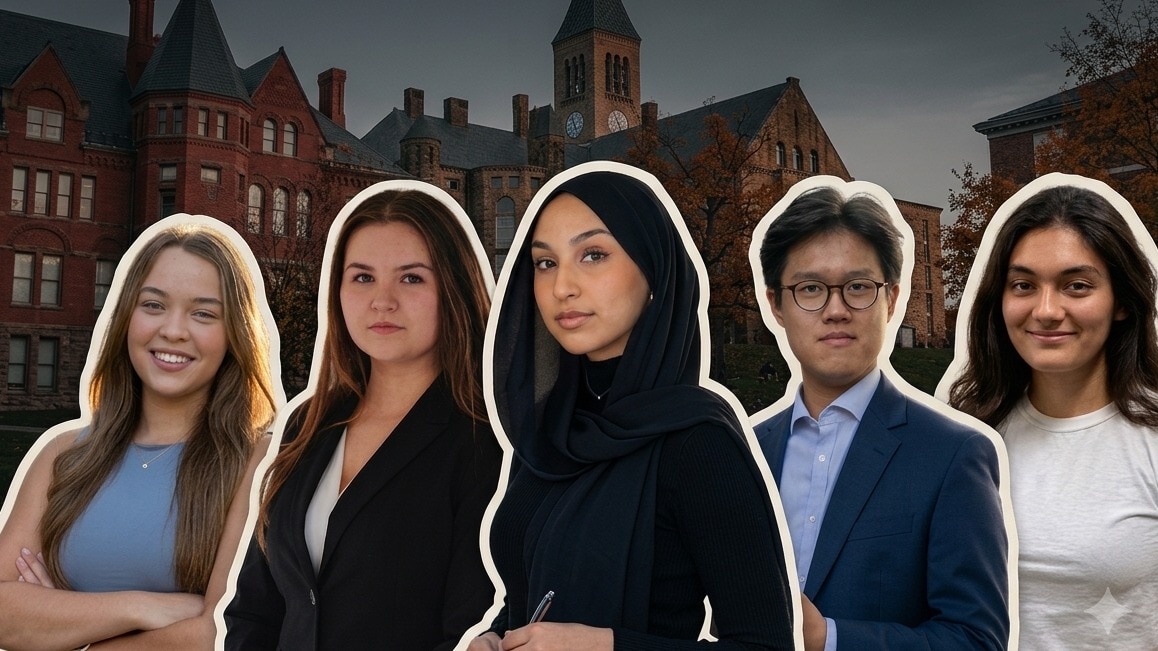
The paper's 144th Editorial Board is led by Sophia Dasser '28, who studies computer science and philosophy. With her are Associate Editor Sophia Romanov Imber '28 and Opinion Editors Zara Cheek '28 and Rayen Zhou '29.
And beyond the four-member editorial board, senior editor Cereese Qusba was doing the reporting. She broke down the lawsuit naming the seven accused and later reported on the reopening of the criminal investigation, giving the editorial's questions a documented news record to stand on.
Dasser is Muslim and has written about it openly. But flattening the article into "Muslim woman editor takes on Ivy League” would miss the real story. Four students had a newsroom, and they refused to waste it.
A case like this usually gets buried in legal filings and polished press statements. They dragged it into the open, and they came with receipts. They quoted Cornell's own November 2024 statement straight back at it:
"Only those who perpetrate sexual violence benefit from its concealment."
The university wrote that line. The students turned it into a mirror.THE NUMBERS CORNELL CAN'T WISH AWAY
The lawsuit alleges the student was assaulted after being drugged. Prosecutors first brought no criminal charges. Cornell says it sanctioned students through its own disciplinary process and supports the reopened investigation.
But look at what Cornell's own data says:advertisement15% of survey respondents in 2025 reported non-consensual sexual contact since joining, up from 11% in 202335% of undergraduate women said the same, up from 23%17% of reported assaults were linked to fraternity houses, per the university's 2026 task forceWhen one in three undergraduate women who answered the survey talk about non-consensual sexual contact, it is clear that the story isn’t about one bad night or one bad fraternity. It is about a pattern, and the question is what the Ivy League university does about it.WHAT A STUDENT PAPER CAN DO THAT A UNIVERSITY CAN'T
Universities have lawyers. They have communications teams and carefully worded statements.
Student papers have one thing no PR office can match: they can keep asking.
The Cornell Daily Sun pressed Cornell on how the emergency suspensions were lifted, how its Title IX (US civil rights law that stops sex-based discrimination in any school or education programme) process ended, and whether the complainant was ever told the outcome.
Its plainest line was its hardest: "We refuse for this victim to be reduced to just another story."
Yes, this is an editorial, and The Sun labels it as opinion. That is exactly why it works. Good student journalism isn't about who shouts loudest. It's about reporting, verifying and documenting first, so the argument stands on solid ground when it finally comes.DIFFERENT CONTINENT, SAME QUESTION
Back home, students from New Delhi’s Lady Shri Ram College and other universities took to the streets after the alleged gang rape of a 17-year-old near Kalkaji's Aastha Kunj Park.
On September 28, Delhi University students marched under the banner "Hum Auratein Aazaad Hain (We Women Are Free)," demanding safer routes, working CCTV, better lighting and real police patrolling.
The demand isn't complicated. Let women use public spaces. Let students walk home. Let campuses be safe.
Whether it's Kalkaji in New Delhi or Ithaca in New York, the pattern is the same. The institution goes quiet, and someone has to keep the question alive.
At Cornell, four students did. They signed off with a line that was never meant to be comfortable:
"We know who you are and we refuse to let you benefit from this University's concealment."
That's what a student newspaper looks like when journalism is a public duty and not a campus club.- EndsRead | Drugged and raped by 7 'frat bros' for hours: Ex-student sues Cornell UniversityRead | Probe reopened into rape-accused Cornell 'frat bros' after ex-student's lawsuit
Roshni has been working in the journalism industry for over a decade, telling stories that matter. She loves writing about student innovations, latest research, and people striving to make the world better for children -- through education, social change, or environmental efforts.
With a special focus on education, the job industry, and mental health, she also enjoys uncovering lesser-known scientists and changemakers from history whose work continues to shape our lives today. Away from work, Roshni finds joy in reading, painting, photography, and exploring the spiritual and the occult.