7 killed as Pak opens fire on POK protesters, military drones used during crackdown
Pakistani security forces launched a major operation in Rawalakot on Thursday morning, targeting key protest sites as tensions escalated in Pakistan-occupied Kashmir (POK). The operation began around 8 am, shortly after Fajr prayers, with Pakistani Rangers and Frontier Corps personnel, backed by local police, moving against demonstrators involved in the ongoing protests.
According to reports, security forces opened fire as they moved towards the protest sites. More than 5,000 people had been staging a sit-in at the Rawalakot Bus Terminal since June 9, demanding the implementation of a 38-point charter of demands.advertisement❮❯ Read Full StorySEVEN KILLED IN INITIAL HOURSAt least seven civilians were reportedly killed and 23 others injured during the first two hours of the operation, between 8 am and 10 am. The reported fatalities have taken the overall death toll linked to the unrest in POK to 153 since June 7. Reports also claimed that drones were used during the operation, with civilian residential areas coming under attack. One strike reportedly destroyed the home of a local resident, Waseem Shakeel.
Clashes and confrontations continued around Omar Farooq Chowk, where thousands of protesters had gathered. Women and children were also reportedly involved in confrontations with security personnel, while mosque loudspeakers were used to call residents to the area and urge them to resist the crackdown.
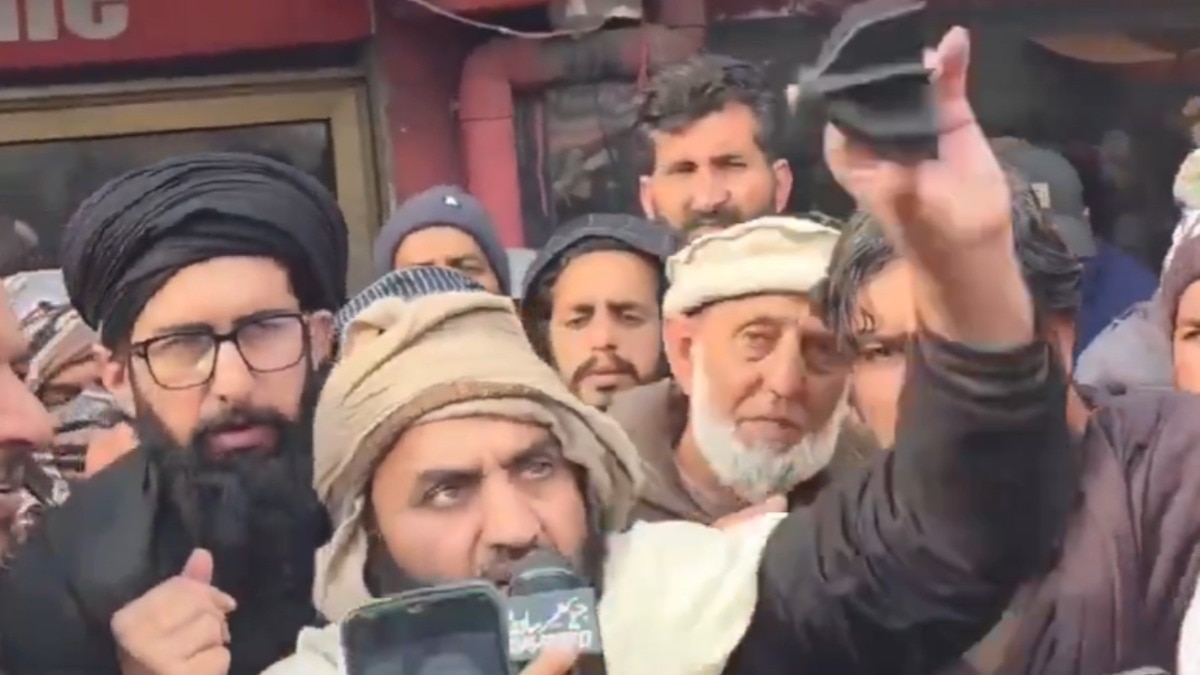
JAAC leader Sardar Umar Nazir displayed what he described as recovered "bomb fragments" in Rawalakot following a reported drone strike on civilian homes and protest sites.
Nazir alleged that drone attacks were being launched from multiple directions around the protest camps and said the situation was continuing to deteriorate. He appealed to residents to travel to Rawalakot and urged Kashmiris living overseas to speak out against what he described as attacks on peaceful protesters.WHAT IS BEHIND THE RAWALAKOT PROTESTS?
The latest operation comes after months of unrest linked to the Jammu and Kashmir Joint Awami Action Committee (JAAC), which has led protests over political representation, economic rights and the implementation of commitments made by the authorities.
The movement has accused Pakistani authorities of using excessive force against its supporters. Pakistani officials, however, have previously accused the JAAC and its supporters of engaging in violence and attacking security personnel.
The confrontation has turned deadly before. In July, clashes between security forces and JAAC supporters left nine people dead, according to Reuters, which cited officials. The violence erupted amid tensions over a planned JAAC march and opposition to electoral arrangements in the region.
The Pakistani authorities also banned the JAAC under anti-terrorism laws in June.
The continuing unrest has been accompanied by restrictions on communications in the region, making it difficult to independently verify reports emerging from the affected areas.
That has also created a widening information gap between accounts from protesters and those provided by authorities. While protesters have accused security forces of launching a violent crackdown, officials have previously alleged that the movement's supporters were involved in attacks on security personnel.- Ends
Born in Pauri district of Uttarakhand, Manjeet Negi did his early schooling from his village school near Rishikesh and then moved to the town for secondary education. Later, he did his graduation from Hemavati Nandan Bahuguna University. In the year 2000, he did his journalism diploma from Kurukshetra University and started his career with Doordarshan News and started reporting on defence forces from the 2001 Bhuj earthquake. In his career as a defence correspondent, Negi has had the opportunity to report exclusives from world's highest battlefield Siachen Glacier in the north to the Andamans in the South and from the Rann of Kutch in the west to the Arunachal Pradesh border with China in the East.
A regular news-breaker on matters of national security and military affairs, Negi considers the coverage of he Kedarnath tragedy of 2013 as the highest point of his career. During the grave disaster at Kedarnath in June 2013, Manjeet Negi was the first and only TV reporter who walked for 55 Kms on the hilly track to reach the Kedarnath shrine. Spending his first night in the complex amidst several hundred dead bodies around him, Negi says he saw Lord Kedar in his dream. After the Kedarnath disaster, the writer got another opportunity to cover another disaster in the Nepal earthquake in 2015 for the Aaj Tak channel. During the reporting of that disaster for about 10 days, the writer got an opportunity to witness and report the large scale relief and rescue operations undertaken by the Indian Army and the Indian Air Force.
Besides reporting, he is also a skilled mountaineer. With Nehru Institute of Mountaineering and Garhwal Regiment, he has undertaken mountaineering expedition to Satopanth via Gomukh. Accompanying the Mount Manaslu mountaineering expedition of a Garhwal Regiment unit, he also reported about the expedition. He has also scaled the Dronagiri mountain near Joshimath in Uttarakhand. Manjeet Negi has also been honoured with a special award by the Union Home Minister, Shri Rajnath Singh for his reporting of Kedarnath disaster. He was awarded the best reporter award for his coverage of Nepal earthquake by India Today Group. At present, the writer has been working as Editor with Aajtak Channel of India Today Group.