
54 years after Martial Law, groups say ‘Never Again’ is a fight for the present - Rappler
Already have Rappler+? Sign in to listen to groundbreaking journalism.
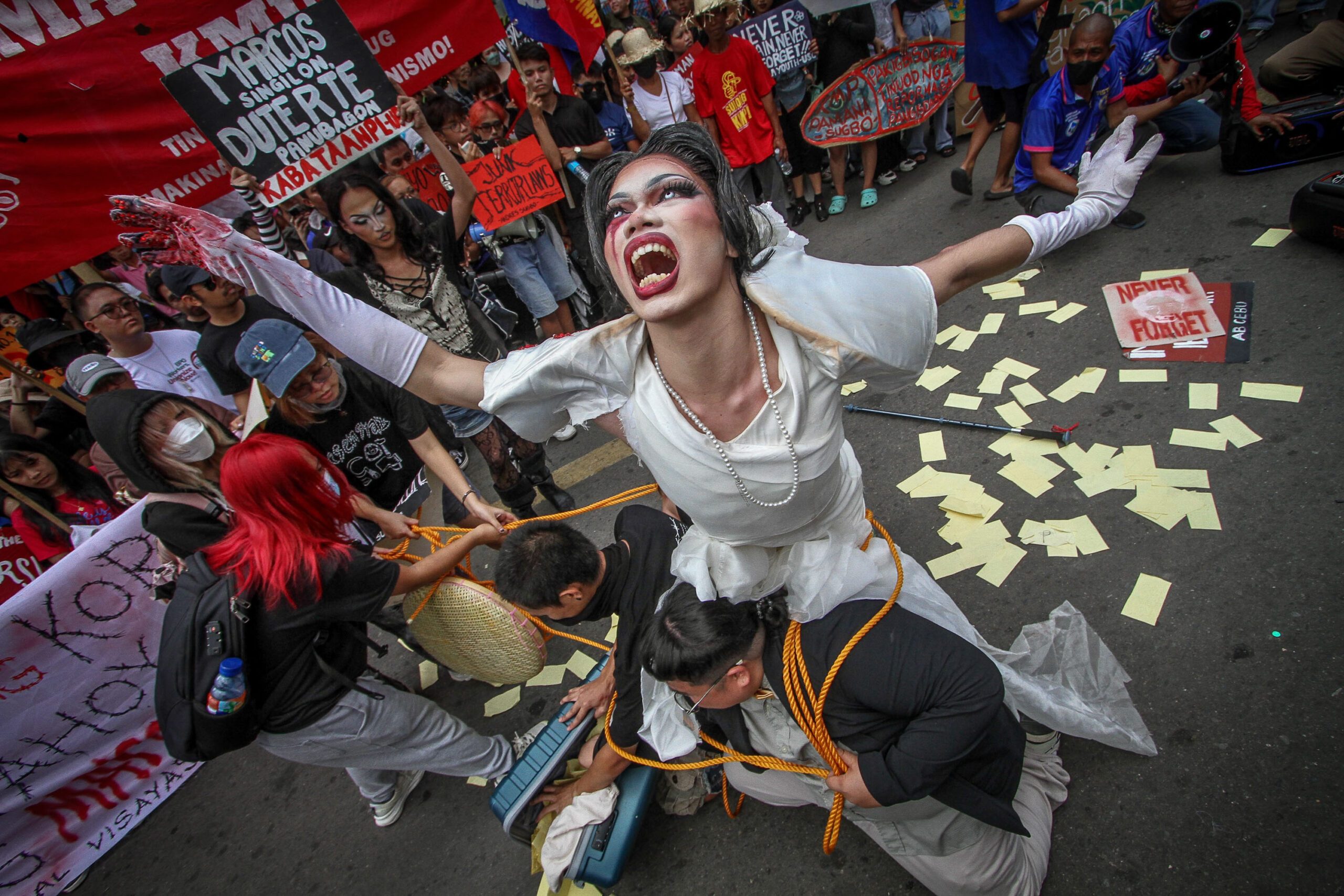
REMEMBERING. Multisectoral groups led by Bagong Alyansang Makabayan-Central Visayas hold a protest march from Fuente Osmeña to Metro Colon in Cebu City on September 21, 2026, to mark the 54th anniversary of the declaration of Martial Law.
This is AI-generated. Read the article for full context. Report any errors.
MANILA, Philippines – More than five decades after the declaration of Martial Law in the Philippines, progressive groups on Monday, September 21, said that abuses of Ferdinand E. Marcos’ tyrannical rule should not be treated as a thing of the past but as concerns of the present as well.
Senator Risa Hontiveros emphasized the need to remember both the victims of Martial Law abuses and those who fought for democracy, while linking the lessons of the dictatorship to present-day concerns.
“We should not allow the memories and the lessons from the dark and shameful period of our history [to] be forgotten. Then and now, we Filipinos have to resist,” Hontiveros said. “We have a duty to remember the past and to take action for a better future.”
The August Twenty One Movement, in a statement, reminded the public of the documented human rights violations under Martial Law, including the estimated 70,000 people illegally arrested, 34,000 tortured, and 3,240 killed.
The group stressed that these figures may not capture the full extent of the abuses, as many cases went unreported. For the group, remembering these abuses also means resisting attempts to sanitize the history of Martial Law.
“The Marcoses have spent decades trying to deodorize what Martial Law was. We name it again,” the group said.
In 2022, President Ferdinand Marcos Jr., the dictator’s son, won the presidential election with over 31 million votes. His victory marked the return of the Marcos family to Malacañang more than three decades after the EDSA People Power Revolution that ousted his father from power in 1986.
The Campaign Against the Return of the Marcoses and Martial Law (CARMMA) similarly looked back at the abuses of the dictatorship, pointing to both political repression and the economic conditions under the late dictator. The group recalled the Marcos family’s ill-gotten wealth and cronyism, alongside the country’s mounting foreign debt and economic downturn during his rule.
CARMMA also recalled how dissent was treated under the dictatorship: “Marcos Sr. branded activists as subversives who were summarily killed, disappeared, tortured or hauled to prison.”
Meanwhile, human rights alliance Karapatan connected the commemoration to present-day concerns such as corruption, red-tagging, arrests, and restrictions on dissent.
Karapatan secretary general Christina Palabay said, “The legacy of Martial Law remains because the same atrocities continue, more than five decades after.”
The group also defended the right to protest, arguing that the lessons of Martial Law include protecting the ability to criticize the government and demand accountability. They argued that this right becomes particularly important when citizens raise concerns over corruption, human rights violations, and other abuses of power.
“The government cannot invoke the language of democracy while treating dissent as a nuisance or a security problem,” Palabay said.
“The right to protest exists precisely so that people can challenge abuses of power,” she added.
Meanwhile, labor group Partido Manggagawa (PM) connected the lessons of Martial Law to the concentration of power in the workplace. They stressed that contract employment, low wages, and restrictions on union organizing leave workers with little power over decisions affecting their lives.
“Demokrasya (Democracy) cannot stop at the ballot box,” PM chairperson Renato Magtubo said in a statement. “Dapat may demokrasya rin sa workplace (There should also be democracy in the workplace).”
Despite rain, various labor groups, including Kilusang Mayo Uno, held a protest outside the National Labor Relations Commission-Calabarzon office in Calamba, Laguna. KMU criticized the Marcos administration’s ineffectiveness in improving the labor conditions of the country’s workers, as well as its relations with the United States.
Apart from the NLRC protest, progressive groups such as Anakbayan Southern Tagalog also converged in Calamba to protest against other issues, including the Pax Silica initiative. Pax Silica is a coalition formed to supposedly counter China’s strength in tech manufacturing, particularly in the aspect of computing components and chips. – Rena Eñano and Rhen Peñada/Rappler.com
Rena Eñano and Rhen Peñada are Rappler volunteers.
Eñano is a senior literature student from Ateneo de Manila University, while Peñada is a third-year information technology student from the Polytechnic University of the Philippines Sta. Rosa, Laguna Campus.


