
What Comes Next After Historic Myanmar Genocide Ruling - Time Magazine
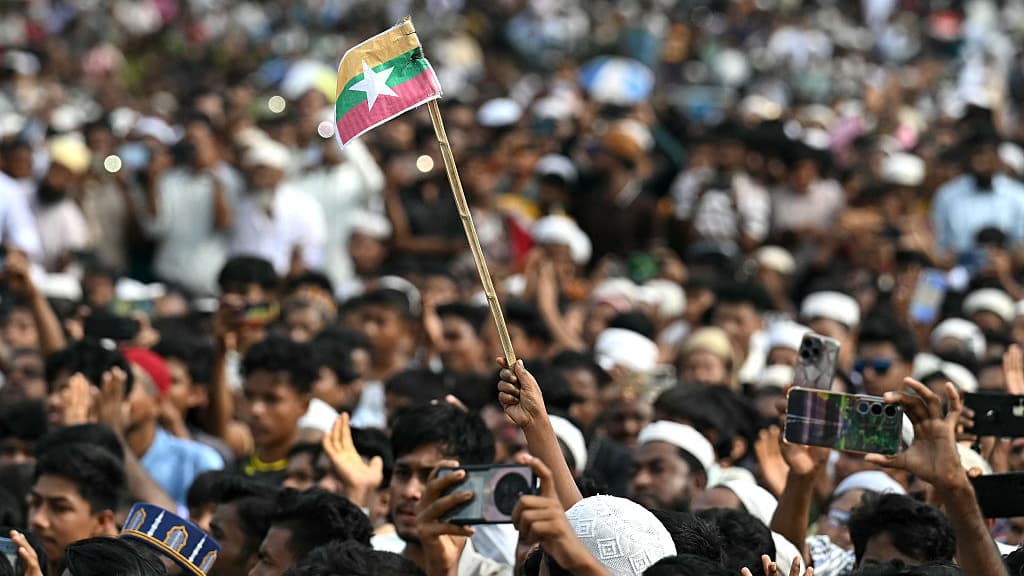
The world’s top international court has ruled that Myanmar committed genocide against its Rohingya Muslim minority, more than a million of whom remain displaced.
The verdict, issued Thursday, is the first time a state has been found responsible for committing genocide in the history of the International Court of Justice, which was established in 1945. In a weekslong military campaign in 2017, Myanmar forces killed at least 10,000 people, including up to 2,109 children under five, and forced more than 700,000 others to flee the country’s northern Rakhine State.
The landmark decision could have significant implications for the legal treatment of cases brought under the 1948 Genocide Convention, Melanie O’Brien, a professor of international law at the University of Western Australia Law School, tells TIME. That includes South Africa’s pending case alleging that Israel has committed genocide in Gaza, where Israeli forces have killed tens of thousands of people over the past three years.
A spokesperson for Myanmar President Min Aung Hlaing told reporters on Friday that the ruling is “unfair.” Min Aung Hlaing was the military’s commander in chief during the 2017 operation.
“It was not a decision made unanimously,” spokesperson Khine Khine Soe said, pointing out that six of the 15 judges dissented. She did not say whether Myanmar would comply with the ruling.
Myanmar’s military junta-backed government denied committing genocide during the proceedings.
The National Unity Government, a parallel government formed after Myanmar’s 2021 military coup, said on Thursday that it respects the judgment.
For the Rohingya, the ruling is “public acknowledgment in a court of law and in the top court in the world that what happened to them was genocide,” says O’Brien, who has published multiple books on genocide and international criminal law, is working on a book about the Genocide Convention in the ICJ.
Members of the Rohingya community also said the ruling is a historic recognition of the Rohingya as a distinct ethnic group.
“Myanmar denies the existence of the Rohingya,” Sayed Ullah, a community leader at a refugee camp in Bangladesh, told the Associated Press, “but now the court made it clear.”
The court’s finding of genocide by a state is a historic first. Two previous genocide cases brought before the ICJ have gone to the merit stages, both arising from the wars that followed the breakup of Yugoslavia in the 1990s.
In 2007, the court ruled on a case brought by Bosnia against Serbia. The court determined that the killing of thousands of Bosniak men and boys in Srebrenica in 1995 was genocide, but it found insufficient evidence to attribute the killings by Bosnian Serb forces to Serbia. Still, the court ruled that Serbia violated its obligation under the Genocide Convention by failing to use its influence over those forces to prevent genocide.
In the second case, which was brought by Croatia against Serbia, the court made no finding that genocide was committed. It instead ruled in a 2015 judgment that Yugoslav army and Serb forces had an intent to ethnically cleanse Croats from Serb-held areas of Croatia, forcing between 80,000 and 100,000 Croats and other non-Serbs to flee the Krajina region between April 1991 and April 1992.
“The Court has not rewritten or expanded the legal definition of genocide” since the earlier cases, Marko Milanovic, a professor of public international law at the University of Reading, said in a statement. “What it has done is take a more flexible approach to the evidence used to establish genocide, particularly the notoriously difficult question of proving genocidal intent.”
The dissenting judges argued that the evidence could support the intent of forced expulsion or collective punishment instead of an intent to destroy a substantial part of the group.
The court ordered Myanmar’s military-backed government to ensure the safe, voluntary return of the Rohingya to the country and prosecute those suspected of having committed genocide.
Myanmar has two years to report to the ICJ on its orders of restitution. If it is unable to carry out restitution, the court ordered the government to pay reparations to the Rohingya, the amount of which will be determined at a later stage.
It’s uncertain whether Myanmar will implement the ruling, which is legally binding.
“Therein lies the rub in that there isn’t necessarily a mechanism for enforcing them,” says O’Brien. If Myanmar does not comply, The Gambia, which brought the case to the ICJ, can turn to the United Nations Security Council, which has discretion over whether to act, although China, which has veto power as a member of the council, is friendly to the Myanmar government.
Third party states can also exert pressure on Myanmar to comply with the ruling, such as through direct diplomatic pressure or sanctions on individuals or companies linked to the genocide. On Thursday, the U.K. ordered the expulsion of Myanmar’s defense attaché and called for an urgent U.N. Security Council meeting to discuss the judgment. ASEAN Parliamentarians for Human Rights (APHR), an independent group of current and former Southeast Asian parliamentarians, called on the Association of Southeast Asian Nations (ASEAN) to support implementation of the ruling. Cheah Wui Ling, an associate professor at the National University of Singapore’s faculty of law, says ASEAN is obligated to “act in ways that respect and not undermine” the ruling, given the organization’s commitment to international law.
Cheah says the ruling could give “fresh momentum” to efforts seeking to hold individuals criminally accountable for the genocide, including an investigation in Argentina and a criminal complaint in Indonesia.
The prosecutor at the International Criminal Court also requested an arrest warrant in 2024 for Min Aung Hlaing. The ruling could have a “snowball effect” on that investigation, says Vincent-Joël Proulx, an associate professor at National University of Singapore’s faculty of law and a former special adviser to the ICJ’s president.
Even so, other challenges remain to seeing restitution through, O’Brien says.
Nine years after the mass displacement, more than a million Rohingya refugees live in Bangladesh, with most in camps in Cox’s Bazar. Some refugees told the AP that they want to return home to Myanmar.
Rohingya refugees visit a market at a camp in Bangladesh's Cox's Bazar on Nov. 17, 2026. Salahuddin Ahmed—AFP/Getty Images
But many of those homes and villages were completely destroyed, O’Brien says. “They have nothing physically to come back to.” She adds that the Rohingya have faced “decades of discrimination and persecution,” and it’s “very difficult to suddenly turn around a culture of hostility and discrimination.”
Restitution is “trying to put the victims in the position that they were in before this had happened,” says O’Brien. But “so many of them have lost family members, and so many of them have been subject to horrific violence and abuse, so they can’t be put in exactly the same position.”
Eyes are now on South Africa’s genocide case against Israel. The case is in a second round of written pleadings and is expected to take at least three more years.
Myanmar’s defense argued that its military operations targeted militants, not civilians. But the court considered a broader “pattern of conduct” by Myanmar, including hate speech, discriminatory laws, displacement, destruction of property, and widespread sexual violence.
“The court definitively acknowledged that genocide is more than just killing,” O’Brien says. “The court acknowledged that the execution of boys and men, and the rape of girls and women, it acknowledged that as being a key part of the genocide.”
The court also looked at the “bulldozing and large-scale terrain clearance” after villages were destroyed, followed by the “rapid construction” of security installations.
The “only reasonable inference” from that pattern is genocidal intent, the court ruled. In other words, O’Brien says, the court found “this is not what you would do if you were genuinely trying to defeat terrorists.”
South Africa has made a similar argument as The Gambia and asked the court to consider Israel’s wider “pattern of conduct” as evidence of genocidal intent.
Israel denies the genocide allegations. It has argued before the ICJ that its military campaign was an act of self-defense after the Hamas attack on Israel on Oct. 7, 2023, that killed more than 1,200 people and took 251 hostages.
“Israel has essentially a consistent narrative that it puts out into the public that it is in compliance with international law,” says O’Brien.
More than 74,000 Palestinians have been killed in Gaza since Oct. 7, 2023, according to the Gaza Health Ministry. In the absence of independent monitoring on the ground, the ministry is the primary source for casualty data relied upon by humanitarian groups, journalists, and international bodies. Its figures do not differentiate between civilians and combatants and cannot be independently verified by TIME. An investigation by the Guardian based on Israeli military data estimated that 83% of those killed in Gaza by May 2025 were civilians.
U.N. investigators have also documented alleged systematic sexual violence by Israeli forces against Palestinian detainees, incitement of genocide by senior Israeli officials, restrictions on aid, and the razing of homes and farmland to create military corridors and buffer zones. The Israeli military occupies more than 60% of the Gaza Strip.
A key aspect of the “pattern of conduct” argument in the Myanmar case was attacks on children. The court found that the killing of children and babies was inconsistent with Myanmar’s claim of a genuine counterinsurgency operation.
In the ruling on Myanmar, the ICJ identified “the targeting of children as striking at the ‘foundation’ of a group’s survival,” says Proulx, noting that some have made the same observation in the context of Gaza.
More than 20,000 Palestinian children under the age of 18, including more than 5,000 under the age of five, have been killed in Israel’s military campaign in Gaza between October 2023 and October 2025, according to a U.N. report. The report also documented several Israeli lawmakers portraying Palestinian babies and children in Gaza as terrorists, and found that National Security Minister Itamar Ben-Gvir had made remarks encouraging soldiers to view people near the Gaza fence, including children, as legitimate military targets.
South Africa could point to Thursday’s ruling in arguing that the killing of children “demonstrates genocidal intent,” O’Brien says.
Israel has denied deliberately targeting Palestinian children and argued before the ICJ that civilian deaths, including those of children, can be an unintended consequence of strikes on military targets in urban areas. Israel’s mission in Geneva rejected the U.N.’s finding in June 2026 that Israeli forces had deliberately targeted and killed children.
Proulx cautions that there is no formal doctrine of binding precedent in international law, meaning that the ruling on Myanmar “does not necessarily determine the outcome, or even the analytical direction, that the case brought by South Africa will take.”
Still, William Schabas, an international law professor and expert on genocide at Middlesex University, told the Guardian, that the ruling is “full of messages for Israel.”
“There are obvious differences, of course, the evidence will be different, but if you exchanged the word Myanmar with Israel, you wouldn’t have to change much in the judgment.”


