The ‘Korean Peninsula’ left out of the US·China·Russia leaders table… only a ‘gap’ in the North Korea nuclear calculus - 경향신문

This article was translated by an AI tool. Feedback Here.
사진 크게보기 US·China·Russia at the center… World leaders take a commemorative photo President Lee Jae Myung and other national leaders are taking an official commemorative photo on the 19th at the Shenzhen International Exchange Center in China during the 2026 Asia-Pacific Economic Cooperation (APEC) summit. Shenzhen | Lee Jun-heon
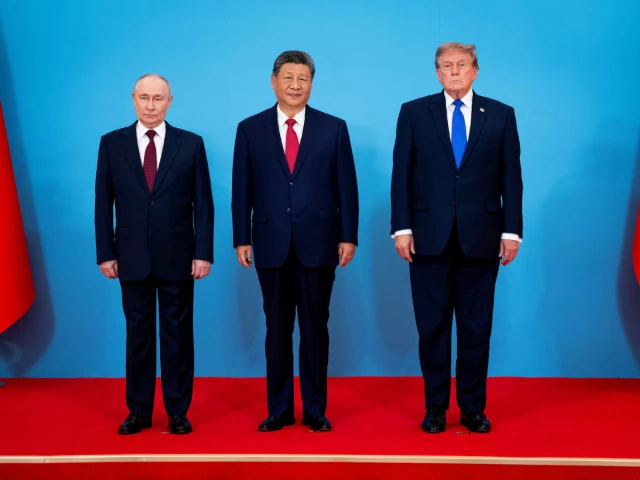
On the occasion of the Asia-Pacific Economic Cooperation (APEC) summit in Shenzhen, China, the first-ever summit among the United States, China, and Russia produced a joint statement and public remarks that contained no mention of the Korean Peninsula.
In the joint statement adopted at their three-way meeting on the 19th by US President Donald Trump, Chinese President Xi Jinping, and Russian President Vladimir Putin, no regional issues, including the Korean Peninsula, were included.
Even in roughly ten minutes of opening statements, where the Russia·Ukraine war and the US·Iran war were mentioned, the Korean Peninsula was not brought up. Ko Yu-hwan, emeritus professor in the Department of North Korean Studies at Dongguk University, said, “Because the Korean Peninsula issue, unlike the US·Iran war and the Russia·Ukraine war, is not an urgent matter, it appears to have been pushed down the priority list of the US, China, and Russia.”
It may also have been difficult to hold concrete discussions because the three countries differ in their positions on the Korean Peninsula. Russia has said it opposes demanding denuclearization of North Korea, and China has avoided citing denuclearization as a goal and is assessed as effectively acquiescing to the North nuclear program. The United States at the administration level maintains the goal of North Korean denuclearization, but President Trump, who is pushing for a US·North Korea summit, is avoiding mention of it.
With North Korea maintaining a hostile two-state posture toward South Korea, China and Russia, as North Korea allies, may find it difficult to actively address the Korean Peninsula issue. Regarding the outcome of the Korea·China summit the previous day, the presidential office introduced President Xi as having said, “We will continue to play a constructive role in resolving the Korean Peninsula issue,” but the Ministry of Foreign Affairs of China release did not contain content related to the peninsula.
As the Korean Peninsula is not being discussed as a top priority among the US, China, and Russia, there is analysis that the government diplomatic plan to build a peace coexistence system through improving inter-Korean relations will also struggle to gain speed. The government intends to promote four-party talks among the South, North, the United States, and China, starting with a resumption of US·North Korea dialogue. Through this, it plans to discuss ending the war and a peace regime on the Korean Peninsula, and to open a breakthrough for restoring inter-Korean relations. There remains a possibility, however, that in closed-door talks President Trump expressed willingness to resume US·North Korea dialogue and sought cooperation from President Xi and President Putin.
Yoo Ji-hoon, a research fellow at the Korea Institute for Defense Analyses, said, “From the perspective of Korean Peninsula security, the key interest is how US·China·Russia nuclear arms control discussions will affect the North Korean nuclear issue,” adding, “As consultations on nuclear arms control among major powers expand in the future, attention should be paid to the possibility that the North Korean nuclear issue will be handled as a separate negotiating agenda item or linked to other strategic issues.”
With President Lee Jae Myung having met all three US, Chinese, and Russian leaders at APEC, there are calls for continued diplomacy to elicit cooperation from neighboring countries to resolve the Korean Peninsula issue. Choi Yong-hwan, vice president of the Institute for National Security Strategy, said, “North Korea has often come to the table when it judged that the diplomatic landscape was being shaken rather than through external persuasion,” adding, “The key is whether Korea can create a turning point in the situation through proactive diplomacy not only with the United States but also with China and Russia.”