S’pore mum says son's school 'strongly encouraged' dressing up for CNY but not for Hari Raya & Deepavali, points out differences in celebrations - Mothership
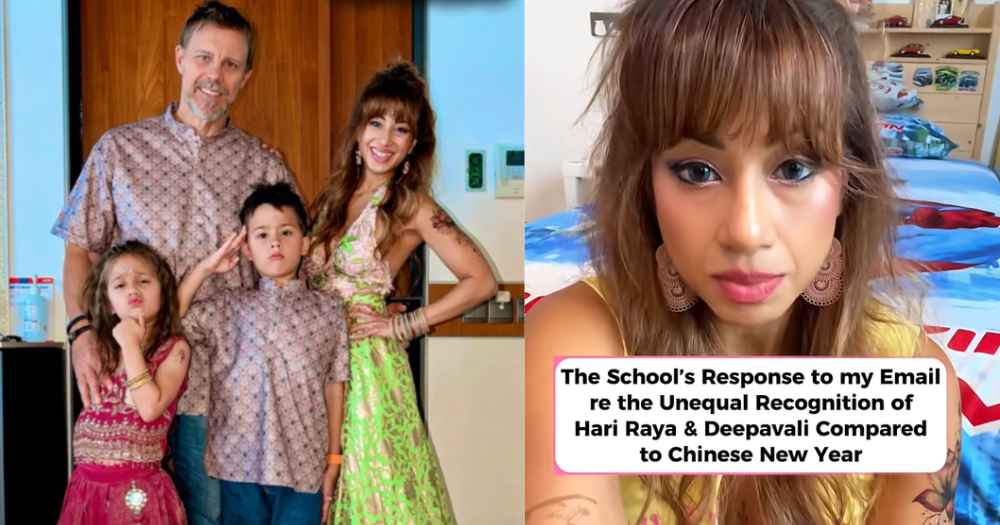
Dressing up was not forbidden for Hari Raya and Deepavali, but neither was it encouraged, she said.
A Singaporean woman alleged that there were significant differences in how her son's school celebrated festivals such as Hari Raya and Deepavali, as compared to Chinese New Year.
Her sentiments became widely shared on social media, and she eventually met with the principals of the school to express her views.
On Nov. 6, Instagram user @fairyfitmama made a post showing an email she had sent to her son's school.
According to her email, she wrote that students were allowed to dress up only for Chinese New Year, but not for Hari Raya and Deepavali.
She questioned this practice, noting that Singapore is a multicultural and multiracial society and emphasised that schools had an important part to play in educating children about other cultures and traditions.
The woman, Lalitha Rajah, 49, recounted to Mothership what happened.
According to Rajah, her son's school sent out a circular for Chinese New Year, which stated that students were "strongly encouraged" to wear traditional Chinese attire that day.
However, she claimed that no such encouragement was made for Hari Raya and Deepavali.
Rajah clarified that the school did not explicitly forbid students from coming in traditional Malay or Indian wear, but that they nevertheless did not encourage students to wear them as in the case of Chinese New Year.
The school did not explain why they did so, she said.
In another video on Nov. 10, Rajah stated that the school had maintained the same policy last year, but that she only decided to raise the matter up this year.
Rajah did not identify the school in her online videos, but told Mothership that her son's school was a mission school.
The scale of the celebrations also differed, said Rajah.
For Chinese New Year, a "big celebration" was held with multiple booths run by parent volunteers, providing traditional snacks and games.
In comparison, stated Rajah, the school organised library activities for Deepavali, where students could do a Deepavali-themed word search during recess time.
Some Indian students also shared more about Deepavali during the morning assembly.
In addition, there was no half day off given to students for Deepavali, whereas school was dismissed at 10:30am for Chinese New Year.
However, Rajah acknowledged that she was unsure about the protocol for half day offs for holidays, and that this was perhaps due to the fact that Deepavali took place on a Sunday, and that its eve could have occurred on Saturday.
Rajah's son's form teacher subsequently contacted her via text after her email to the school, and she and her husband eventually met with the principal and vice-principal on Nov. 13.
In another video, she said that she raised to the principals that children should be educated on minority cultures precisely because they are minorities.
She noted that many Singaporeans mistakenly think that Hari Raya and Deepavali are the 'Malay New Year' and 'Indian New Year' respectively.
Furthermore, she argued that if mission schools could separate the religious aspects of Chinese New Year — such as ancestor worship and religious rites — from the cultural aspects, the same could be done for Hari Raya and Deepavali.
"No one is asking them to conduct Hindu pujas or Islamic prayers," she wrote in the caption.
Rajah also questioned why international schools in Singapore could allegedly "celebrate all the three festivals equally", while her son's school did not.
She also stressed that schools have the power to educate the new generation of Singaporeans.
Additionally, Rajah shared a personal experience — that when she was in primary school student, she recalled her maths teacher calling her "that Indian girl", despite her being half Indian and half Chinese.
"So much so that I always felt that I had to explain to people that I'm half Chinese, as if that was my better half.
And I never, ever want my children or any minority race child to ever have to feel this way. Children should be proud of their culture, of their roots."
In response, she said the school apologised for "the perception that they did not give due recognition to Deepavali and Hari Raya", and for "caus[ing] feeling that they did not value these cultures".
This was unintentional, the school said, according to Rajah.
Rajah was told that her feedback would be taken into consideration, and was asked if her and her husband would like to help with next year's celebrations, which she agreed to.
Comments to Rajah's videos were supportive, with many praising her for her willingness to speak up.
Some shared similar experiences from their own childhood, or in their children's schools.