
Senate passes bill simplifying permitting rules to build in America, sending it to House
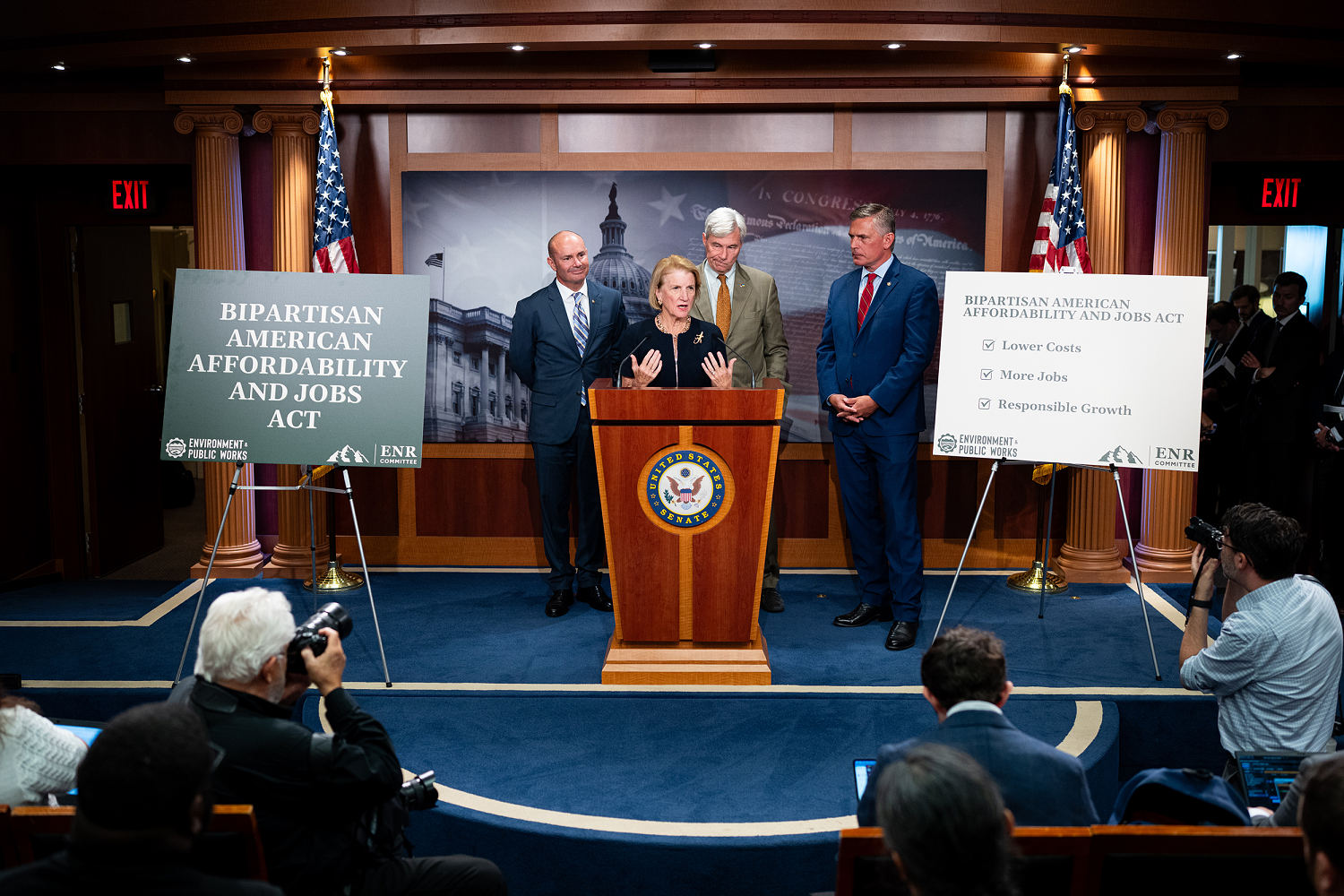
From left, Sen. Mike Lee, R-Utah., Sen. Shelley Moore Capito, R-W.Va., Sen. Sheldon Whitehouse, D-R.I., and Sen. Martin Heinrich, D-N.M., co-authored the permitting bill.Bill Clark / CQ-Roll Call, Inc via GettyShareAdd NBC News to GoogleNov. 19, 2026, 10:09 PM ESTBy Sahil KapurWASHINGTON — The Senate voted 62-33 on Thursday night to pass a sweeping bill to simplify and overhaul permitting rules for energy and infrastructure projects.
The bill, called the Bipartisan American Affordability and Jobs Act, was crafted by an unusual coalition of Sens. Shelley Moore Capito, R-W.Va.; Sheldon Whitehouse, D-R.I.; Mike Lee, R-Utah; and Martin Heinrich, D-N.M.
The legislation would revise and speed up environmental reviews with tighter deadlines; accelerate electricity transmission; restrict the power of federal agencies to revoke existing permits; and reduce chokepoints for approving and completing projects.
To conservatives, it’s about cutting government bureaucracy.
“For far too long, critical investments in our nation’s infrastructure, energy production, and economy have been forced to sit on the sidelines due to endless red tape, duplicative reviews, and regulatory uncertainty,” Capito said.
For liberals, it’s an opportunity to make it easier to build long-sought projects, including clean energy, and address high costs.
“Democrats are focused on lowering energy costs, reducing emissions, and stopping data centers’ free ride,” Whitehouse said. “Americans will start to get some relief quickly if this bill passes.”
In an attempt to alleviate Americans’ concerns about data centers, the bill would require “new data centers of 20 megawatts or more to pay the full incremental cost of the infrastructure built to serve them,” according to the Bipartisan Policy Center.
The legislation sparked opposition from some environmental groups and Native American tribal organizations, which objected to easing reviews and consultation rules that can be used to protect their interests. The bulk of the opposition in the Senate came from Democrats.
FOR SUBSCRIBERS‘GTA VI’ goes beyond crime and chaos: Key takeaways after day one of game playFOR SUBSCRIBERSAfter a stillbirth, L.A. police investigated her for murder. Now she’s suing.FOR SUBSCRIBERSWhat Anthropic’s blockbuster IPO says about AI anxietiesFOR SUBSCRIBERSVenture capitalists digest tech world chaos over cocktails and crabcakesFOR SUBSCRIBERSWhy Anthropic’s $1.7 trillion debut wasn’t enough to save the market from a dropFOR SUBSCRIBERSJosh Hawley says he is giving ‘serious thought’ to a presidential bidFOR SUBSCRIBERSTech billionaires who embraced Trump distance themselves after midterm routFOR SUBSCRIBERSTrump touts ‘unbelievable’ talks with Xi and Putin, though peace deals remain elusiveFOR SUBSCRIBERSSave the salmon, kill the sea lions? Why an unlikely coalition wants to try itFOR SUBSCRIBERSThe midterms were bad for the GOP. The closest races show how it was nearly even worse.FOR SUBSCRIBERSTech outages have fueled a blackout panic — and a prepping boomFOR SUBSCRIBERSTrump responds to Elon Musk’s ‘I’m not MAGA’ commentsFOR SUBSCRIBERSPeople who say GLP-1s changed their lives are scrambling after employers stop coverageFOR SUBSCRIBERSCalifornia’s billionaire tax failed, but Democrats see a bigger fightFOR SUBSCRIBERS‘Blessing in disguise’: Lobbyists shrug off Stephen Miller’s crackdown on their businessSlide 1 of 1For SubscribersFOR SUBSCRIBERS‘GTA VI’ goes beyond crime and chaos: Key takeaways after day one of game playFOR SUBSCRIBERSAfter a stillbirth, L.A. police investigated her for murder. Now she’s suing.FOR SUBSCRIBERSWhat Anthropic’s blockbuster IPO says about AI anxietiesFOR SUBSCRIBERSVenture capitalists digest tech world chaos over cocktails and crabcakesFOR SUBSCRIBERSWhy Anthropic’s $1.7 trillion debut wasn’t enough to save the market from a dropFOR SUBSCRIBERSJosh Hawley says he is giving ‘serious thought’ to a presidential bidFOR SUBSCRIBERSTech billionaires who embraced Trump distance themselves after midterm routFOR SUBSCRIBERSTrump touts ‘unbelievable’ talks with Xi and Putin, though peace deals remain elusiveFOR SUBSCRIBERSSave the salmon, kill the sea lions? Why an unlikely coalition wants to try itFOR SUBSCRIBERSThe midterms were bad for the GOP. The closest races show how it was nearly even worse.FOR SUBSCRIBERSTech outages have fueled a blackout panic — and a prepping boomFOR SUBSCRIBERSTrump responds to Elon Musk’s ‘I’m not MAGA’ commentsFOR SUBSCRIBERSPeople who say GLP-1s changed their lives are scrambling after employers stop coverageFOR SUBSCRIBERSCalifornia’s billionaire tax failed, but Democrats see a bigger fightFOR SUBSCRIBERS‘Blessing in disguise’: Lobbyists shrug off Stephen Miller’s crackdown on their businessSlide 1 of 1Still, the willingness to simplify permitting rules represents a philosophical shift for the Democrats who endorsed it. Part of the reason is that liberal policy experts recognized that existing laws hinder their own goals.
“This removes a lot of the obstacles that hamstrung [Joe] Biden’s climate investments,” said Adam Jentleson, a former Senate Democratic aide and founder of the research group Searchlight Institute. “A big part of the Inflation Reduction Act — a lot of the projects couldn’t break ground because of all the red tape.”
The bill still needs approval from the House, where Majority Leader Steve Scalise, R-La., expressed optimism that Congress will send a bill to President Donald Trump’s desk.
“Well, we want to see a bill pass both chambers,” Scalise said when asked if the House will take up the Senate version of the legislation. “Obviously, the details matter. ... Hopefully, they pass a good bill back, and if not, we’ll work out those differences. But we want to get a bill to the president’s desk, and that’s still got a great chance to happen.”
Senate Majority Leader John Thune, R-S.D., said the clearest path to making a law is for the House to take the Senate’s measure and pass it, noting that it has been through extensive debate.
“It has been litigated now for months. Continues to be,” Thune told reporters. “Everything gets more complicated over here procedurally, and if it were to go over there and then come back over here, I can’t predict what happens. So hopefully there’ll be the critical mass there to move it. ... It’s been through the full monty when it comes to the legislating process.”
Sahil KapurSahil Kapur is a senior national political reporter for NBC News.
