Inside the Toronto murder acquittal of this ‘completely innocent’ man - Toronto Star
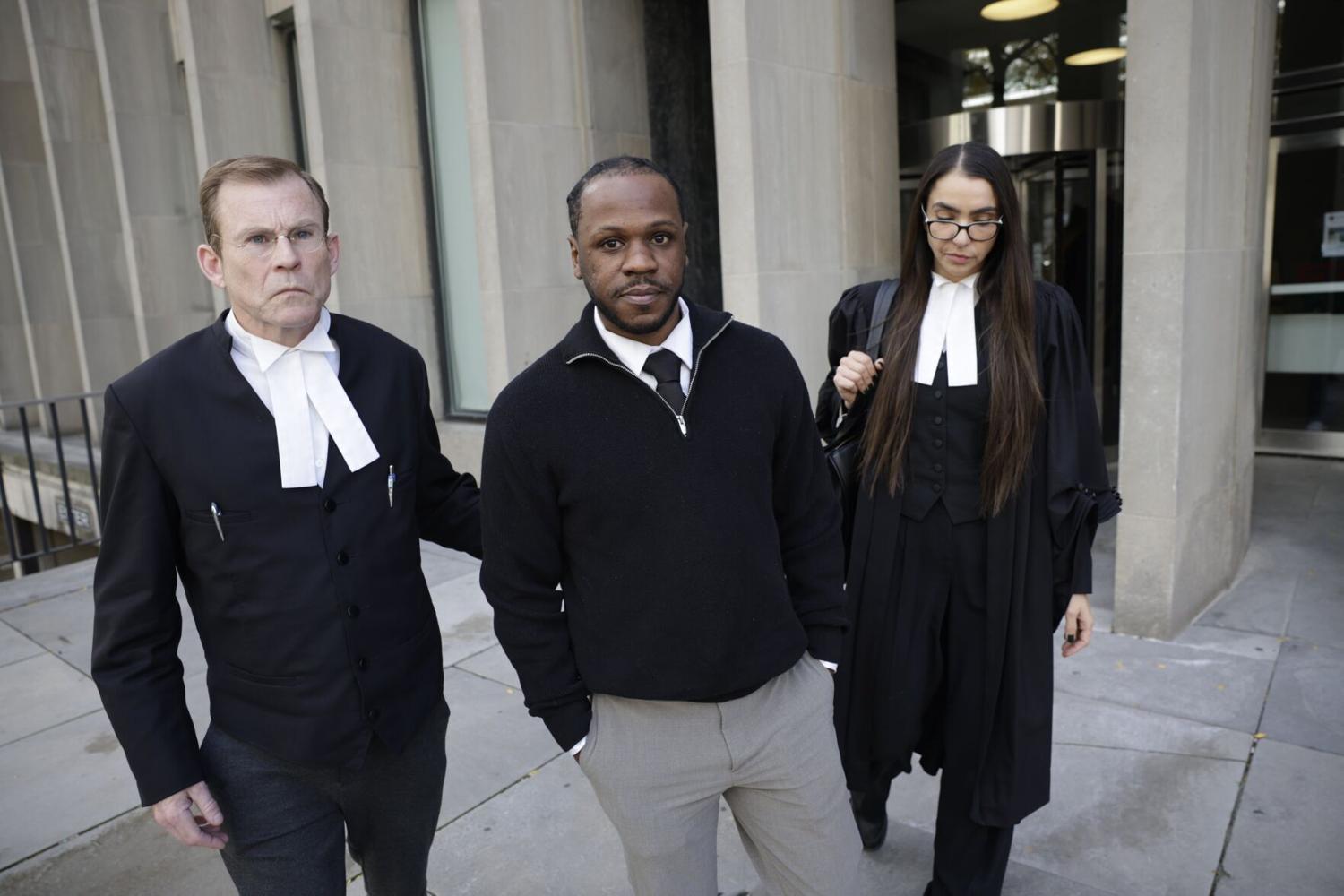
Duan Julien's lawyers ask why his case went to trial at all. The prosecution boiled down to this: an attempted kick.
“It could well be the case that at the end of the trial, Mr. Julien will be determined to have merely been present when a crime was committed by someone else.”
It took a jury about six hours to agree.
Late last month — more than three years after Julien’s arrest — the 28-year-old man stood in a virtually empty courtroom with a few family members and just one reporter present.
Defence lawyers Monte MacGregor and Amanda Warth were visibly shaking.
The jury foreperson stood and declared Julien not guilty in the shooting death of his former friend, 24-year-old Munawar Warsama.
MacGregor let out a loud “Yes!” And then he and Warth left court with their client — a free man.
What they took with them out of that courtroom was a question: How did the case of a “completely innocent” man get to this point in the first place?
It’s not unusual for a Toronto murder trial to begin and end without outside attention. And acquittals do happen. What was different here was the nature of the Crown’s case for murder.
Julien was not the shooter. Instead, the prosecution came down to one action by the accused, captured in a few frames of grainy video: an attempted kick.
It was April 14, 2023, and Julien was out near Bloor Street West and Ossington Avenue with two close friends — Deniell McKenzie Clark and Matthew Phillips-Downey — and Daniel Lara-Orellana, a friend of Phillips-Downey’s who Julien described as an acquaintance.
They were looking to buy some marijuana before they went their separate ways. Approaching a dispensary, Julien was beckoned across the street by someone on a scooter he soon recognized to be his former friend, Munawar Warsama.
They had known each other for years, but the friendship had “fizzled out” during the pandemic.
Julien testified he had learned Warsama had been spreading a rumour that he’d fled the scene after a friend of theirs got stabbed during a robbery while the three of them were downtown ringing in the new year in 2019.
In response to the rumours, Julien said he had told people the truth — it was Warsama who had fled, while Julien himself had also been stabbed. That night outside the dispensary, Julien said, Warsama tried to confront him.
“I was calling him a bitch, and he was calling me a bitch,” Julien testified. But he insisted this dispute was “not important at all” to him, and that he kept telling Warsama to leave him alone.
In one of several surveillance footage clips showing Julien walking away from Warsama, he appears frustrated before entering the dispensary with the three others, while Warsama waits outside.
The initial altercation: Warsama (riding his scooter) confronts Julien (white T-shirt and ball cap) as he, McKenzie Clark (white T-shirt, no cap), Phillips-Downey (black track suit), and Lara-Orellana (grey T-shirt and cross-body bag) enter a dispensary.
Inside, the group can be seen laughing and fist-bumping employees. Crown attorney Anna Tenhouse contended at trial that this footage showed Julien was readying himself for a fight. Pointing to one frame, she suggested to him in cross-examination: “You kept raising your shirt in aggression.” Julien replied: “I was hot.”
When the four emerge, they walk in the opposite direction of Warsama, but he follows them on his scooter. Julien testified Warsama followed him to his car and suggested they take it to a nearby alley.
“At this point, I feel like if this is the only way to get you to leave me alone, let’s go fight,” Julien told the jury.
Surveillance footage shows Warsama and Julien — about six-foot-two and five-eight respectively — heading into the dark alleyway, followed by the other three. Julien set down his belongings: a phone, hat, car keys and a ring.
“He’s bigger than me,” Julien testified. “It was a fight I was going to lose.”
The entire fight is not captured on camera.
Julien testified he was unable to land a blow before Warsama left the alley — leaving Julien to think the fight was over — only to return with a weapon. It was described in court as a garden lamp retrieved from the lawn of a nearby home. There was no dispute that the light component fell off at some point in the next few moments, leaving only a black stake.
The centrepiece of the Crown’s evidence was an eight-second cellphone video of what happened next, filmed by a woman visiting from France between the blinds of a window overlooking the alley.
The video was repeatedly played in court, frame by frame. Warsama’s family stepped out to avoid having to watch it over and over again.
In it, Warsama charges past Julien and heads directly for Lara-Orellana, who shoots him.
In the moment Lara-Orellana fires, Julien is already approaching Warsama from behind. Warsama falls to the ground and begins screaming just as Julien comes over. He can be seen to move his leg down near the side of Warsama’s body in a quick motion.
The key moment — and it’s over in an instant.
The key moment in the footage. The Crown argued it was an attempted kick to the head.
Almost immediately, Julien turns to flee as Lara-Orellana moves in to fire a second volley. Then the video ends.
Julien ran right past his own belongings on the ground as well as his own car. Phillips-Downey soon found him and told him that McKenzie Clark had picked up Julien’s keys and retrieved his car. They all got in and drove off. Meanwhile, Lara-Orellana fled alone on foot.
All four were soon charged with second-degree murder.
When Julien was arrested, police initially assumed he was the shooter — he was, after all, the one with a personal dispute with Warsama.
By the time of his bail hearing in May 2024, investigators were able to sync up surveillance footage from the vicinity with audio of the gunshot. This revealed Lara-Orellana must have been the shooter because Julien was already running away during the final shots.
In granting Julien bail, Superior Court Justice Anne Molloy — the judge who had just finished presiding over the high-profile murder trial of Umar Zameer in the death of a Toronto cop — said there was “no evidence whatsoever” connecting Julien to the gun.
Molloy summed up the Crown’s case for murder as not “particularly strong.”
Julien walks away from Warsama, who follows on his scooter.
The prosecution continued anyway. Just weeks before a preliminary hearing in December 2024, the woman came forward with her cellphone video, which MacGregor contended shows his client’s foot going down near the side of Warsama’s body — not his head.
And the pathologist also confirmed that there was no evidence of injuries consistent with a kick.
The prosecutors pressed their case.
Then, in April of this year, five months before Julien’s trial, Lara-Orellana pleaded guilty to second-degree murder for shooting Warsama seven times. He later apologized to Warsama’s family and was sentenced to life imprisonment with no chance to apply for parole for 12 years.
While Julien was not the shooter, a person can still be guilty of murder if they’re found to have aided or abetted the killer.
Prosecutors Tenhouse and Bronte Willitts zeroed in on the cellphone video at Julien’s trial. In her opening statement to the jury in September, Willitts described Julien’s action with his foot as an attempt to “head stomp” Warsama on the ground after he had been shot once.
The entire duration between the first gunshot and Julien approaching Warsama on the ground is about three seconds. In that amount of time, the Crown argued, Julien determined that Lara-Orellana intended to commit murder, and chose to help out.
2. Duan Julien approaches Warsama on the ground.
3. Julian lowers his foot toward Warsama.
4. Julien flees as Lara-Orellana opens fire again.
There’s no obligation on an accused person to testify at their trial; it’s entirely their decision. Julien testified over two days, and never wavered from his version of events: He was focused on getting the stake away from Warsama.
While he heard a bang and saw Warsama fall in the dark, screaming, he didn’t immediately register he had been shot — no evidence was presented that Julien knew beforehand that Lara-Orellana had a gun.
“I was scared to get close enough to him to bend over to grab it,” Julien testified, his voice trembling. “I tried to use my foot to try and sweep it away.”
Had he known Lara-Orellana had just shot Warsama, he said he would have never moved toward him for a very simple reason: He was putting himself in the line of fire.
The garden lamp stake that Munawar Warsama was holding.
But as he stood over Warsama, Julien said he could see Lara-Orellana “hovering” with a gun, “and that’s when it all came to me.” He ran, worried he might get shot next.
Tenhouse suggested that Warsama dropped the stake and was unarmed just before the first shot, and that Julien knew a gun had gone off.
“You wanted to make sure he never spread rumours about you again,” the prosecutor put to him.
Julien, who had testified calmly to this point, started to speak rapidly — as his lawyer would later say, he was fighting for his life.
“There was a stake,” he said, in a desperate, higher-pitched voice. “You can see it.”
(At Lara-Orellana’s guilty plea, the Crown had agreed with the defence that Warsama suddenly moved toward Lara-Orellana with the stake, and never mentioned that he dropped it just before getting shot.)
Tenhouse concluded her cross-examination by putting her whole case for murder to Julien, in a rapid-fire set of questions that left him in tears: He was focused on kicking Warsama in the head to help Lara-Orellana shoot further. And by “engaging” with the injured Warsama on the ground, Julien was encouraging Lara-Orellana to shoot — in other words, abetting.
Julien started choking up and seemed unable to speak.
“Do you need a minute?” Tenhouse asked.
After a few seconds, Julien spoke softly: “I didn’t kick him.”
Julien and McKenzie Clark were initially on trial together, represented by separate defence teams. But at the close of the Crown’s case in early October, Superior Court Justice Suhail Akhtar acquitted McKenzie Clark of his charges in what’s known as a directed verdict application, finding the Crown had failed to present sufficient evidence to convict. (Phillips-Downey, whose case was severed before the trial, saw his manslaughter charge get withdrawn in November.)
MacGregor had brought a similar directed verdict application for Julien.
“This is a dangerous case, in my view, to put to a jury,” he told Akhtar, who ordered that Julien’s trial for second-degree murder would continue.
Julien’s hat and phone, which he left behind after Lara-Orellana shot Warsama.
In his closing arguments, MacGregor repeatedly asked the jury: Just what exactly did his client do that makes him guilty? Mere presence at the scene is not enough, he reminded them. If Julien really did want to kill Warsama, why did he walk away from him so many times before the fight? Why doesn’t he actually touch him with his foot? Kick him multiple times? Stay for the rest of the shooting? Say anything to encourage Lara-Orellana? And what about his “acts of innocence,” such as running past his own belongings and car?
Gripping the podium, MacGregor reminded the jurors that they come from all walks of life and are expected to use their common sense when analyzing the evidence.
“I’m begging you to do that,” he said.
The cost to Julien had already been enormous: The young man with no criminal record spent over a year in jail before being released on bail. He lost his ability to work; he used to wake up at 3 a.m. every day to deliver appliances. He had to live on a strict house arrest bail with his mother several hours from the courthouse and wear an ankle monitor. And he was publicly identified as an accused murderer.
“My life was going nowhere,” Julien told the Star. “Seeing everybody else having kids, getting married, and I’m stuck in this position. It was tough.”
All the while, he was staring down an automatic sentence of life imprisonment.
And then an issue arose during Tenhouse’s closing arguments that had MacGregor asking for a mistrial: She offered the jury a new route to find Julien guilty.
It is uncommon for anyone to plead guilty to second‑degree murder, given that the conviction carries a mandatory life sentence.