Have we missed our chance to stop climate change?
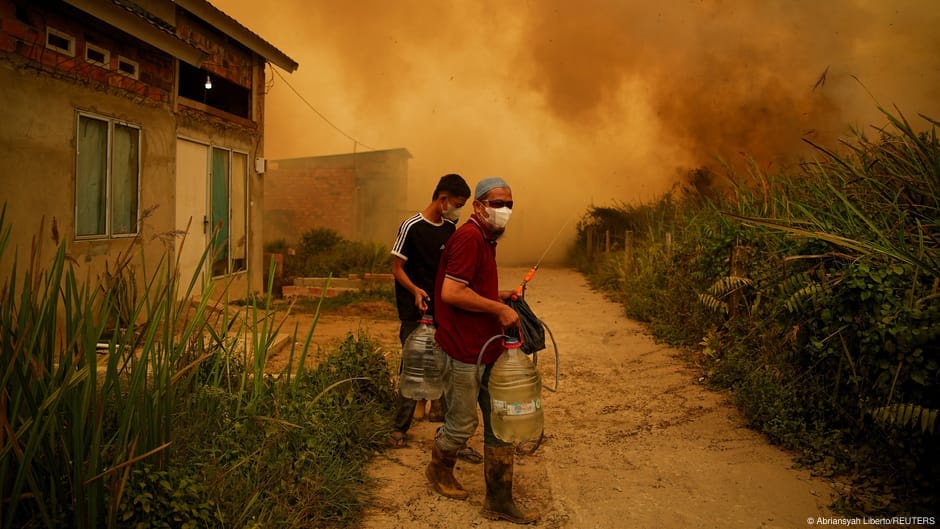
Has the world acted too late to stop catastrophic climate change?Image: Abriansyah Liberto/REUTERSAdvertisementWhen world leaders agreed to do what they could to stop the world from overheating back in 2015, it was heralded as a victorious moment. Hope rippled from Paris, where the historic deal was made.
Since then, efforts to curb the use of planet-warming fossil fuels have achieved some success, with coal, oil and gas falling to a record low share of global primary energy supply. But they still account for around 86% of the world's energy.
"We're still burning stuff like [it's] the 19th century," Mark Maslin, professor of Earth System Science at University College London, told DW.
And that has consequences. The United Nations now says overshooting the temperature threshold agreed in Paris 11 years ago is inevitable. That means even more extreme weather events, like storms, flooding, droughts and deadly heat waves and resultant crop failures and water shortages across the world.
The impacts are already being felt globally. This summer, Europe alone recorded 50,000 heat-related deaths in urban areas. In Delhi, India, summer heat waves saw temperatures soar above 45 degrees Celsius (113 Fahrenheit). Even in the relative cool of the evening, there was little respite.
"It feels like your eyes are burning," said Disha Ravi co-founder of the India chapter of youth climate movement Fridays for Future (FFF). "I always describe it as being cooked alive in an oven."
Heat waves and other weather extremes are killing people now, says Ravi, and she is aware that as the global average temperature continues to rise, life is only set to become tougher.
"Even at this moment where we haven't even reached the worst of what it could be, it's already difficult," she said.
"We should have dealt with climate change 10, 20 years ago," Maslin said.
The UN now says that the world must keep the time it spends in overshoot as brief as possible, bringing global heating back down by the end of the century.
The longer the planet spends above the threshold, the greater the risk of triggering irreversible, self-perpetuating tipping points, such as massive forest die-back and permafrost melting that would release huge amounts of carbon into the atmosphere.
A recent report by science-based assessment Climate Action Tracker says limiting overshoot will require policies to rapidly and steeply reduce the emissions warping the climate.
"The stark choice for governments is to continue to support the fossil fuel industry, which would consign humanity to insurmountable economic damages, rising mortality from heat and climate-driven diseases and disasters that they are unable to adapt to — or pivot to the solutions which are available and cheaper than ever," the authors said.
Failure to cut emissions quickly has made it significantly harder to get climate change under control, and the window for doing so is rapidly closing. But Maslin refers to a Chinese proverb: "When is the best time to plant a tree? Yesterday. When's the next best time to plant a tree? Today."
He points to the massive expansion in renewable energy as reason not to despair. Wind, solar and hydropower accounted for around 34% of global electricity production in 2025 and are increasingly being used to meet rising demand.
Last year, record growth in solar power meant that clean energy met all new global electricity demand, stifling new fossil fuel generation, according to an analysis by energy think tank Ember.
"At the moment, $2 trillion is being invested in new renewable energy projects around the world, which is twice as much as fossil fuels," Maslin said.
But no country is weaning itself off fossil fuels quickly enough to limit the time spent in overshoot. "The transition is happening, it's just not happening fast enough," he added.
One of the problems is that most climate and energy plans focus on building a green energy system rather than creating policy to shift away from fossil fuel use and production, according to recent report on how to manage the transition by nonprofit research organization, World Resources Institute.
A group of 57 states is working together to manage and accelerate the complicated task of phasing out oil, coal and gas by creating specific roadmaps to do so.
Under the Transition Away from Fossil Fuels initiative (TAFF) initiative, Brazil has published a global roadmap that suggests various measures that can be tailored to each country's financial circumstances and capabilities.
So far, a small but growing number of countries, including, Ireland, Denmark, the Netherlands, France, Germany, and Finland, have released national roadmaps.
Yet renewables advocacy group Oil Change International says they largely repackage existing commitments rather than offering new ones, when "what we need is an accelerated timeline for a clean, secure energy system."
France is sticking to a previously announced deadline of phasing out fossil fuels entirely by 2050. The Netherlands has not published binding dates for quitting oil and gas, and will continue to extract gas in the North Sea.
Germany, however, explicitly mentioned transitioning away from fossil fuels by 2045 for the first time, in line with its existing climate neutrality target. The country has also reduced its emissions by 48% compared to 1990 levels.
And while Finland has not set a hard and fast target for phasing out the fossil fuels that still account for 26% of its total energy consumption, it already generates more than 96% of electricity from non-fossil sources.
"None of these examples is a perfect template," according to the WRI report. "But together, they show that countries are already developing many of the core ingredients of a fossil fuel transition plan."
Limiting the time spent in overshoot would mean fossil fuel use falling 20% by 2030 and being phased out completely by 2070, according to research institute Climate Analytics.
It also means removing hundreds of billions of tons of CO2 from the atmosphere using carbon removal technologies that remain unproven at scale, as well as nature-based approaches like reforestation.
And it requires fast action on the short-lived but highly potent greenhouse gas methane. A 45% cut would reduce warming by 0.3%, according to the UN.
Scientists stress that every fraction of a degree matters as the world blows past the threshold of 1.5 degrees Celsius (2.7 Fahrenheit) of warming above pre-industrial levels. That's because every increment will bring more extreme heat, heavier rainfall, rising seas, and greater and more catastrophic risk for everyone around the world.
Still, even in the face of accelerating climate change, FFF co-founder Ravi rejects the idea that it is too late to act.
"I refuse to believe we'll ever run out of time. No matter how bad it gets," she said. "We owe it to ourselves. We owe it to each other to always try to get out of this mess."